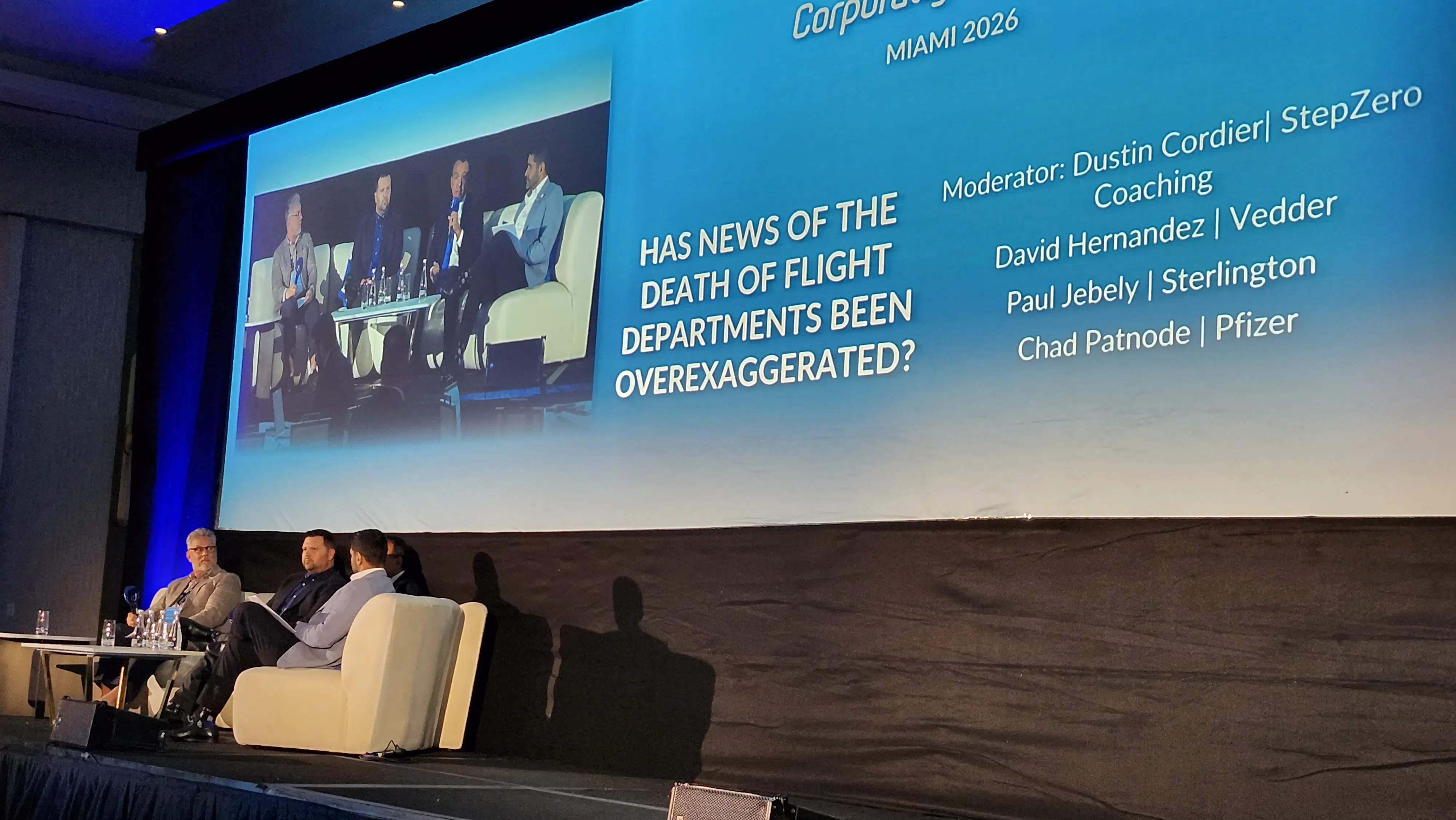
Channeling their best Mark Twain, panelists at Corporate Jet Investor Miami this week were asked, “Was the news of corporate flight department closures exaggerated?”
And yes, corporate flight departments have still seen significant declines and cuts over time.
In a market dominated by cost-cutting and corporate mergers, experts discussed why flight departments have seen closures.
Importantly, they discussed how the survivors prove their worth.
State of the industry
Corporate flight departments operate an aircraft fleet for a corporation.
While there are thousands worldwide, they’ve been seeing stiffer competition and fewer contracts.
How many corporate flight departments?
Flight department aircraft departures fell 9.6% year-to-date to 14.2% of the global share, according to the JIQ Market Barometer.
The report attributed the decline to “ongoing cost discipline and fleet rationalization among corporate operators.”
According to WingX, corporate flight departments worldwide dropped 19% from 2019 through 2026 down to 4,225.
Share of active aircraft fell from 30% to 21%.
Causes for decline
But what caused this cost-cutting, and why do some corporate executives see third-party management and charter as cost-effective alternatives?
“I see value added with flight departments in major companies,” said David Hernandez, an aviation attorney with Vedder.
He described how, among his corporate clients, half use third-party aircraft management companies and half choose an in-house corporate flight department.
He elaborated on why closing flight departments is often seen as a cost-controlling measure:
‘The times that I see people winding down flight departments are either a merger, acquisition, or they want to try something different, more efficient… But at the end of the day, I think there’s still value added, but our CD (corporate department) will re-evaluate cost. And one of the ways that unfortunately people control costs is to eliminate employees.’
Unclear mission statements are another reason why flight departments get cut, said Chad Patnode, Pfizer Flight Operations Manager.
“So, if they’re acting like just another department of a corporation,” said Patnode, “Whose job is to book a trip and schedule a flight and go from point A to point B, when a charter can do that or a management company can do that, what are you there for?”
Patnode clarified that flight departments have to justify their existence in brand terms, not just monetary ones.
Corporate flight department value
Three key reasons that justify a corporate flight department’s importance are control, privacy, and brand alignment.
“I’m always asked when we start doing most of our trips in-house with dispatchers, well, how much money did you save?” said Paul Jebely, an aviation lawyer, on the panel.
Jebely continued:
‘I go, ‘Well, we save probably a million dollars a year.’ Which is which is a lot of money, it’s great, but it’s it’s a lot more than that… The reason why we did it wasn’t really money, it was more of the service, because how we feel, and this goes beyond dispatch, but with the whole flight department we want to bring as much control in-house as possible.‘
Jebely described how in-house operations allow greater control and security over fleet management.
Fleet control is useful for the same reason corporations spend millions on these fleets: to ensure executives arrive on time and without delay.
If third-party managers cause delays, Jebely said, corporate executives can miss out on big deals.
In-house management ensures the fleet can be scheduled around the company’s needs and preferences.
Another key justification is alignment with brand and corporate mission.
Departments can show they add enterprise value, not just monetary value.
Patnode described how he keeps a pulse on his CEO’s and the company’s priorities at any moment.
Monitoring the company’s priorities lets a department know what to prioritize and how best to present its value.
“I can quickly realize not only what the pulse of the company is right now,” explained Patnode, in a panel. “But what’s important.”
Patnode continued:
‘Everything is cyclical. What’s important today may not be important tomorrow, and what’s not important today could be business critical, and we have to execute.’
Dustin Cordier, an aviation consultant and the panel’s moderator, agreed that understanding company sentiment matters.
“If they’re a public company,” said Cordier, “The CEO has outlined his or her priorities in the annual letter to shareholders. And have you, as a flight department leader, bothered to read that memo? Because that’s telling you the vision of the company. And so, like Chad (Patnode) was saying, like, hey, we’re your dogs, we’re your team, we’re the ones who are going to run through brick walls to make this happen.”
When flight departments aren’t worth it
Despite all the benefits of an in-house flight department, it’s not always necessary.
“There’s certainly times when the corporate flight department is not appropriate,” said Jebely, “And that’s most often it comes down to simply when the (flight) hours don’t don’t justify it.”
Jebely described a public company he had worked with that justified the cost of the fleet by considering the millions spent as an investment.
If the executive uses the jet, they can go and “expand the commerce of the company.”
Jebely argued that ensuring executives make it to big deals can justify the fleet.
When asked whether companies should have an in-house fleet, Hernandez answered by discussing corporate priorities, not fleet size.
“You have to figure out what you value most,” explained Hernandez. “If it’s privacy and control, you’re not going to get that with a management company at the highest levels. You certainly may, but, you know, there’s no right or wrong answer to that. It’s what your personal preference is or what the company’s preference is.”
So while corporate flight departments can benefit their companies, they must also justify their value, monetary or otherwise, to survive the cost-efficiency every company strives to achieve.
Visit PJCC for Corporate Flight Departments