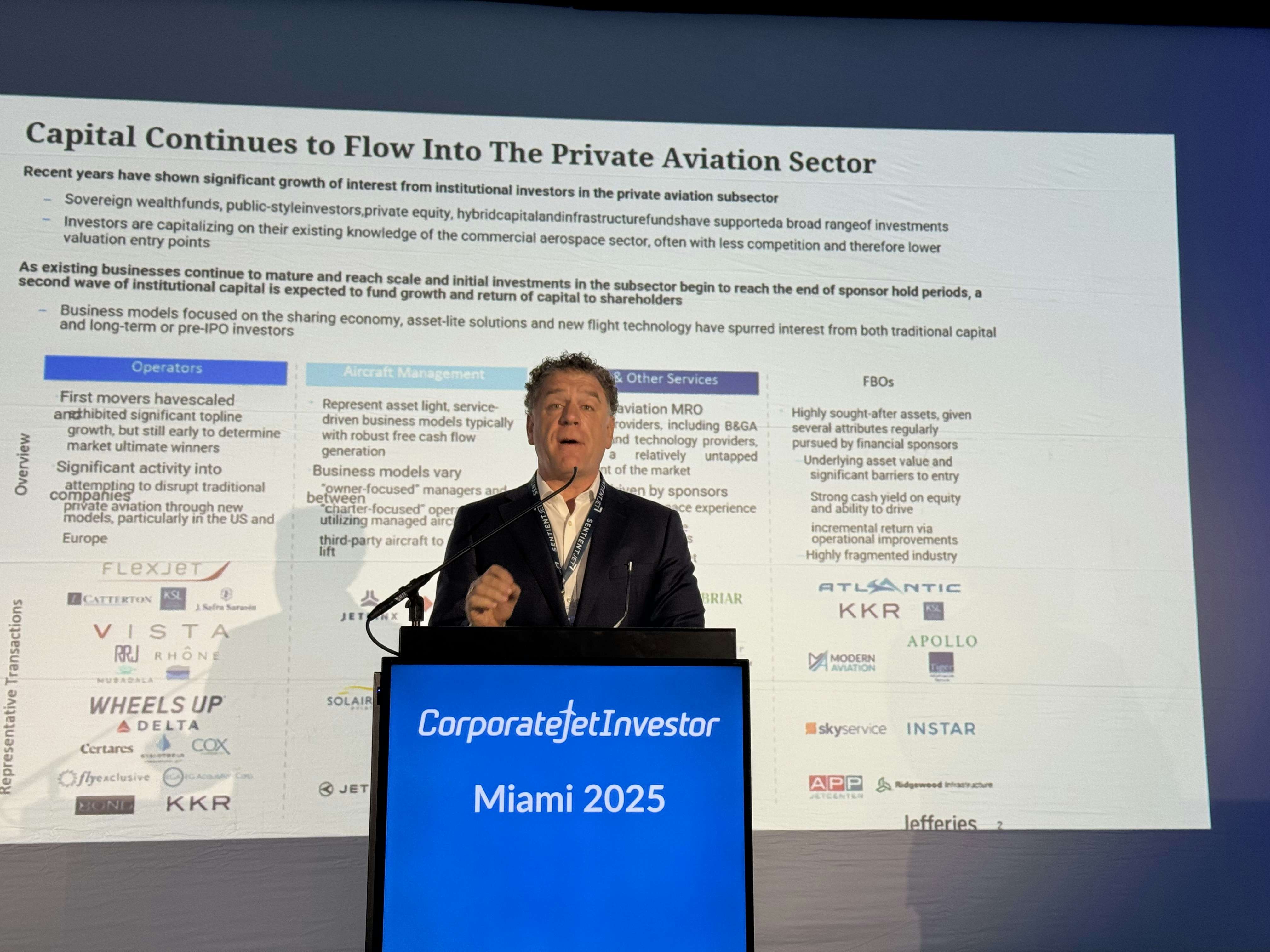
For private jets and private aviation, the forecast is more deals, more big deals, more scale.
That’s the prediction of one of the top financial players.
Private jet operators, management companies, FBOs, and MROs will all be in the mix as the market heats up, according to longtime Jefferies Managing Director James Palen, who spoke at the recent Corporate Jet Investor conference.
The company has served as an advisor and investment bank on deals involving major players such as Flexjet, Wheels Up, Vista Global, JetEdge, and the FBO chain Atlantic Aviation, among others.
Institutional Capital
“Over the past four or five years, we’ve seen a growing presence of institutional capital,” Palen told attendees.
He added, “That means non-family office, non-individual sort of retail type investments, but the larger institutional professional money management firms coming into this sector.”
That includes include “sovereign wealth funds, public style investors, which are either those that invest in public companies or pre-public companies through pipes, private equity, which we’re all familiar with, and hybrid capital, which is a quickly growing portion of the institutional capital space, which really sort of was born out of or accelerated coming out of COVID, as well as infrastructure and other sort of hard asset funds.”
Who and Why?
Palen said, “A lot of investors we see flocking to this space, particularly in private aviation, are ones that want to capitalize on their knowledge of the commercial aerospace sector or the business aviation sector and use that sort of leverage themselves into a sector which is if you compare it to commercial aviation and where they can leverage a lot of their knowledge and seek valuations that might be a less than what you would see in commercial aviation and seek higher than average returns.”
Palen added, “What’s also part of what’s driving this influx of capital is a lot of the existing businesses continue to mature, grow organically and through mergers and acquisitions and a lot of the investments that came into this sector five, seven and 10 years ago are nearing the end of their natural fund lives and so while some of the capital coming in you see is to help grow these companies and fund M&A some of it is also to begin to provide returns and dividends to existing shareholders.”
Who’s Next?
Aircraft management companies could be ripe for investors, according to Palen.
He told the audience, “On the aircraft management side, we’ve also seen a fair amount of consolidation. It’s one where not as much capital is coming in, but as those aircraft managers begin to develop fractional programs and so forth, that fleet growth has all been demanding incremental institutional capital.”
While MROs have historically been “the boring part of the sector,” he said, COVID struggles highlighted the importance of the repair shops and have driven operators to invest vertically.
As the sector has drawn interest from “the KKRs, Blackstones, Black Rocks and so forth,” the deals are getting bigger.
They are looking for size, scale, and platforms to grow on.
Palen said the big firms “don’t necessarily have interest in the five, 10- or 15-million-dollar deals. These are institutions that need to deploy billions of dollars per week among hundreds of different strategies.”
He said they are seeking investments of $200 million to $1 billion.
Just A Starting Point
Initial investments, he said, are just the start.
“They’re looking for beyond just the initial investment in buying that company or coming in and taking a large sort of minority interest in it. They’re looking for platforms which they believe can begin to roll up the sector, whether it’s on the operating side or the maintenance side,” Palen said.
Targets are “large platforms with predictable and proven revenue streams and earnings growth and positive cash flow,” Palen added.
Additionally, he continued, “There’s been a lot of debt and leverage coming into this sector to fund growth and to fund, for the most part, for the largest part, the acquisition of aircraft.”
He said this is being driven by high-yield loan and bond funds “that can be very liquid.”
Palen added:
‘If they want to get in or out, they have a view in the sector, they can call a desk, and they’ll be able to sell it on the wire, if you will. Those types of investors are looking for transactions that are $500 million to a billion (dollars). And why? Because they’re looking for larger, scalable transactions, and they know that those larger transactions offer them a lot of liquidity in terms of trading in and out of their positions. Typically, they’re looking for ratings because these more public style investors are looking for generally the sweet spot is single B-type investments on the credit side and triple B on the secured aircraft finance side.’
Synergy of Customers
In some cases, the deals go beyond dollars to synergy.
Palen pointed to KSL and L. Catterton “with its partnership from LVMH,” which led to an $800 million investment into Flexjet.
He said all three are focused on “high-end customer experiences.”
LVMH owns luxury goods brands including Louis Vuitton, Dior, Dom Pérignon champagne, and the Belmond group of luxury resorts, trains, and, soon, yachts. KSL is invested in luxury holdings, including Miraval, La Costa, and others.
Palen also said the market is bifurcating into large fleet operators that need to run airplanes 1,000-plus hours per year and those managing for owners who, with charter, where aircraft fly in the low hundreds of hours per year.
The latter only needs to ensure the airplanes are available when the owner needs them.
In contrast, the former will need to maintain their own fleet with in-house resources to serve their fractional owners and jet card customers.
He said operators need at least 30 to 40 aircraft to scale up.
Asked about his outlook for the coming year, Palen said, “We foresee more consolidation on all of the verticals.”
Alongside Palen, speakers included top executives from more than a dozen companies that have been in the M&A and financing spotlight.
Not Impressed
However, the increasing interest of big finance in private aviation didn’t impress everyone in the audience.
Andy Nixon, co-founder of Alpha Wingman, which helps connect operators and MROs, penned a LinkedIn column titled, “Investor Money? Nah, I’ll Pass: CJI Miami Takeaways.”
In a business where there is a large long tail of small operators, boutique brokers, repair shops, and family-run single-location FBOs, he wrote, “If you get to a certain size, with positive cash flow, and need to accelerate growth or buy heavy assets to continue growing, you may need to seek PE or other funding options. That’s where it stops. If your business can continue without giving away equity, do that.”
He urged companies to eschew the “evil temptress” of raising money and instead “grinding out company growth over many years and playing the long game.”
Consumer Impact
For flyers, the dealmaking is likely to be a mixed bag.
Rollups of operators have caused service interruptions and lapses, irritating customers who pay a lot of money to save time by flying privately.
By the same token, operators have found that not having vertically integrated MRO capabilities has made it harder to get airplanes back in service when they need maintenance.