The latest jet-sharing play comes from 2021 start-up FlyHouse.
The company has been cutting a high-profile recently, taking over professional sports sponsorships previously held by Wheels Up.
Bringing private aviation to Monday Night Football and GameDay exposes the industry to a broad range of potential new consumers, helping expand the market.
Private jet flying is set to top its 2022 all-time record in 2025.
November set a record for year-over-year increase per ARGUS TRAQPak.
FlyHouse wants to soar on those tailwinds.
In 2024, investor Benevolent Capital’s Grant Johnson told attendees at the Corporate Jet Investor conference, “My belief is if (FlyHouse does) what I think they can do in the years to come and they do it on a global scale, I will be disappointed if this isn’t worth two
to three billion on the low side in five years.”
Shared private jet flights are part of the plan.
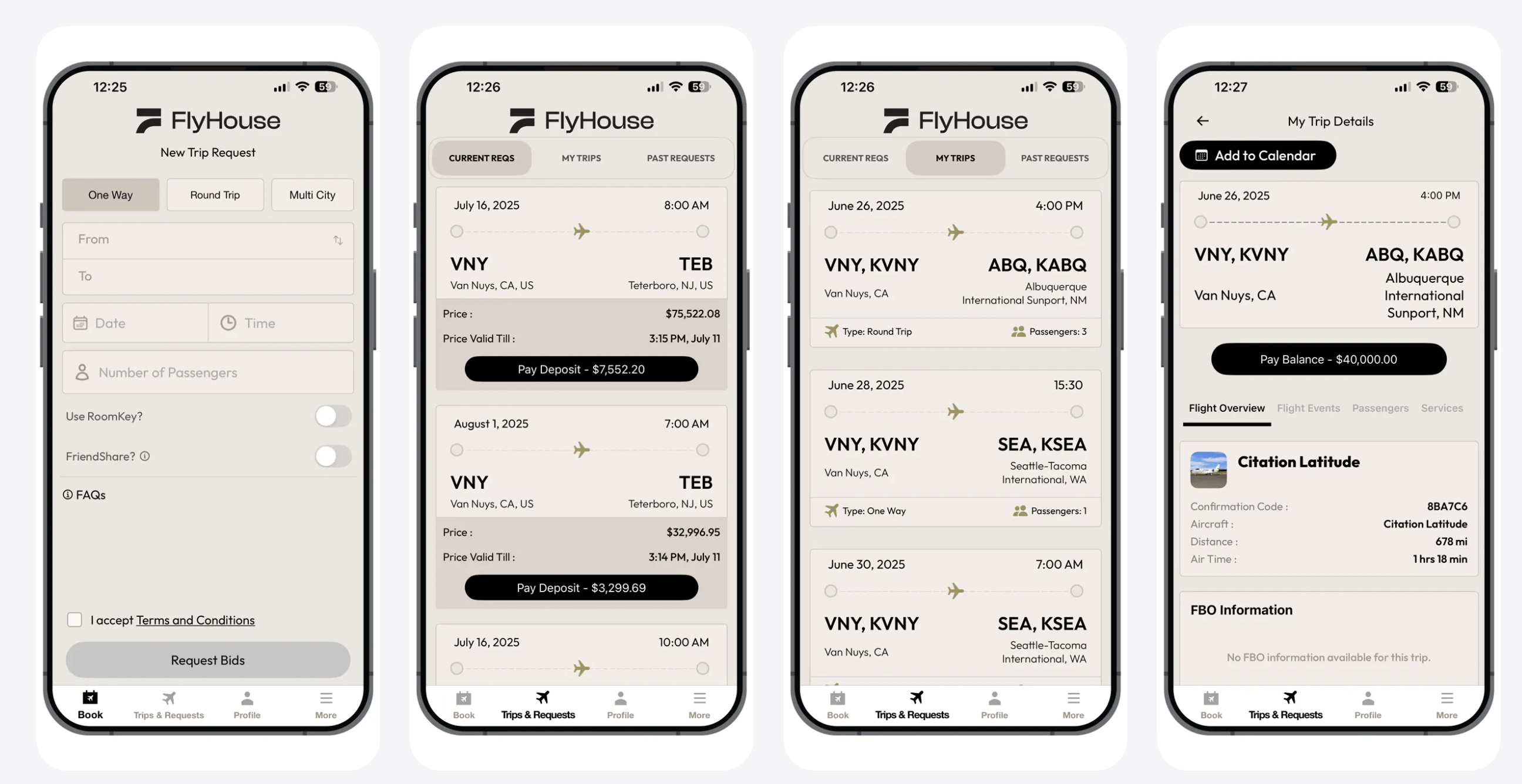
Its new product is an app called FriendShare.
It is an add-on product to near-instant online booking for on-demand charter flights.
The FlyHouse app provides consumers with bookable pricing directly from operators with over 2,000 aircraft on the platform.
You get back firm quotes in less than 60 seconds.
Like most private flight providers, FlyHouse executives can reel off the shortcomings of alternative solutions.
“FlyHouse was created to completely transform private aviation,” CEO Jack Lambert told Leaders magazine.
Last year, FlyHouse bought JetASAP, a platform that connected consumers and operators.
However, Lambert describes JetASAP as a lead-generation tool and not central to the technology it is now implementing.
Instead, he says that what you see today is a starting point, with enhancements to come.
In fact, executives describe their app as still in a soft launch despite touting it to the media.
One thing that was clear in my conversation with Lambert and Sanford L. Michelman, the chairman, was that as I rolled through my critique of the app, they were anxious to address what I viewed as shortcomings.
FriendShare lets you legally self-aggregate to share flights, split costs, and book them online.
Illegal charter flights present both financial and safety risks.
If you are considering sharing, read this and this.
The FlyHouse press release promises, “First-of-its-kind groundbreaking technology that enables a charterer to create their own travel communities and use a payment option that makes chartering a private jet more accessible than ever.”
It adds, “More than a booking tool, FriendShare is about building communities, strengthening bonds, and creating unforgettable memories with friends, family, and colleagues.”
FlyHouse, in addition to managing aircraft, continues JetASAP’s position of connecting consumers directly to operators.
The press release notes, “No brokers. No waiting. Charterers simply scan, download, and book to begin a group journey that’s about more than the destination.”
Michelman says that, cutting out brokers in fact, is not the objective.
Michelman says the initial release was wrong and has been reissued.
He says, “In fact, it’s the complete opposite. We welcome and want brokers using FlyHouse.”
He continues, “We specifically built a B2B platform, and traditional brokers are a vital part of the flight provider ecosystem.”
The B2B platform also serves family offices, corporations, and large travel agencies.
Back to FriendShare, Lambert says in the release, “This isn’t about selling seats—it’s about creating accessible, shared experiences.”
He continues, “Whether it’s a golf weekend group…or F1 Race Getaway, FriendShare allows travelers to organize trips around passions and milestones, turning flights into memories that last a lifetime and keep the payment seamless and transparent among the group.”
Lambert adds, “We’re bringing clarity, community, and flexibility to an industry that has often felt impersonal.”
He continues, “This is shared luxury, reimagined—not about the transaction, but about the memories made along the way.”
READ: Overpromising, lack of education, hurting the private jet industry
How FriendShare Works
We spent a bit of time with the FlyHouse app.
Downloading it from the Apple store was easy.
It’s free.
There are no joining costs to get started or book flights.
You do have to register for an account.
It was an easy process.
You then enter the airports you wish to depart from and arrive at.
Next, select the date, departure time, and number of passengers.
During these steps, a toll-free telephone support number is prominently displayed.
More on that in a bit.
Within about 60 seconds, you get quotes back.
I tried several routes and received between six and 12 offers that could be purchased instantly.
They were all aircraft-type specific, so it’s not just a category guaranteed – light jets, midsize, etc.
To share, you select the quote you wish to buy.
There is a FriendShare button you toggle.
You can select how many passengers you have.
You can then select the number of friends you want, including a maximum number.
That allows you to restrict the number of seats being sold.
In other words, you may not want to squeeze eight people into an eight-seat light jet.
The app then calculates the cost per passenger based on the number of seats you are selling.
Your friends or group has up to three hours to opt in, so they need to respond quickly.
Payments are collected directly from the folks who share, so you don’t have to chase them for money.
All in all, the app is user-friendly.
It would be a relatively easy process to book the flight yourself or invite friends.
And perhaps that’s part of the problem.
Booking on-demand private jet charter flights has lots of nuances.
It’s expensive.
If you don’t know what you are doing, it’s easy to make costly mistakes.
READ: How Artificial Intelligence is set to change private jet travel
Needs Improvement
To sum up, FlyHouse’s shortcomings are typical of providers that offer instant booking and of the private jet charter app ecosystem as a whole.
Using the FlyHouse app shows that, so far, no one has solved the problem of creating a one-stop marketplace.
Whether you are shopping for the lowest price or a specific aircraft type, vintage, or configuration, there is no single place to search the entire market online or offline.
During Corporate Jet Investor, Lambert described the industry as “very fragmented, very opaque, and filled with a bunch of friction.”
That’s true.
The FAA lists over 600 operators with at least one jet aircraft available for charter.
Lambert says 94% have less than 15 aircraft in their charter fleet.
If you include turbopropos, piston aircraft, and rotorcraft, there are over 11,000 aircraft in the U.S. charter fleet.
FlyHouse doesn’t source from the universe of available charter operators and jets.
It sources from its network of operators who may or may not respond with quotes.
Receiving a dozen quotes speaks to the large majority of operators who didn’t quote my trip request.
Michelman says that on the B2B platform, users such as family offices or corporate flight departments receive more quotes because the quote window stays open for an hour rather than 30 seconds.
Plans are to enable a similar capability for B2C app users shortly.
Like other apps and websites that offer instant booking, don’t assume you’re saving money if that’s your goal.
The same goes for calling several brokers to shop for a flight.
Cancellation Policy
General terms are that all one-way bookings carry a 100% cancellation penalty after booking.
Roundtrips, as defined in private aviation, have more generous cancellation terms.
You lose 50% of your money if you cancel between 72 and 24 hours before departure.
Within 24 hours, there’s a 100% cancellation penalty.
Lambert points out that these are pretty standard cancellation terms.
He is correct, but there are exceptions.
You can specify flexible cancellation terms when you call a broker.
That may narrow your selection; however, it’s not something that can be easily accomplished online for now.
To hold your booking, you need to pay a 10% non-refundable deposit.
If you are not a regular in the ad hoc charter market, it’s not like when you cancel an airline flight and get a flight credit.
Your money goes bye-bye.
In other words, read the contract.
Understand the difference between private jet charter one-way flights and roundtrip flights as they relate to cancellation terms.
Aircraft Choices
Make sure you know what you are booking.
Does the airplane have enough space for your luggage?
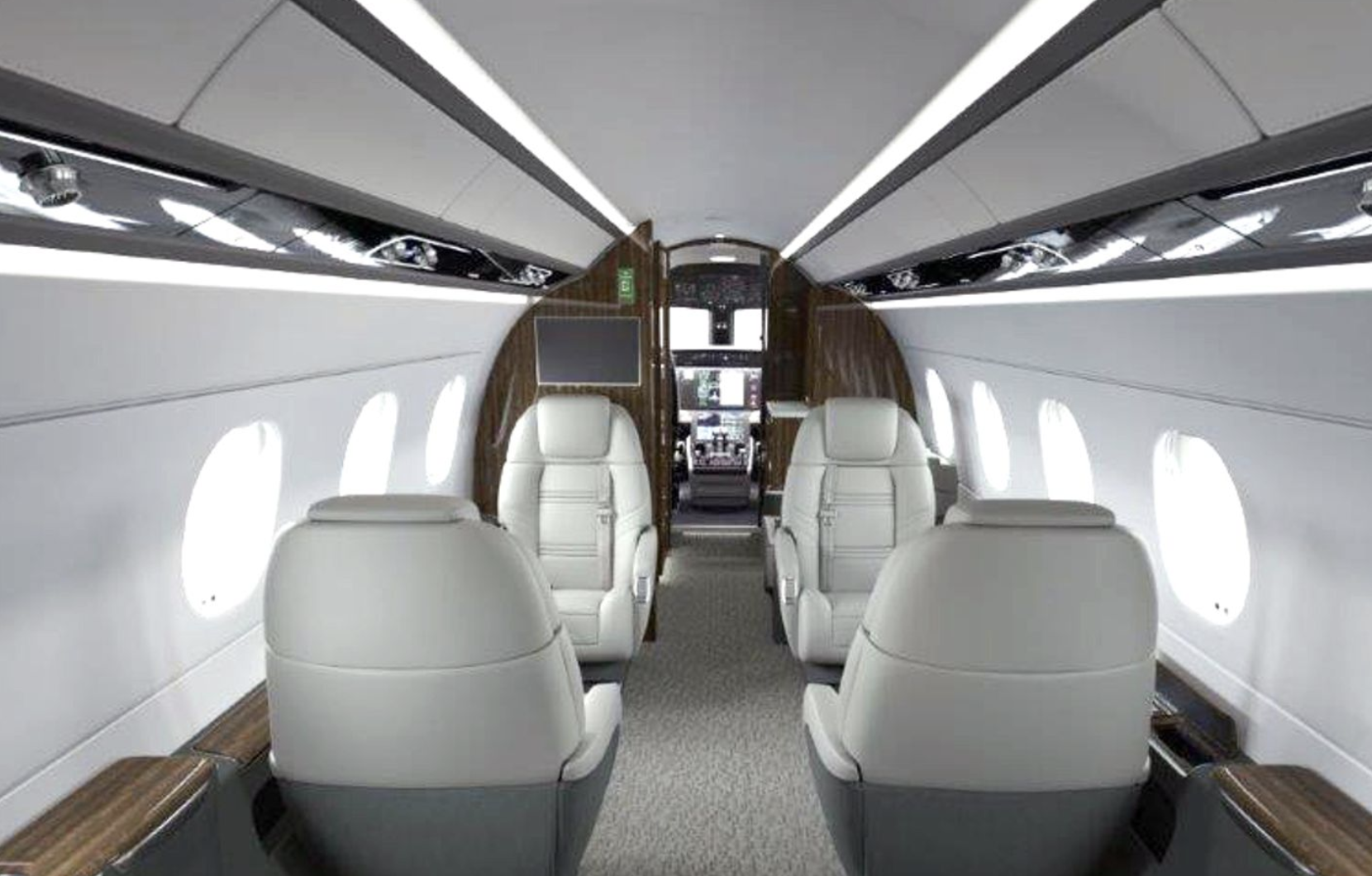
What is the seating configuration?
Some options have images, others don’t.
The same goes for cabin layouts.
How many seats are shared on a divan versus individual seats?
FlyHouse is not alone in these shortcomings.
It just reflects the gap between what is a very expensive purchase and the limits of today’s technology.
It’s that type of advice and consultation you get from a good broker.
Of course, not all brokers are good.
However, it’s worth noting that in the larger travel industry, travel advisors are doing best in luxury travel, serving HNWs who prefer their services to online booking.
This is a similar segment to the private jet flyer.
READ: A lawsuit spotlights financial risks of ASAP private jet charter flights
Other Charges
There are costs beyond booking the flight.
Deicing and WiFi are extra charges if the operator does not include them.
You also agree you are responsible for “any unanticipated, unforeseen or unknown charges…without limitation.”
That could include FBO special-event fees.
Those fees range from hundreds of dollars to over $20,000 for large jets during F1 or major sporting events.
We looked at flight prices to Miami for January 19, 2026.
That happens to be on the day of the NCAA National Championship being held at Hard Rock Stadium.
We didn’t see any notifications of potential extra special event fees.
The FlyHouse executives noted that the FBOs don’t necessarily post peak and special-event fees very far in advance.
It’s a challenge for the greater industry.
That’s true of all the various private flight options, but for apps, it’s something newbie flyers should be particularly tuned in to, particularly since sharing is being marketed as a great way to go to the big game.
READ: FBO special event fees are getting bigger and broader. What’s next?
Fuel Stops
We requested flights from Miami to Portland, Oregon.
The app gave us a “best value” of a CJ3 light jet for $33,450, plus FET.
It did note “fuel stop may be necessary.”
Taking a light jet cross-country, well, it’s not something that will make you want to spend the money to fly privately.
Fuel stops eat away at the time savings.
They also create opportunities for delays and inconveniences.
Most traditional brokers wouldn’t quote a light jet for a transcontinental flight.
Michelman agreed and said FlyHouse would screen out options that would require a fuel stop.
When we tested the FlyHouse app a day later, it had already screened out aircraft that needed fuel stops.
However, it also highlights the challenge of pushing technology against the variables of private jet charter bookings.
A light jet that would easily make a north-south flight with two passengers, Boston to Miami, could need a fuel stop with seven passengers.
It would also vary based on the type of light jet.
Apps haven’t figured that part out yet.
Competing On Price
We looked at the nonstop options for our proposed flight from Miami to Oregon.
A Citation X, which would make it nonstop, was $49,746 plus tax from FlyHouse.
The lowest instant booking price from XO was for a large cabin Gulfstream at $53,769, plus FET.
XO doesn’t display aircraft that require fuel stops.
On the same date, Wheels Up only offered request pricing.
We also called two traditional brokers who don’t offer online pricing.
Unity Jets responded right away.
We told them we needed an immediate turnaround and told them the FlyHouse price.
Within 20 minutes, they had a Citation X option at $40,000 plus FET, so $9,000 less.
That included a fairly standard broker markup.
The other broker, TLC Jet, we ended up texting.
They initially returned $49,000 on a Citation X, plus FET.
They then came back with a $ 40,000-plus FET price from another operator.
The Unity Jets quoted provided a 72-hour cancellation deadline before departure, even though it was a one-way flight.
The initial TLC Jet quote had a 100% cancellation penalty.
The second quote matched the 72-hour cancellation terms.
This example is not an indictment or endorsement of any of the solutions we tried.
It reflects what Lambert said are the market challenges, namely, fragmentation and friction.
Michelman says the current 60-second instant booking was because users didn’t want to wait an hour for quotes.
He says FlyHouse will soon enable additional quotes to be relayed, essentially matching the back-and-forth of traditional brokers.
In both the case of Unity and TLC Jet, they said it was personal outreach – phone calls and emails to operators – that generated the favorable quotes.
More Pricing
Looking at flights from Miami to Tampa on Dec. 10, FlyHouse’s lowest-priced option was a PC-12 for $9,990, plus 7.5% FET.
Wheels Up offered a King Air for $8,444, plus tax, on the same day via instant booking.
If we could have waited a day, Cobalt Air, the retail site for PlaneSense, had a PC-12 for $4,680, plus FET.
FlyHouse was offering the same $9,990, plus tax, on Dec. 11 for a PC-12, so more than twice the price of chartering via Cobalt Air.
Again, the FlyHouse executives say once they extend the window for operators to respond to quote requests, users will see more options and more competitive pricing.
Another Pricing Example
We looked for Miami to Nashville a week out.
FlyHouse prices ranged from $14,057 to $57,874, not including 7.5% FET.
We were able to find lower pricing via XO’s website on a request basis and higher pricing on an instant booking basis.
Wheels Up, which also offers instant booking, was priced higher.
READ: 16 reasons to use a private jet charter broker
Airports And Timing
Currently, you have to select a specific airport with the FlyHouse app.
You can’t select all Miami airports as an example.
When we spoke with the brokers, we told them we were open to the various local options to save money.
We also told them we were open to shifting the departure time to save money.
Currently, the FlyHouse app doesn’t allow you to enter a region, for example, Miami airports, or a time window – morning, afternoon, etc.
Customer Service
While the toll-free number was prominently displayed before purchase, after completing the booking process and reaching the point of payment, having accepted the terms, we couldn’t find it.
We needed to create another booking to trigger that window pop-up.
In our case, we were concerned that we may have actually booked flights.
We didn’t want to get charged.
When we called the number, we were given the option to enter an extension or reach an operator.
When we chose the latter, we got a nondescript mailbox.
To its credit, we received a callback about 20 minutes later, which we missed.
A text message followed stating that no bookings had been consummated and we had nothing to worry about.
Still, it was a bit stressful and didn’t seem very high-touch, since we couldn’t reach a live person right away.
Michelman and Lambert agreed our experience wasn’t where it should have been.
They emphasized that the app is still in soft launch.
It’s also just an example of how press releases about innovation in private aviation and breakthrough solutions often outkick the coverage.
Short Notice Bookings
FlyHouse online bookings, both full charters and to share, need to be made at least 36 hours in advance.
Data from Avinode, a marketplace used by operators to source aircraft, shows that 10% of broker requests are for departures within 24 hours, with 20% for same-day, next-day, or day-after departures.
FlyHouse wasn’t claiming it is like Uber.
And it’s not like Uber if you are looking to fly ASAP.
Again, that’s standard for online booking.
Final Thoughts
While FlyHouse and others beat the drum for apps and B2C booking, not everyone agrees.
TLC Jet Founder Justin Firestone dismisses the apps.
He says that on-demand charter “is never going to be a self-service kiosk.”
Everyone agrees that technology and artificial intelligence will significantly improve the industry’s efficiency behind the scenes.
What’s true is that FlyHouse has created another option.
Both Michelman and Lambert seemed genuinely interested in feedback.
Users will need to make their own assessments if booking ad hoc charters from their smartphones is better than using a trusted traditional broker.
There are five parting thoughts:
- At least for now, apps are not a good place to shop if you want a specific aircraft type, vintage, configuration, or amenities.
- If you are not sure about aircraft capabilities as they relate to your mission, again, apps are probably not where you want to make a booking with a 100% cancellation penalty.
- If you are looking for the best price, there is no single place to shop – online or offline. You’ll have to shop across multiple providers.
- B2C interfaces like FlyHouse, Wheels Up, XO, and others that offer instant live pricing are fun to play around with.
- Most of all, whatever you do, read the contract and understand what policies and rules apply to you – something that is not always clear and can be costly.