February 21, 2026
The FAA issued the fourth February version of its monthly list of certificated Part 135 charter operators and aircraft. It still has mistakes.
The fourth time wasn’t the charm for the Federal Aviation Administration, which has struggled to provide an accurate list of operators and private jets, turboprops, piston aircraft, and helicopters certificated for commercial charter flights.
In the case of the FAA, practice is not making perfect.
A spokesperson tells Private Jet Card Comparisons, “The FAA is aware of the issues with the Part 135 Operators and Aircraft list.”
He continues, “We take the integrity of the data seriously and therefore have decided to temporarily deactivate the spreadsheet until we resolve the issues.”
The FAA spokesperson says, “We are working on a solution to ensure the data is current and accurate.”
Here’s what happened.
Yesterday, the FAA updated its Part 135 operator and aircraft list for the third time this month.
A fourth update to the monthly list quickly followed that.
The fourth update of the month removed drones.
Drones were added to the FAA’s second posting this month, doubling the list.
Major mistakes appear to have been corrected.
Those major mistakes started in the first February posting, before the drones were added.
After all that, there are still issues for consumers who wish to use the list to ensure they are not being sold what is referred to as illegal charter.
An ongoing issue is that the FAA list includes aircraft listed under operators that have ceased operations and have since moved to other operators.
Verijet filed for Chapter 7 bankruptcy last October, while Air Associates Charter closed in June.
Both remained on the FAA’s fourth try this month, and second posting yesterday.
Their listings include aircraft now flown by other operators.
Those aircraft (see below) would need to go through an entire process known as conformance with the new operator to be authorized for legal charter operations.

By referencing the aircraft’s registration number (tail number) on the FAA list, a consumer could supposedly ensure they were not being sold an illegal on-demand charter flight.
However, industry experts say the Verijet and Air Associates examples are just the tip of the iceberg.
READ: FAA Part 135 private jet charter list contains many mistakes
Being on the list implies that the operator is currently certificated under 14 CFR Part 135 rules to conduct commercial on-demand flights.
The layman’s translation is that it’s the authorization needed to operate commercial flights that support on-demand charters, jet cards, some shared flights, and even fractional operators.
The list, which the FAA had been publishing monthly since early 2020, combined with another list of aircraft.
That list, the D-085, was the Part 135 operator’s list of aircraft that complied with the regulations.
Only aircraft on the D-085 can be used to sell charter flights.
Operators typically manage aircraft that fly under both the vastly different Part 135 and Part 91 rules.
In other words, not all of the aircraft a Part 135 operator manages are necessarily certificated for charter flights.
Part 135 – and Part 91K, the certification of fractional operators, have much more stringent regulations governing operators than Part 91.
The Part 91 rules govern a person or company that owns and operates their aircraft for non-commercial use.
Writing in Business Jet Traveler, comparing the different standards, Jeff Wieand explains, “Under Part 91, your caffeine-swilling pilots can fly your aircraft around for days without ever taking a break. Part 135 (and Part 91 subpart K, which applies to fractional programs), on the other hand, has specific flight-duty-time and rest requirements.”
The more stringent Part 135 and 91K rules extend to drug and alcohol testing, maintenance, training, pilot experience, required runway length, insurance, liability, operational control, and more.
The list, in Excel spreadsheet form, was published by the FAA on its website in the first few days of each month.
It was the only free public resource that enabled consumers to verify if the operator and the specific aircraft they were flying on were certificated to operate their charter flight.
Illegal charter – selling flights operated by aircraft not on the list – is considered a major safety issue.
In fact, the FAA issued a warning to consumers about illegal charter flights before the recent Super Bowl.
It cited the high-profile death of soccer star Emiliano Sala in 2019.
On its website, the FAA outlines nearly two dozen enforcement actions it has initiated against individuals and companies for alleged illegal charter operations since 2019.
After keeping its monthly routine, the FAA failed to post an updated list over the summer of 2025.
It was attributed to a move to a new centralized database.
On Sept. 17, 2025, the FAA posted an update to the data.
That list reflected what should have been accurate as of the end of August.
There was then nothing until early this month.
That delay could have been in part due to the government shutdown last year.
That shutdown began Oct. 1, 2025.
It lasted 43 days.
However, the first update in February, which carried a 10, implying it was the list that should have been published in early October, carried massive errors.
It omitted major operators such as NetJets and FlyExclusive, along with their entire fleets.
On Feb. 18, 2025, the FAA posted a second update.
It was numbered to reflect that it was the list that should have been published in early December.
The number of spreadsheet rows, each representing an aircraft, more than doubled.
There were fewer than 200 duplicates.
And while the actual aircraft from major operators returned, a small operator, Southern Seaplane (see below), was instead listed as the operator for over 21,000 of the 23,000 listings.
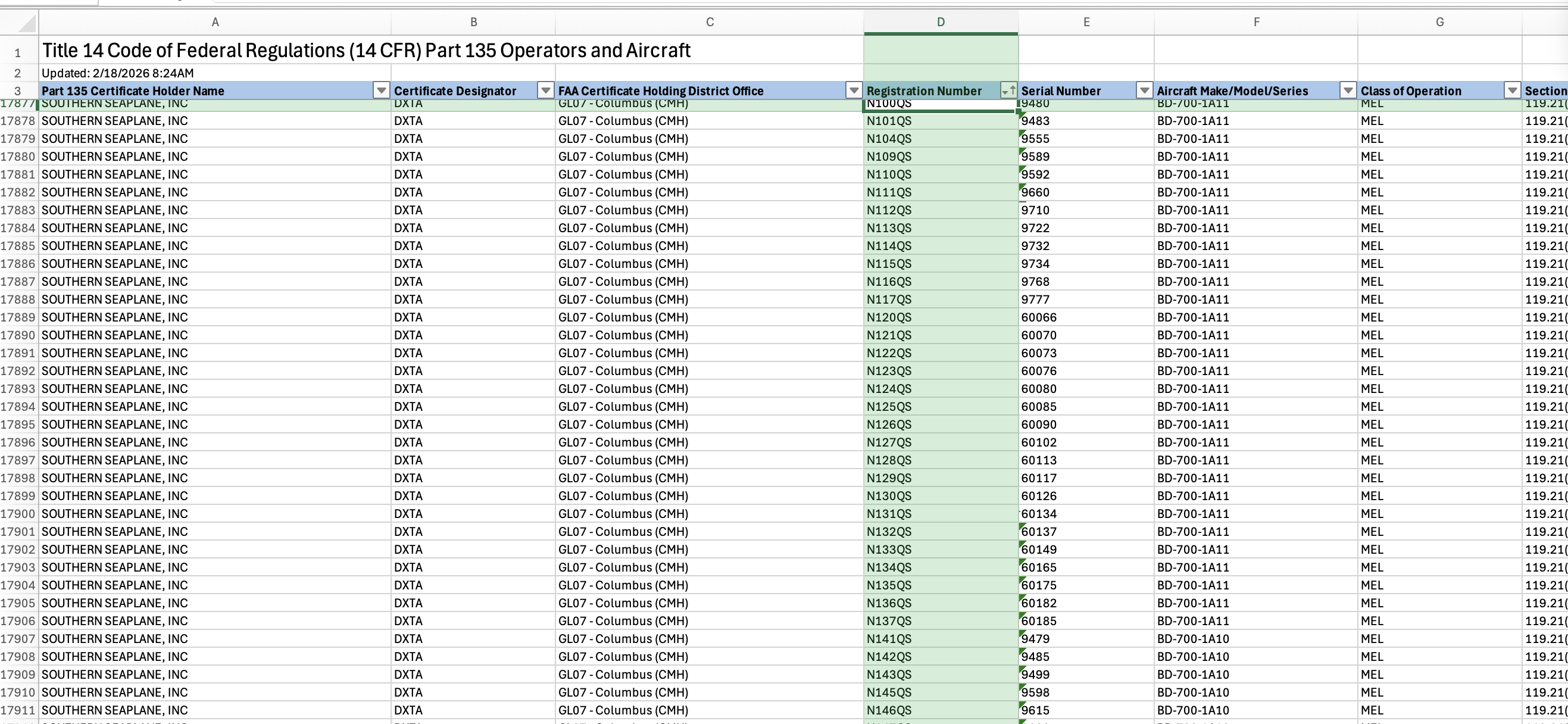
That included the NetJets fleet, which can be identified by the QS in their registration or tail numbers.
The FAA’s latest posting, made yesterday, appears to have restored the list’s overall integrity, with NetJets, Wheels Up, FlyExclusive, Jet Linx, and others now appearing alongside the aircraft on their D-085.
However, there are still important gaps in the data.
The recent massive errors are highlighting what some in the industry say is a deeper issue.
It takes weeks and months, FAA inspections and oversight, and costs to the aircraft owner and operator to add an aircraft to the operator’s D-085.
Conversely, an operator can have their airplane removed in days.
Airplanes come and go from the list with some frequency.
That includes when they are sold, and owners switch management companies.
Airplane owners move their aircraft if their management company shuts down.
In some cases, an owner may no longer want their airplane on the D-085, even if they don’t switch operators.
In all cases, it is the operator’s responsibility to notify the FAA of the change.
Each time an aircraft changes management companies, the new management company must initiate the conformity process.
That means adding the aircraft to its D-085 if it wants to sell charter flights.
The owner and the management company incur the associated costs.
Owners may also decide they no longer want the expense of complying with Part 135 regulations.
Since operators fly aircraft certificated under Parts 135 and 91, the updated D-085 provides critical verification of which aircraft they can legally offer for charter.
The examples from Verijet and Air Associates Charter cited earlier are just the tip of the iceberg, some say.
It’s easy to catch those mistakes because the former operator is defunct.
Private Aviation Safety Alliance President Jessie Naor says, “We spend many hours cleaning these lists each month for public use.”
For much of the industry, the FAA’s list was an additional tool.
ARGUS TripCheq and Wyvern PASS are reports that brokers use.
The reports confirm that operators, aircraft, and pilots comply with FAA rules and regulations.
Those emblems operators showcase with their ARGUS and Wyvern status do not relate to the aircraft on their D-085 or pilot compliance.
That is only verified via the TripCheq and PASS reports.
Naor of Private Aviation Safety Alliance says there is a significant gap.
ARGUS and Wyvern reports only cover operators in their respective databases, which do not include all Part 135 operators.
Being part of ARGUS and Wyvern entails fees borne by the aircraft owner or management company.
Tracking when an aircraft comes off a D-085 to ensure it is no longer offered on the charter market is a concern, say the experts.
The aircraft and pilots must go through the entire conformance process each time the aircraft moves to a new operator, and the owner and operator wish to offer it for charter flights.
Expenses to add an aircraft to a D-085 run from the thousands of dollars to tens of thousands of dollars, say executives with management companies.
That process includes verifying previous maintenance records.
It entails time-consuming logbook inspections.
Much of the cost is attributed to the required pilot training.
It usually means time in a simulator.
The FAA suggests consumers contact the operator directly or the FAA office that tracks the operator’s D-085s.
However, industry executives say that it is not practical.
Many operators fly under DBAs.
The offices that oversee their certificates are not always based where they are.
Industry executives say FAA offices are not staffed to handle an onslaught of consumer requests.
One executive with a Part 135 operator said, “For the average consumer, that’s like giving the carjacker your keys and asking him to park your car because he’s dressed like the valet. The people selling illegal charters are experienced at fraud.”
Brokers should request the D-085 and proof of insurance from operators when selling flights.
However, that still leaves them open to unscrupulous operators who could manipulate the documents they send.
B2B platforms, such as Goodwin, are used by brokers to source aircraft.
A spokesperson says it has its own procurement process to ensure aircraft are compliant.
Brokers say they mitigate the risk of selling an illegal charter beyond the ARGUS and Wyvern reports and requesting D-085s and proof of insurance flight-by-flight by concentrating their business with operators they work with regularly, instead of simply shopping the vast market of over 1,000 Part 135 operators based on price.
An Aviation International News analysis found that between 2010 and 2020, there were no fatal accidents involving U.S.-registered private jets operating under Part 91K, and just three involving Part 135 operations.
By contrast, Part 91 operations accounted for 31 fatal accidents over the 10 years.
The death of former NASCAR driver Greg Biffle in a December crash and the Challenger 650 that crashed last month on takeoff from Bangor, Maine, are recent examples of accidents on jets operating under Part 91 rules.
When it came to turboprops, Part 91K fractional operations again had zero fatal accidents during the decade.
U.S.-registered charter turboprops had 15 fatal accidents.
Part 91 operations accounted for 82 fatal turboprop accidents over the 10 years.
The crashes that killed four people on a night approach to Steamboat Springs aboard an Epic E1000 earlier this month and the crash in Wyoming that killed three members of the gospel group The Nelons in July 2024 were both on turboprops operating under Part 91 rules.


Find the perfect solution for your private aviation needs
Save Time. Buy Confidently.
Receive an apples-to-apples comparison of programs that meet your needs from more than 500 jet card and fractional options covering 65 points of differentiation and over 40,000 data points.