From early 2020 until July 2025, the United States Federal Aviation Administration uploaded an Excel spreadsheet to its website on the first few days of each month.
The spreadsheet listed the 1,800 charter operators and more than 11,000 aircraft certificated to perform private charter flights, based on data from the prior month.
The public list was the result from years of industry lobbying and cajoling aimed at providing consumers with more transparency into the private jet charter market.
Private Jet Safety
Operators and airplane owners selling flights and seats on airplanes not certificated by their country’s aviation authorities, such as the FAA, are recognized as a major safety issue in the industry.
Those illegal charter flights have been tied to multiple fatal accidents, from the one that killed Buddy Holly, Ritchie Valens, and the Big Bopper in 1959 to soccer star Emiliano Sala in 2019.
On its website, the FAA outlines nearly two dozen enforcement actions it has initiated against individuals and companies for alleged illegal charter operations since 2019.
Back in 2022, it warned, “Unauthorized 135 operations continue to be a problem nationwide, putting the flying public in danger, diluting safety in the national airspace system, and undercutting the business of legitimate operators.”
It has taken action against players it believed were trying to use limited cost-splitting exemptions or leases allowed under Part 91 flying to conduct what it alleged were illegal charter flights.
Consumers are often oblivious that they are flying on an illegal charter flight, experts say.
‘Both (FAA Part 135 charter operator and aircraft) files were bad in two unique ways’
– Jessie Naor, Private Aviation Safety Alliance
Between 2010 and 2020, U.S.-registered private jets operating legal charter flights were involved in three fatal accidents.
That compares to 31 for Part 91 privately operated jets, according to an analysis by Aviation International News.
Summer Break
Since the July 2025 Excel file of certificated operators and aircraft was posted, reflecting updates to the FAA’s database through June, there was a gap until mid-September.
Sources say this was caused by the FAA’s transition from a system referred to as WebOPSS, short for Web-based Operations Safety System, into its new Safety Assurance System called SAS.
The FAA promised the transition would reduce “redundancies and mismatches of data.”
Delays and Mistakes
From mid-September until earlier this month, there were no updates.
One possible reason is the government shutdown.
The shutdown began Oct. 1, 2025. It lasted 43 days.
Back and Wrong
In early February, the FAA uploaded data that appeared to have been from an October 2025 update.
That would have meant data current as of September.
The data would be at best four months out of date.
FAA Data Shows A Louisiana Seaplane Operator As World’s Largest Airline
![Southern Seaplane]()
Days later, on Feb. 18, 2026, a new list was posted.
Based on the file numbers, which are marked to correspond to the month they were uploaded, the file appeared to be a December list.
That data would have reflected updates from November, so it is still two months in arrears.
Both uploads had massive mistakes – more than usual.
The most recent file listed twice as many aircraft as the previous one.
‘The bigger question is why the mistakes on the list weren’t caught (by the FAA) before it was posted publicly.’
– Keith DeBerry, former FAA and former NATA official
Operators that were out of business – and aircraft tail numbers associated with those out-of-business operators – were still on the list.
Major operators and much of their fleets vanished in the first update in February.
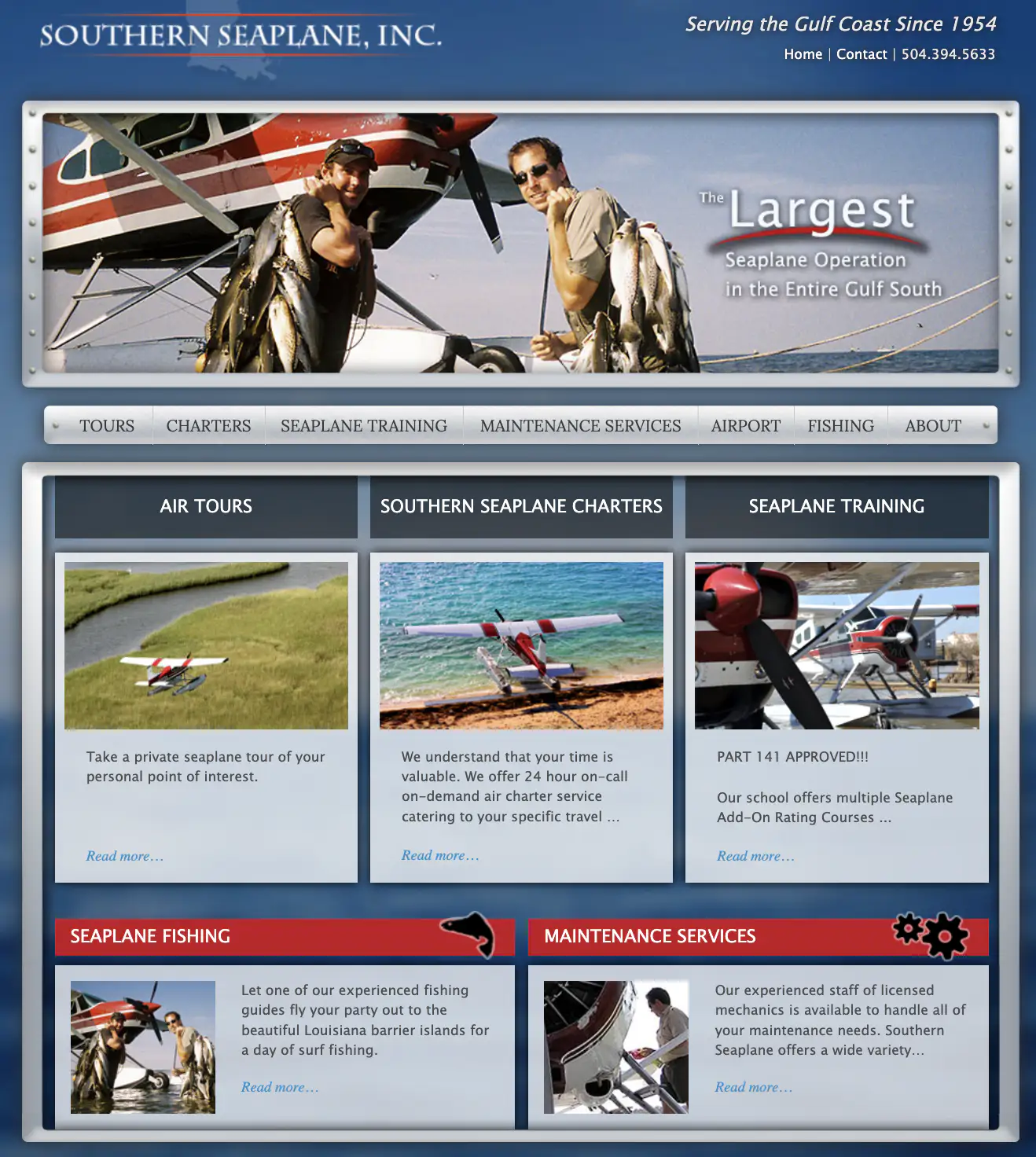
In the latest update, fleets from those operators were listed under a small seaplane company based in Louisiana (pictured above).
According to the FAA, Southern Seaplane of Belle Chase is currently the world’s largest airline, scheduled or unscheduled, with over 21,000 airplanes, including dozens of Bombardier Globals.
What Is A D-085?
The file is supposed to combine the list of aircraft operators certificated under 14 CFR Part 135 for on-demand charter operations and their aircraft, as listed in what’s called a D-085, identifying the specific aircraft that have been certificated for charter flights.
The D-085 list changes constantly.
Airplanes are added and deleted as they are bought and sold, new ones are delivered, old ones are parted out, and aircraft owners, who make their airplanes available on the charter market, move them from one operator to another.
Adding an airplane to a D-085 is a rigorous process that can take months.
An operator can have an airplane removed from their D-085 in days.
Beyond the errors in the current FAA list posted on its website, it’s important to keep in mind that airplanes move off an operator’s D-085.
‘Only Official List’
A spokesperson from the FAA tells Private Jet Card Comparisons, “The link you have is our only official list of certificate Part 135 operators.”
The list includes private jets, turboprop aircraft, piston aircraft, and even helicopters.
Soccer Star Emiliano Sala Died In A 2019 Illegal Charter Crash
![Emiliano Sala Shutterstock]()
It includes everything from large-cabin Gulfstream jets to sightseeing helicopters in Hawaii, and those airplanes used by skydivers.
The list features around 1,800 certificated operators and more than 11,000 aircraft.
When you see brokers crowing that they provide access to 5,000 or 15,000 aircraft, they are referring to aircraft certified by national aviation authorities.
Like the FAA, each country authorizes operators and specific airplanes to perform these commercial on-demand charter flights.
It’s often referred to as an AOC. That’s short for Air Operator’s Certificate.
The list on the FAA website usually includes big names like NetJets and Flexjet.
They have hundreds of jets.
Then there is the industry’s long tail of operators.
Many may have only a couple of aircraft certificated for charter flights.
Only around 70 operators on the list have more than 10 jets certificated for charter flights.
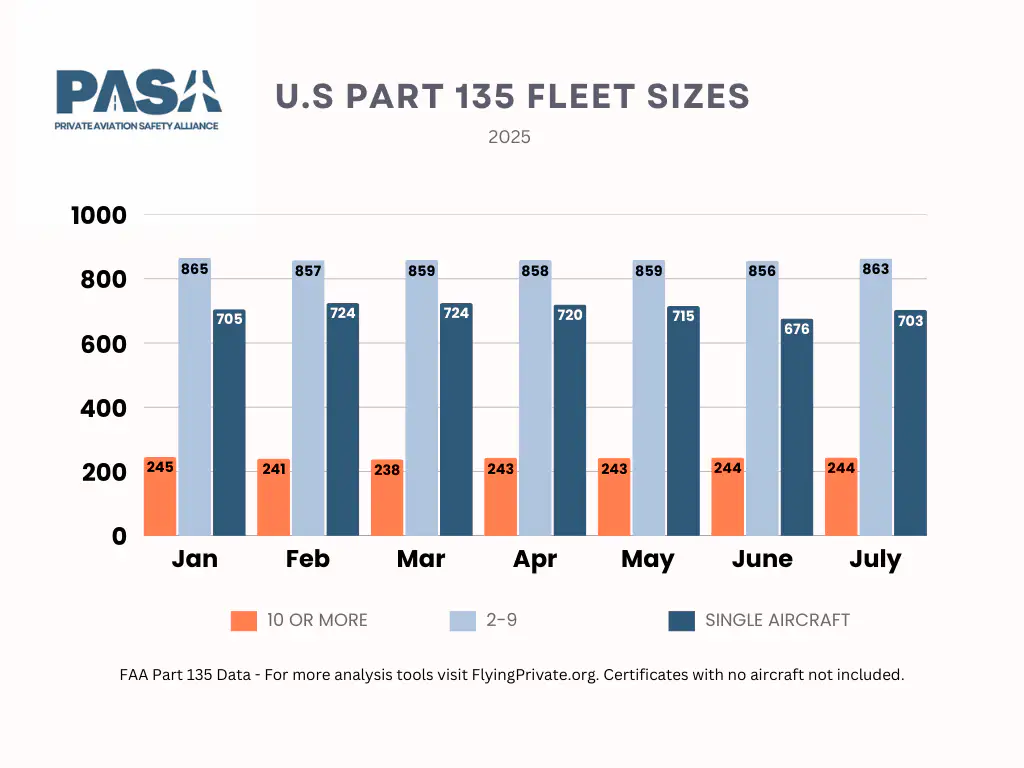
Including piston aircraft, turboprops, jets, and helicopters, an analysis by Private Aviation Safety Alliance (below) as of July 2025 shows that 87% of Part 135 operators had fewer than 10 aircraft on their certificate.
Part 135 Fleet By Size of Operator
![Charter Jets by Operator Size]()
39% of all charter operators only have a single aircraft for charter.
Operators certificated for Part 135 flights can use only their airplanes on their D-085 for charter flights, including flights that support jet card programs, which, at the end of the day, are governed by the same rules as ad hoc charter flights.
If you look at the ARGUS list of the biggest charter and fractional operators, the fleet size quickly drops from hundreds to teens.
Jacqueline Rosser is a senior advisor for the National Air Transport Association.
NATA is a trade group representing general aviation service companies on federal legislative and regulatory matters.
Rosser says, “Data accuracy is essential to combating illegal charter activities.”
She says, “NATA understands and shares concerns about the integrity of the data used to identify FAA-certificated Aircraft Operators – legal Part 135 holders – and their aircraft.”
“The list is just a symptom of what’s happening at the FAA,” says Keith DeBerry, a former NATA and FAA official.
During his 23 years at the FAA, he led the development and implementation of the FAA’s first flight program safety management system, according to the announcement upon his joining NATA.
DeBerry adds, “The bigger question is why the mistakes on the list weren’t caught (by the FAA) before it was posted publicly.”
Part 135 vs. Part 91
Part 135 governs on-demand air charter as well as several other categories of operators.
Aircraft certificated for Part 135 flights allow the operator to charge customers for flights.
The operators function as private airlines that fly schedules based on when and where customers want to go.
Unlike Part 91, which allows the owner to recover expenses under only a few very narrow exceptions, Part 135, which governs operating private aircraft for hire, imposes more stringent requirements.
That includes pilot training, drug and alcohol testing, maintenance recordkeeping, and regulations on the number of hours pilots can fly.
Part 135 operations also require longer runways to provide an extra measure of safety.
Fractional operators, which are regulated under Part 91K and follow rules like those of Part 135, often operate their aircraft under Part 135 for various reasons, so the list includes operators better known for fractional fleets.
Writing in Business Jet Traveler, comparing the different standards, Jeff Wieand explains, “Under Part 91, your caffeine-swilling pilots can fly your aircraft around for days without ever taking a break. Part 135 (and Part 91 subpart K, which applies to fractional programs), on the other hand, has specific flight-duty-time and rest requirements.”
How Safe Are Private Jets?
The analysis by Aviation International News found that between 2010 and 2020, there were no fatal accidents involving U.S.-registered private jets operating under Part 91K, and just three involving Part 135 operations.
By contrast, Part 91 operations suffered 31 fatal accidents.
The death of former NASCAR driver Greg Biffle in a December crash and the Challenger 650 that crashed last month on takeoff from Bangor, Maine, are recent examples of accidents on an aircraft operating under Part 91 rules.
When it came to turboprops, Part 91K fractional operations again had zero fatal accidents during the period.
U.S.-registered charter turboprops had 15 fatal accidents.
Part 91 operations saw 82 fatal turboprop accidents. That’s one every seven weeks.
The crashes that killed four people on a night approach to Steamboat Springs aboard an Epic E1000 earlier this month and the crash in Wyoming that killed three members of the gospel group The Nelons in July 2024 were both on turboprops operating under Part 91 rules.
Not all owners want to make their airplanes available for charter flights, including the additional expenses it demands, so aircraft management companies often end up having aircraft that are Part 135 and Part 91.
To make matters more confusing, an airplane on that operator’s D-085, certificated for charter flights, can be operated under Part 91 rules when the owner is flying in it.
However, the current issue is the FAA’s publicly available data on which operators and specific aircraft are indeed legally available for charter flights – its accuracy (or lack of it) and how that is impacting the industry’s ability to ensure the charter jet you are flying on is indeed compliant.
FAA Part 135 List
The Excel spreadsheet uploaded by the FAA lists the certificate holder – the company, although there are numerous DBAs. Airshare, a prominent player, is listed on its certificate and on the FAA’s list as Executive Flight Services LLC.
The spreadsheet lists the FAA regional office overseeing the company, known as the FSDO (Flight Safety District Office).
The registration of each aircraft certificated for charter flights, known as the tail number, is listed.
All U.S.-registered airplanes start with the letter N.
It also included the aircraft’s OEM-issued serial number.
Finally, there is the aircraft’s make, model, and series.
Want to find a Phenom 300, the top-selling light jet over the past decade?
If you search for “Phenom 300,” you won’t find any on the list. They are listed as EMB-505, a technical designation.
A Citation Latitude, a widely used charter jet, is listed as CE-680.
In other words, before the dysfunction, while it’s relatively easy to search for a tail number, the primary way of identifying the aircraft designated for your charter flight, beyond that, the data is cumbersome for novice private flyers.
Mind The Gap
After the gap in posting the list from early July to mid-September, the FAA published a list of 11,323 aircraft on Sept. 17, 2025.
The count was in line with the 11,488 aircraft in the July list.
The June FAA list had 11,467 tails.
From Sept. 17, 2025, through this month, there was again nothing.
After a new list, marked 10, indicating it was the October list, was published earlier this month.
Double Trouble
Last Wednesday, a version marked 12 was uploaded.
It contained 23,521 aircraft, about twice as many as the previous lists.
And no, it wasn’t simply that somebody copied the same list twice. Only 174 tail numbers among the 23,521 listed were duplicates.
Despite the list’s doubling, some of the industry’s biggest operators were still missing in name.
Absent were NetJets, Wheels Up, FlyExclusive, Jet Linx Aviation, Fly Alliance, Thrive Aviation, and a host of others from the file titled “Part_135_Operators_and_Aircraft_12.”
The list was marked as being updated on Feb. 18, 2026, at 8:24 am.
Private Aviation Safety Alliance President Jessie Naor says the monthly publication began only about six years ago.
She tells Private Jet Card Comparisons, “Pressured by trade organizations following concerns about illegal charter operations, the FAA began publishing the Part 135 operators list on its site sometime around 2020.”
Naor, the former president of Part 135 operator GrandView Aviation, says, “Before that, there was no independent way to confirm an operator was legally certified without asking them for their certificate.”
READ: Cheap illegal charter, jet sharing has safety, liability risks for flyers
Illegal Charter Dangers
The FAA believes illegal charter operators and owners of aircraft offering transportation in exchange for consideration aboard airplanes not certificated under Part 135 are a significant issue in the industry, with serious ramifications.
Before Super Bowl LX, the FAA published a blog post on its website titled “Best Super Bowl Play: Avoid Illegal Air Charters.”
The post noted, “Legal air charters operate as on-demand or commuter operations under Part 135 of the federal aviation regulations and are subject to higher safety standards, with more stringent crew training and aircraft maintenance requirements than general aviation operations under Part 91.”
It continued, “They incur and absorb necessary overhead costs to safely run their operations and remain compliant with FAA, Internal Revenue Service, and, in some cases, Transportation Security Administration regulations.”
The FAA warned:
‘There are hard lessons underscoring this issue’s urgency. Today marks the seventh anniversary of the tragic 2019 English Channel illegal air charter accident that took the life of Argentinian soccer star Emiliano Sala. Jan. 21 is designated Fly Legal Day in his memory to highlight the importance of flying on safe charters. One can also go back 60 years before Sala’s accident to recall an event seared in our nation’s memory as The Day the Music Died. Shortly after midnight on a frigid Feb. 3, 1959, a chartered Beechcraft Bonanza took off with three passengers from Clear Lake, Iowa, into deteriorating weather conditions and crashed six miles away. Found dead at the crash site were rock and roll music legends Buddy Holly, Ritchie Valens, and the Big Bopper, J.P. Richardson. The subsequent investigation determined the pilot was not qualified to operate under instrument flight rules. This event endures as a reminder for everyone touched by aviation to guard against the dangers of unsafe air charters.’
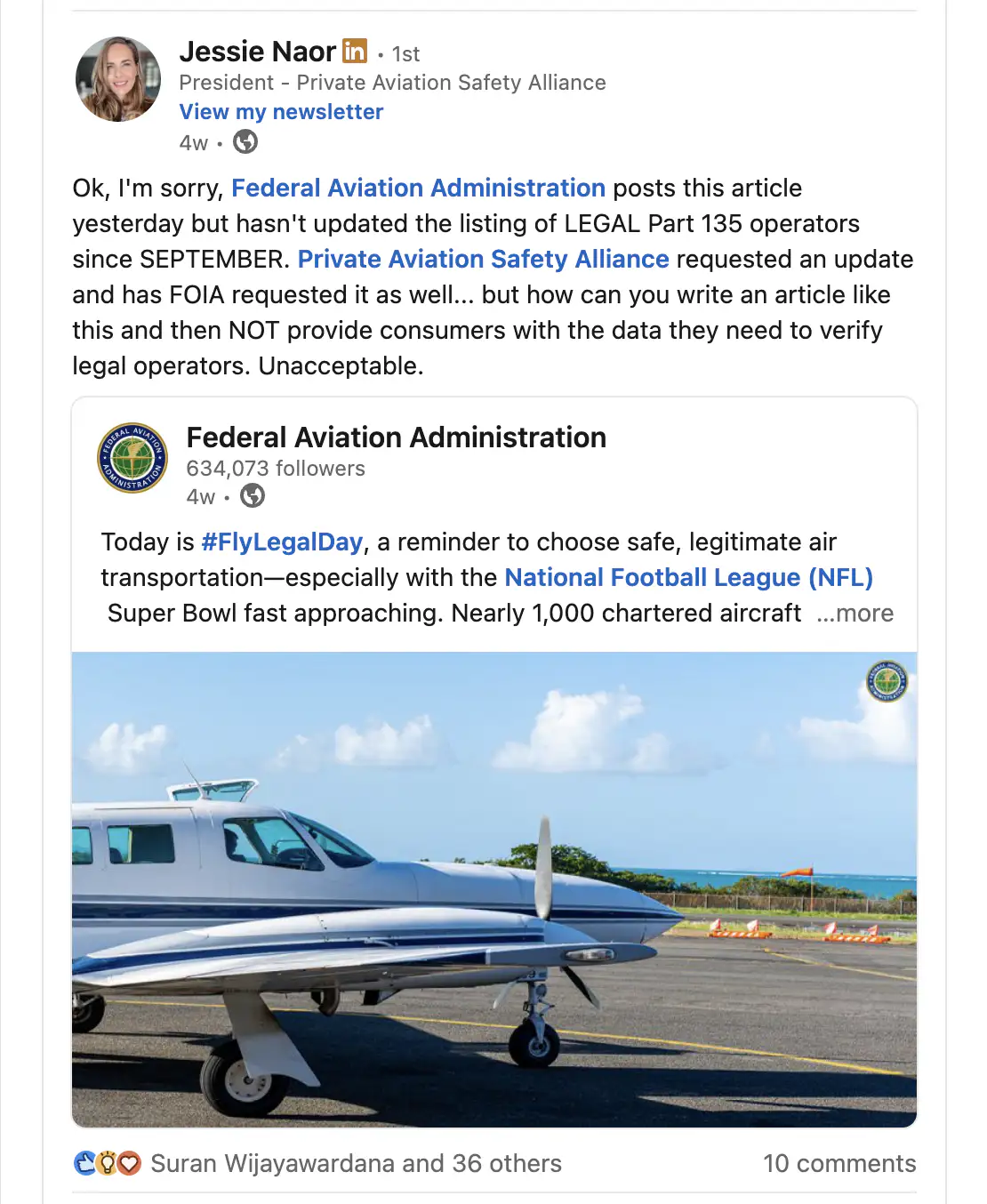
Naor responded to the FAA’s LinkedIn post.
FAA Highlights Fly Legal Day
![Private Aviation Safety]()
She posted, “Ok, I’m sorry, Federal Aviation Administration posts this article yesterday but hasn’t updated the listing of LEGAL Part 135 operators since SEPTEMBER. Private Aviation Safety Alliance requested an update and has FOIA requested it as well… but how can you write an article like this and then NOT provide consumers with the data they need to verify legal operators. Unacceptable.”
READ: FAA issues notice on Illegal Charter: ‘Putting the flying public in danger.’
Outdated Data
Naor says that at best, before the most recent lapses and gyrations, the spreadsheet often contained outdated listings.
Naor says her website, which operates like a Carfax for private jets, keeping a history of accidents, incidents, and violations, must regularly verify “companies are still in business.”
The problem is that while the operator is no longer around, the airplane is, and its tail number is on the FAA’s published list, but in fact, it is no longer certificated for legal charter flights.
Verijet, which filed for Chapter 7 bankruptcy on Oct. 9, 2025, and hadn’t flown since the summer, has two aircraft on the current list.
On the October list, published in early February, six aircraft were listed as being legally available for charter from Verijet.
The list published on Sept. 17, 2025, showed Verijet’s fleet as having three Cirrus SF50 Vision Jets on its D-085.
Out Of Business
On the list published in early February, two jets operated under Part 135 by Air Associates Charter, Inc., which shuttered in June 2025, were still listed under the defunct operator, although the AMSTAT database shows one as being sold last September and the other in November.
In the most recent list, N1LF, a 2013 Citation CJ3 light jet, was still listed under Air Associates Charter’s certificate designator, even if it has been misclassified by name under Southern Seaplane.
Anyone looking up the tail number in the FAA’s Part 135 Excel file that it posted would have believed the light jet was certificated for charter flights.
At least according to the private AMSTAT database, it is not.
AMSTAT shows it operating under Part 91 rules, something experts say is not unusual.
The same goes for N29VJ, formerly with Verijet.
According to AMSTAT, it is now Part 91, even though the FAA’s current list shows that it’s legal to operate charter flights.
Think of it like selling a vacation house. The former owner had it on Airbnb, but you don’t want to rent it out.
In this case, the new owners of N1LF and N29VJ apparently are not interested in getting charter revenue. They are just going to fly the airplane for non-commercial use, perhaps to support their business, the main reason people and companies buy airplanes.
Before the two most recent lists, an executive with a private jet flight provider said it was “only 85-90% accurate.”
If you were depending on the FAA to parse data, you would think the jet is still available to charter.
ARGUS and Wyvern
Thankfully, the FAA’s list is not the way most of the industry verifies which operators and aircraft can legally perform charter flights.
ARGUS and Wyvern are ubiquitous in the industry.
Operators use their safety ratings on their websites and promotional material as a Good Housekeeping seal of approval.
They have different levels of certification, such as Gold, Platinum, and Wingman, based on verification of operator safety standards and procedures.
Both then provide reports that brokers often use to verify that the actual airplanes are on that operator’s D-085 certificate.
The reports also validate pilot medical records, flight hours, experience with that aircraft type, valid insurance, and so forth.
Naor says one issue is that ARGUS and Wyvern don’t track all operators, just those that pay to be part of their services.
She says, “Ratings agencies can help consumers check for legality, but it isn’t comprehensive. Wyvern has 192 rated operators listed on their public directory page, ARGUS has over 500 on theirs, which leaves consumers in the dark on at least 1,000 Part 135-rated operators.”
While ARGUS and Wyvern publish on their websites the Part 135 operators who have earned their ratings, access to verifications of specific aircraft from the operator’s D-085s is available only through ARGUS’s TripCheq and Wyvern’s PASS reports, which are run before the flight.
Representatives of ARGUS and Wyvern say the list the FAA provides to the public is just one of their tools, so their ability to verify operators and aircraft hasn’t been affected by issues with the list posted on the FAA’s website.
Checking Legality
Charter brokers say they use a combination of tools to make sure the aircraft chartered for clients are on the operator’s D-085.
Some brokers also use AMSTAT and another database called JetNet. Annual subscriptions cost thousands of dollars.
Avinode, a database of charter jets that brokers use to source aircraft from and where operators pay to list their aircraft, requires operators to provide their D-085 to have those aircraft listed.
However, operators don’t always list all their aircraft on a D-085 with Avinode.
Pricing to market your charter jet on Avinode is per aircraft.
When a broker calls or emails about one of the listings, the operator may offer another aircraft that is available for charter but not listed.
The broker would still need to make sure the aircraft was on the D-085.
The FAA’s Excel spreadsheet is handy for cross-referencing, some say.
Brokers will request and retain D-085s and proof of insurance from the operators they use.
The D-085s are in PDF format.
They are updated as the FAA adds or removes aircraft.
However, insiders say an unscrupulous operator could provide an outdated or altered PDF.
It’s one reason many brokers concentrate their business with operators they know, trust, and have already vetted, rather than just sourcing aircraft randomly from databases.
Still, that’s not always possible, especially when someone wants to fly ASAP.
That term means a flight request for the same day, the next day, or the day after.
Avinode says that ASAPs account for about 20% of all broker charter requests.
ARGUS TripCheq & Wyvern PASS
Many brokers have the operator run a TripCheq or PASS report from ARGUS or Wyvern, depending on which service they use for their audits, assuming they are audited by either.
This is usually done around 24 hours before the trip, as it involves verifying the pilot’s qualifications and medical clearances.
Some industry executives say relying on brokers for safety checks isn’t good enough, pointing out that brokers aren’t regulated and aren’t required to undergo any training.
Naor says, “The need for consumers to be able to look up who they’re flying with independently is critical.”
She says, “From families flying on a helicopter tour to hospitals vetting a vendor, and private jet fliers, illegal charter is rampant in the U.S. and overseas, and consumers do need to take an active role in researching who they’re flying with.”
World’s Largest Charter Operator
While major operators disappeared from the most recent update, a new player emerged.
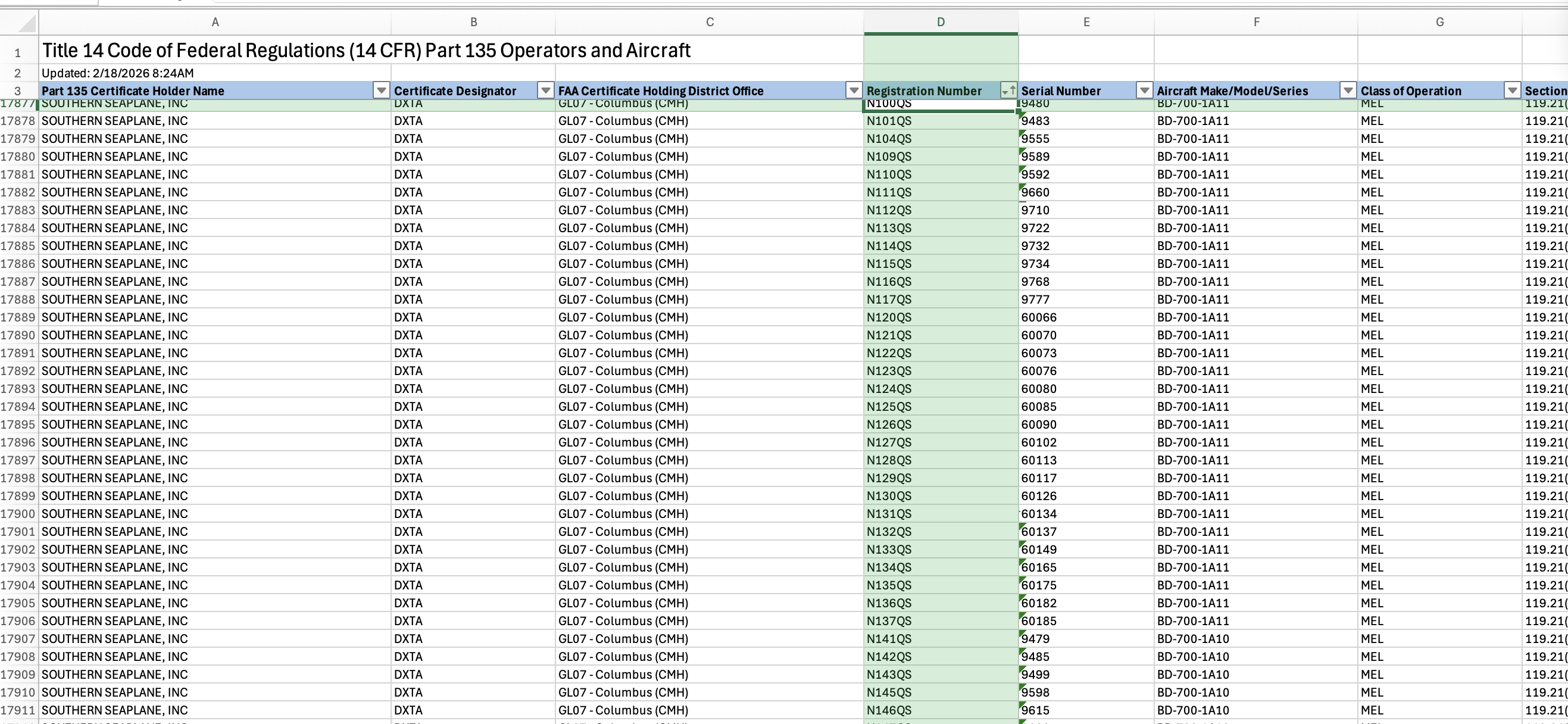
According to the FAA, Southern Seaplane, Inc. has over 21,000 aircraft available for charter flights.
In the listing published earlier this month, which appears to be the October list, and in the September list, which was published in mid-September, Southern had five aircraft, all single-engine piston aircraft.
Lacey Charvet, one of the owners, said she had no idea that, according to the FAA database, the Belle Chase, Louisiana, operator had four times as many airplanes as the combined fleets of American Airlines, Delta Air Lines, United Airlines, and Southwest Airlines.
The company normally operates sightseeing and fishing charters.
Naor, after reviewing the two most recent lists, the first the FAA had published since September, said she saw significant mistakes in both.
Bad Files
“Both files were bad in two unique ways,” she says.
As for the missing operators, many of their aircraft are listed on the most recent list; they are just listed under Southern Seaplane.
To find the company, you need to know its certificate designator or a specific tail number.
For example (see below), NetJets aircraft can be spotted by the QS in their N-number registrations or on the list via its DTXA designator.
Most Recent Part 135 Operator and Aircraft List Uploaded By The FAA
![NetJets]()
FAA Troubles
The FAA has been under fire for a while.
There have been radar approach control outages, causing delays.
There have multiple near misses in the air and on the ground.
The deadly collision between an American Airlines regional jet and a military helicopter near Washington, D.C., last year highlighted that there had been numerous near misses previously.
More recently, a notice closing El Paso International Airport for 10 days, effective immediately, was rescinded hours later.
Super Bowl Advice
In its blog post warning of illegal charter, the FAA’s Greg Young advises, “If you have a question about whether or not the aircraft (charter companies) are offering is authorized under an FAA certificate, you can ask them for a copy of their operations specification (called the D-085).”
He says, “That, in conjunction with a copy of their (Part 135) certificate, would tell you that they are a legitimate air carrier and the aircraft they are promoting to you is available and authorized.”
The FAA told attendees heading to the Big Game and considering a private flight, “For Super Bowl air charter passengers, it is important to verify the legitimacy of the operator before you book your flight.”
For its part, the FAA, in its Super Bowl post, said its multi-year Safe Air Charter Team campaign has included 235 virtual and live briefings with pilots, students in aviation schools, aircraft brokers, insurance brokers/underwriters, and aviation attorneys, more than two dozen presentations to airport authorities, and 40,000 emails to FAA-certificated pilots warning of illegal charter’s dangers.
Naor says with the current situation, “It’s just not possible for the average consumer or passenger to do a quick check that they’re flying with a legal operator and aircraft.”
She says the government also needs to make available to consumers easy-to-access data on operators, their aircraft, accidents, and violations, something she says is tedious and difficult to find.
FAA Response
It’s unclear what is causing the significant errors and omissions in the file, which, as of this morning, was still on the FAA’s website.
Several operators say that when they access the FAA’s SAS portal, their data is accurate. However, they cannot see other operators, so it’s hard to tell whether the data corruption is limited to the spreadsheet.
While ARGUS and Wyvern say they can keep their data updated through various other sources, including directly from the operators, for the public, it is a different issue.
Impactical Advice
The FAA recommends calling your local Flight Standards District Office to verify an operator or aircraft not on its public Excel file list. However, its list includes aircraft that are no longer on a D-085.
Industry executives said the advice is impractical.
For example, while Wheels Up is based in Atlanta, its certificate is overseen by the FAA’s Denver office.
VistaJet’s U.S. fleet flies under the Jet Select certificate and is overseen by the FAA’s Columbus, Ohio FSDO.
“How does a consumer figure that out?” says one observer.
What about contacting the operator to ask for its charter certificate and the D-085, another FAA recommendation?
An executive says that, in the case of an unscrupulous operator, that is not sound advice.
He says, “For the average consumer, that’s like giving the carjacker your keys and asking him to park your car because he’s dressed like the valet. The people selling illegal charters are experienced at fraud.”
The FAA spokesperson says he expects to provide answers by early this coming week.