February 23, 2026
Private fliers are asking about winter flying risks and deicing. Jessie Naor of Private Aviation Safety Alliance explains how it works.
Jessie Naor is the president and founder of The Private Aviation Safety Alliance (PASA). It is an independent nonprofit that makes private aviation safety data accessible and easy to search for the public at no cost. Its platform enables users of private jets, helicopter tours, medevac flight operators, risk management teams, and safety researchers to search operator accident and incident records, verify legal status, fleet information, and FAA enforcements and sanctions.
By Jessie Naor
The recent crash in Bangor, Maine, is still under investigation, and the NTSB won’t publish its final report for years. In aviation, we don’t speculate on the causes of crashes for a reason… we’re often wrong until the investigation is complete, and accidents are usually more complex than a single cause.
Still, the questions raised by this event are valid. Private fliers are asking whether flying in winter weather is safe, and what risks are unique to these conditions.
Winter weather itself does not make flying unsafe, but it does place greater demands on aircraft, flight crews, and most importantly, the organizations that operate aircraft. Whether a winter flight in a private jet is safe depends on how those risks are identified and controlled.
Aviation is fundamentally a business of risk management. Every day, thousands of crew members, mechanics, and dispatchers make risk calculations before aircraft depart. The question isn’t whether risk exists; it always does. The question is whether it is systematically managed or left to individual judgment calls.
Winter operations introduce additional layers of risk, including:
• Ground Contamination on aircraft surfaces (snow, frost, ice)
• Runway and taxiway surfaces
• In-flight icing
• Personnel experience, training & organizational standards
How well these risks are managed depends on three things: the aircraft’s design, the crew’s training and experience, and the operator’s safety culture.
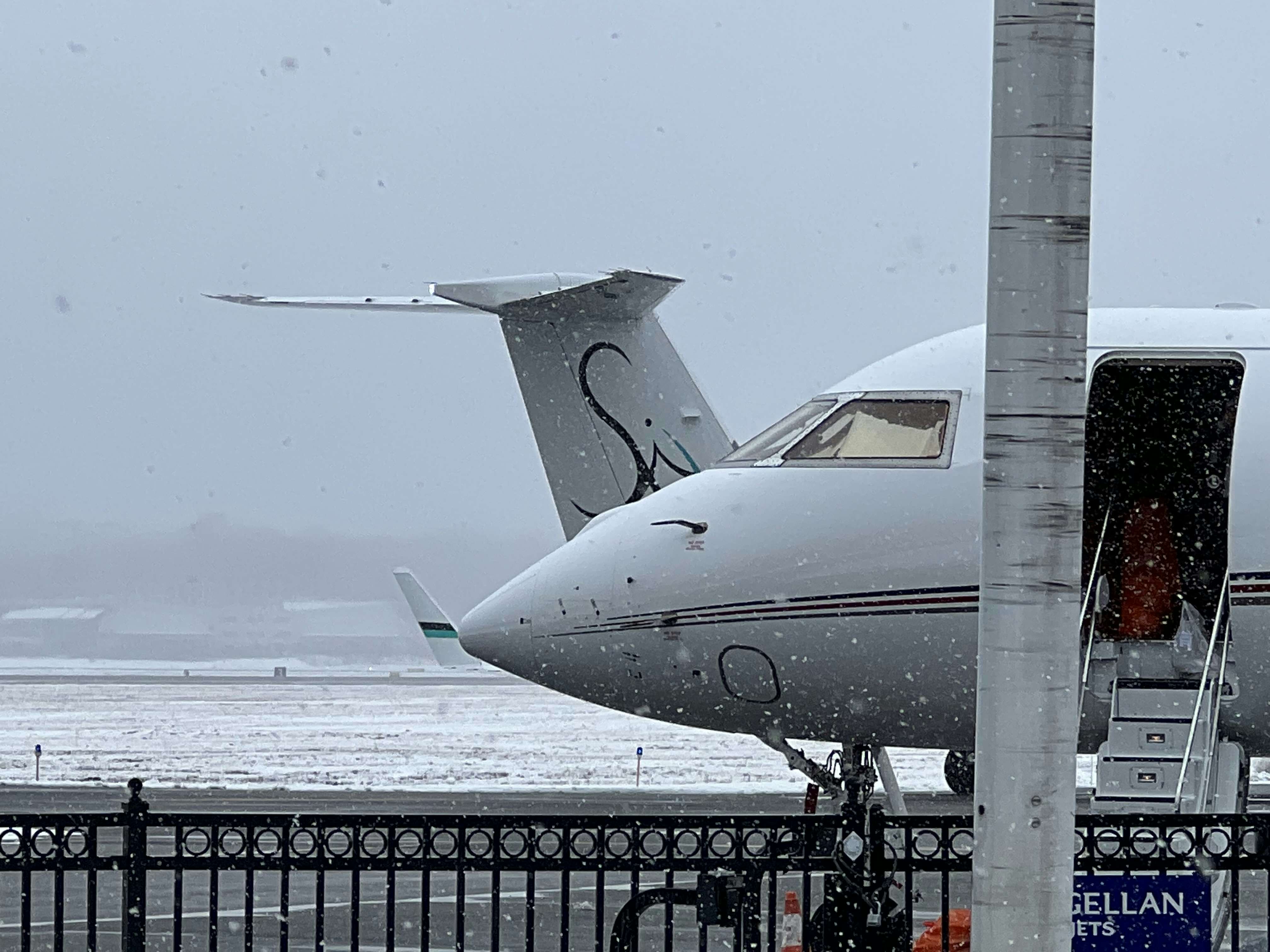
Runway and taxiways are controlled by the airport; airports like Bangor are experts at these kinds of conditions. Think of it like trying to drive on a highway in Boston the morning after a snowstorm versus Atlanta – one has the infrastructure and experience to keep those runways clean and safe quickly, the other will get there eventually, but it may take a little longer. Pilots rely on braking reports from other aircraft, visual inspections, and weather reports for how clean the runway is.
In-flight icing doesn’t only happen in winter; at high altitudes, outside temperatures are well below freezing, so icing conditions happen even in “warm weather”. Advanced aircraft used in corporate aviation are designed to handle in-flight icing with deicing systems. Those systems are not designed for Ground Contamination, which is where deicing fluid comes in to remove accumulated snow, ice, or frost before takeoff.
At major airlines, there are very strict guidelines for deicing and removing contamination, and those rules are regulated by the FAA. On the night of the crash in Bangor, multiple airlines cancelled their takeoffs because they reported they couldn’t make their “HOT” times (holdover times). Without going into specifics, HOT is a set of rules that predict how long deicing fluid will keep surfaces free of contamination before takeoff. Depending on conditions, it could be 2 minutes or 30 minutes, which is material when long taxi times to the runway are involved.
These airline deicing programs reduce the risk of ground contamination to near zero.
Private aircraft (135, 91K, 91) are not required by law to follow the same program as airlines. At the time HOTs were codified in the late 90s, small aircraft operators were concerned about the cost and difficulty of implementing a program designed for large airlines.
As an alternative to an expensive and complex deicing program, smaller operators were permitted to use the “5-minute rule” as an alternative. As long as the wings are checked 5 minutes before departure, the legal requirement is met. Many crews reference the HOT tables for guidance, but they are not a legal alternative to the 5-minute check.
This does not mean private flying is inherently unsafe. It does mean that winter safety depends far more on organizational discipline than on regulatory minimums. Decisions may rely heavily on individual pilot judgment, which introduces subjectivity and variability, particularly among less-experienced crews.
Some major fractional companies voluntarily use the same program as the airlines, favoring strict limits over personalized decision-making.
Having an airline-style program isn’t required, but it’s another way to reduce risk. If your operator isn’t approved to use HOT tables by the FAA, and most aren’t, ask for their winter operating procedures and how they train crew members, especially those new to flying in winter.
If you can delay or reschedule your flight to avoid winter weather, you can completely eliminate the risk. You also lower the chance of deicing costs, which can be at least $2000 and up to tens of thousands for large aircraft. Even switching airports can cut down on long taxi times, reducing the chances of deicing fluid running off and needing to be reapplied.
Deicing is expensive (often $2,000 at a minimum and tens of thousands of dollars for large aircraft), but it is a cost directly tied to safety. Passengers should expect it, budget for it, and support conservative decisions when conditions demand it.
Winter flying isn’t unsafe. Weak standards are.

Find the perfect solution for your private aviation needs
Save Time. Buy Confidently.
Receive an apples-to-apples comparison of programs that meet your needs from more than 500 jet card and fractional options covering 65 points of differentiation and over 40,000 data points.