Selling private jet charter, jet card, and fractional programs is not for the faint-hearted.
Prospecting is hard work.
Getting your attention is not easy.
Beyond dozens of emails are hundreds of phone calls.
Most end with the batter returning to the dugout.
It’s a numbers game, and the successful salespeople work hard and have excellent sales skills.
A fairly standard practice is to use fear.
Not able to close the sale?
Make the prospect feel like they could be making a poor decision.
After all, it’s a lot of money.
That at least keeps the at-bat going.
Another approach is positioning oneself as a consultant.
Truthfully, that’s like the salesperson at your local Porsche dealership claiming to be your automotive consultant.
Sellers of private jet programs typically have at least two mobile phones, and they are constantly on the go.
Below are some of the claims you tell us flight providers tell you, and the reality.
Buying Jet Cards: What they say vs. reality
| What They Tell You |
Reality |
| We don’t have those problems |
Everyone has delays and cancellations. Yes, some are more reliable than ever. Only Wheels Up publishes any metrics about on-time performance. The difference is how flight providers deal with them and how you are charged for recovery flights. |
| We are financially secure |
It’s hard to tell with private companies. Most failures and most private jet flight providers are privately held. |
| We have a segregated account |
Segregated accounts don’t protect your funds in the event of a failure. |
| They use your money to fund operations |
Unless specified, jet card providers – particularly operators – can use your funds for operations. |
| We only use Argus and Wyvern-rated aircraft |
Unless specified in the contract, the requirement is for Part 135 or AOC aircraft. |
| We have higher safety standards than they do |
This is hard to quantify, and many claims lack a clear basis. See above. There have been four fatal Part 135 private jet accidents in the U.S. in the past 15 years. Compare that to other activities, including driving to the airport. Also, check out AvHerald.com to see what happens every day with the big airlines. |
| We use newer airplanes |
See above re part 135. Some brokers have vintage standards, but they can go outside them to fulfill your flight |
| You are always flying on our airplanes |
Contracts allow fleet operators to go off-fleet when needed |
| We don’t have Peak Days |
Some operators call their Peak Days by other names – High Demand, Advance Booking, etc. – but the key is that they use different terms for booking, cancellation, pricing, or can move your departure time. Programs that use dynamic pricing charge you more because pricing varies for each flight request. |
| Booking flights ad hoc is a way to avoid the risk of losing jet card funds in a failure |
An ad hoc charter is a good fit for many flyers; however, it carries financial risks, including stricter cancellation terms, requote charges, and the time it takes to secure flights. |
When it comes to safety — something essential to everyone — we believe it is personal and worth discussing with the provider.
That said, things happen every day in aviation.
Check out AvHerald.com.
On any given day, major airlines that we fly without thinking twice have all sorts of incidents, from trying to take off on a taxiway to engines shutting down in flight or losing cabin pressure.
To compare the options—jet cards, ad hoc charter, fractional ownership, full ownership, and shared options – the good and bad of each, we suggest reading this.
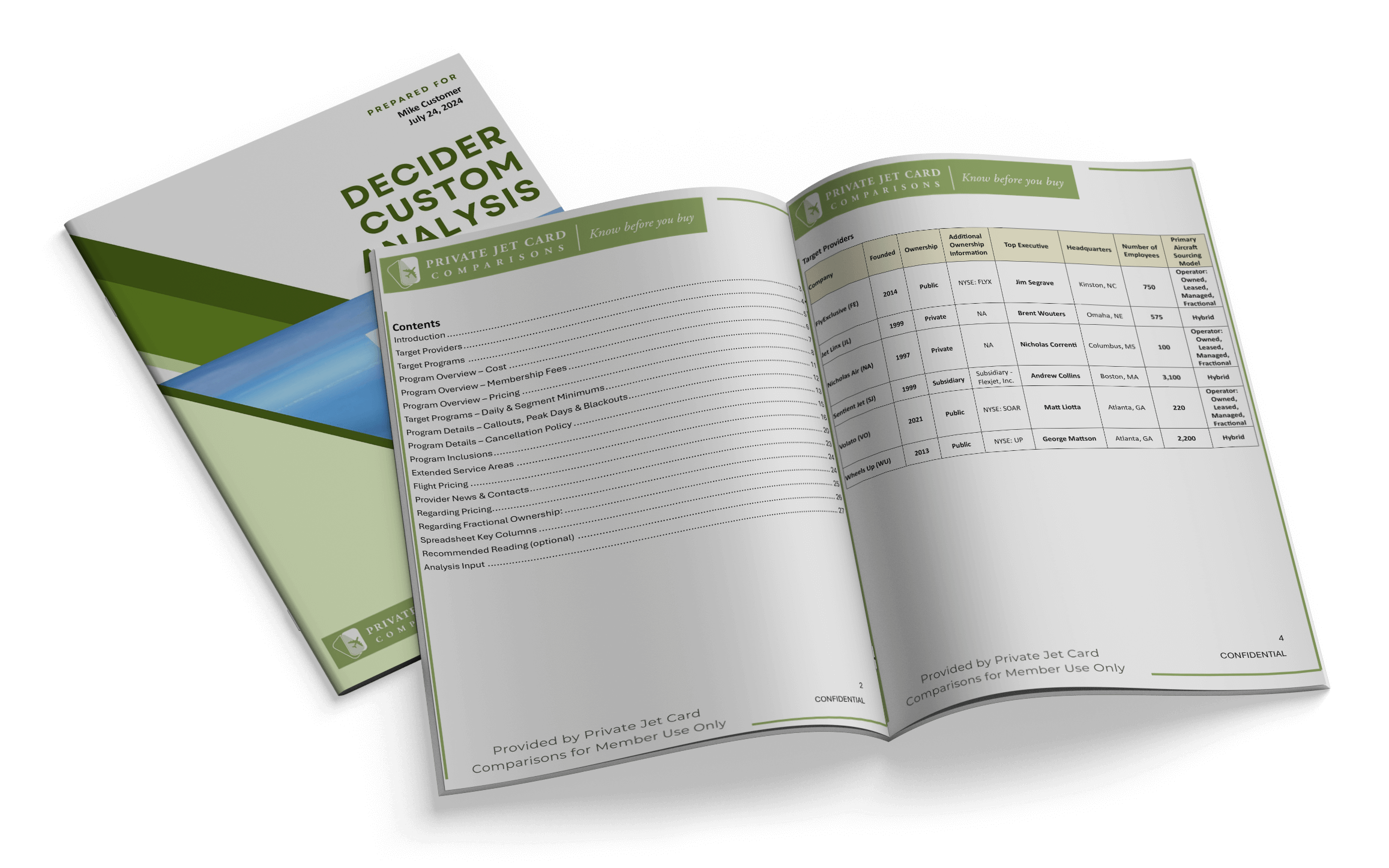
We believe the best starting point is narrowing down the competition via completing a Decider Custom Analysis.
That identifies which programs best fit your needs based on rules and policies.
From there, we always recommend speaking to the companies.
That way, you can measure those points where there isn’t available qualitative data to compare.