During June, private jet flight activity in North America recorded yet another year-over-year increase.
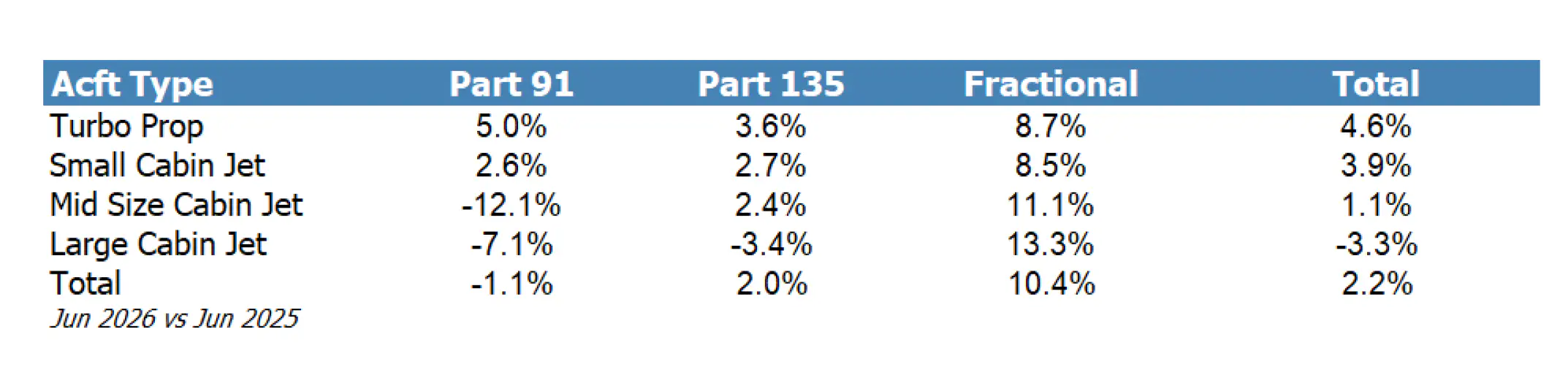
According to ARGUS TRAQPak analysts, private jet flight hours in North America increased by 2.2% compared to June 2025.
ARGUS had predicted 1.0% year-over-year growth last month.
Its analysts expect this growth to continue, estimating that flight hours in North America will increase by 4.3% in July.
Travis Kuhn, Senior Vice President at ARGUS, spoke with Private Jet Card Comparisons.
He stated:
‘June activity remained on positive footing. There continues to be some erosion of demand in the large cabin market and it doesn’t appear as though that will change anytime soon. On the positive side, Fractional activity continues to remain incredibly resilient with double digit yearly growth. Our overall forecast remains positive as we look into H2 2026.’
Overall, private jets in North America recorded an approximate 2.2% year-over-year increase.
Private Jet Growth
Turboprops and light jets led the growth story for June.
The turboprop segment saw the largest year-over-year increase, recording 4.6% more flights.
The small cabin business jet category was close behind, recognizing 3.9% more flights year-over-year.
Additionally, the midsize business jet segment saw a slight year-over-year increase of about 1.1%.
However, the large cabin jet class was the only aircraft type to see a decrease, recording 3.3% fewer flights.
June 2026 Private Jet Flight Activity
![ARGUS June 2026]()
As expected, private jet flights recorded about 2.1% fewer flights in June compared to May.
Even so, June saw about 115 more flights per day on average.
However, because of the extra day in May, June saw fewer total flights.
Several categories of private jet flights saw month-over-month decreases.
This includes Part 135, which saw a 3.3% month-over-month drop, and Part 91, which saw a 5.0% decrease.
However, Part 91K activity increased by about 0.5%.
Across North America, several northern regions saw month-over-month increases.
This was led by 24% gains in the Pacific Northwest and 18.2% in the Northeast.
However, several southern regions saw month-over-month drops, including a 16.1% decrease in the Caribbean.
Fractional Operators
Over the last month, fractional operations saw a 10.4% year-over-year increase in North America.
Several aircraft classes saw double-digit increases.
This includes a 13.3% increase for large-cabin jets and an 11.1% increase for midsize-cabin jets.
The small cabin jet class saw an 8.5% increase.
Meanwhile, the turboprop segment saw the smallest increase, yet still saw 8.7% more flights than last June.
Part 135 Operators
Part 135 operations in North America saw a smaller year-over-year increase, recording about 2.0% more flights than in June 2022.
The turboprop segment saw the largest year-over-year jump, seeing 3.6% more flights year-over-year.
The small cabin jet market saw a 2.7% increase, while the midsize jet segment saw a 2.4% jump.
Meanwhile, the large cabin jet class saw the only decrease in Part 135 operations. The segment recorded 3.4% fewer flights year over year.
Part 91 Activity
Part 91 operators recorded the only major year-over-year decrease. The segment saw about 1.1% fewer flights than last year.
Larger business jets struggled the most in June.
Large cabin jets saw a 7.1% year-over-year decrease, while midsize jets saw 12.1% fewer flights.
The small cabin jet class saw about 2.6% more flights than last June.
However, turboprops saw the largest year-over-year increase, recording 5.0% more flights.