December 19, 2025
FlyExclusive is ‘no longer a company in transition’ according to executives as it reported increased revenues and positive EBITDAR.
Third quarter 2025 results for FlyExclusive saw an increase in revenue, a decrease in loss from operations and Adjusted EBITDA, and a move to positive EBITDAR.
(Full financial results can be downloaded at the bottom of this story.)
The fifth-largest U.S. private jet operator, based on charter and fractional hours, also highlighted a swath of operational improvements.
Both the improved financial and operational performance are tied to its fleet modernization efforts and a post-IPO revamp of its business.
Executives say possible transactions with both Jet.AI and Volato will add to the bottom line.
Chairman and CEO Jim Segrave told analysts on a call this morning, “The third quarter marked another very strong step forward for FlyExclusive.”
He added, “Our transformation is working, and our strategy is delivering.”
Segrave continued, “Over the past year, we’ve modernized our fleet, streamlined our cost structure, and strengthened every part of our operation.”
He said the result is a “company generating stronger growth, more profitability, and more momentum than at any point in our history.”
CFO Brad Garner added, “The heavy lifting of our transformation is behind us, and we are entering the next phase of our growth story with confidence, momentum, and a clear line of sight to sustained profitability.”
Segrave again pointed to the previous drag of legacy aircraft.
‘Our fleet refresh continues to be a major driver. Over the last 12 months, we have eliminated 26 non-performing planes, including two more in the third quarter. That reduction has decreased the operational drag from these jets by roughly 85%, taking monthly losses from over $3 million at the start of 2024 to just over half a million dollars per month today. We expect to reduce the number of non-performing aircraft to mid-single digits by the end of 2025, and to fully eliminate them in 2026. At its peak, our underperforming fleet represented an annualized EBITDA drag of roughly $36 million. That’s nearly gone.’
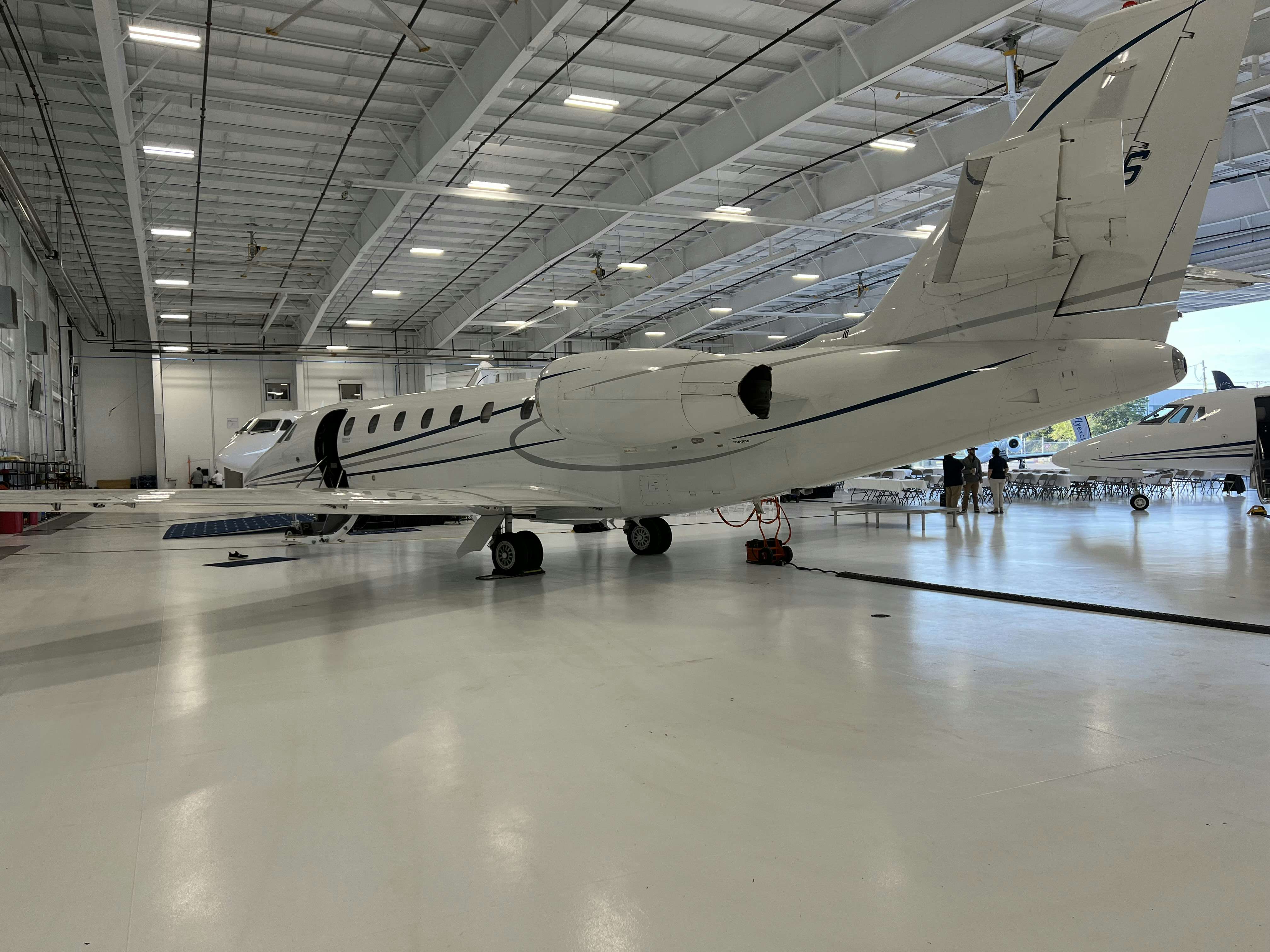
Its fleet of older Encores, Citation Xs, and large-cabin Gulfstream jets is being replaced by new and recent-vintage Citation CJ3+ light jets, XLS midsize jets, and super-midsize Bombardier Challengers.
Segrave said there are currently seven Challenger 300 and Challenger 350s with two more in the “immediate pipeline.”
Previously, Segrave had said the legacy aircraft were sitting idle, nearly 70% waiting for maintenance.
Segrave noted today, “Even with a fleet that’s about 20% smaller than a year ago, flight hours increased 15%, and our core-fleet utilization – the CJ3s, XLSs, and Challengers – rose 12%.”
Segrave said the improvements go directly to the bottom line.
“Our dispatch availability improved 650 basis points year over year, or about 16%, which reflects the performance of the new fleet and the benefits of our vertical integration,” he said, adding, “Each percentage point of additional aircraft availability improvement contributes roughly $3 million to annual EBITDA, so this is and will be a major driver of profitability going forward as well as service quality.”
The company has doubled the number of its mobile AOG units.
The trucks are dispatched to repair aircraft when they have mechanical issues away from base.
Segrave also pointed to the company’s move to contracted consumer demand via its jet card and fractional ownership programs.
He noted:
‘Flight revenue grew 17%, while total company revenue rose 20% year over year to $92 million. Importantly, just short of half of that revenue is now contracted through our Partner, Fractional, and Jet Club programs, giving us more visibility and recurring volume than ever before. Across these programs, our contractually committed hours grew 30% compared to Q3 2024. This increasing share of contracted revenue enhances visibility and stability in our operating model. That mix shift continues to strengthen the predictability and quality of our revenue base.’
At the same time, Segrave said the wholesale market will continue as an essential channel.
“While we are growing our retail footprint, and often highlight that growth, we are not reducing our wholesale flight hours or revenue,” Segrave told the analysts.
He said the company receives over 500 quote requests per day from brokers and other operators who use it for off-fleet lift.
“The broker community is just as important to our model as the retail side of our business,” Segrave said.
With its 20% year-over-year Q3 revenue boost, FlyExclusive increased year-to-date revenue gains from $235.9 million in 2024 to $271.6 million this year.
Net Loss year-to-date dropped to $60.2 million from $85.0 million.
Year-to-date Adjusted EBITDA loss was cut from $48.4 million to $13.5 million.
FlyExclusive also showed a positive Adjusted EBITDAR of $1.5 million through the first nine months.
That compares to a negative EBITDAR of $33.6 million for the same period last year.
Garner said FlyExclusive is “no longer a company in transition.”

Source: FlyExclusive
Garner provided an optimistic outlook for Q4 2025.
“The fourth quarter is traditionally our busiest for fractional activity, and based on the pipeline we’ve developed and new inquiries we’re seeing, we expect that trend to continue this year,” he said.
DOWNLOAD: FLY_EXCLUSIVE_Q3_2025_FINANCIALS

Find the perfect solution for your private aviation needs
Save Time. Buy Confidently.
Receive an apples-to-apples comparison of programs that meet your needs from more than 500 jet card and fractional options covering 65 points of differentiation and over 40,000 data points.