The National Air Transportation Association is advising consumers and charter brokers to exercise extra diligence following the Federal Aviation Administration’s removal of the only publicly available list of certificated charter operators and aircraft.
NATA promotes private aviation safety through advocacy efforts with policymakers in Congress, at federal agencies, and state and local governments.
The FAA’s decision to disable the list followed two reports by Private Jet Card Comparisons.
“FAA Part 135 private jet charter list contains many mistakes” was published Feb. 18, 2026, detailing gaps in the FAA’s updates to the list, first from July to September 2025 and from September to February 2026, as well as widespread mistakes.
After its third and fourth attempts to correct the list, it still included defunct charter operators and aircraft formerly in their fleets as being available for legal charter flights.
The FAA then told us they planned to turn off the list.
“FAA to ‘deactivate’ public Part 135 list until ‘current and accurate‘” was published on Feb. 24, 2026.
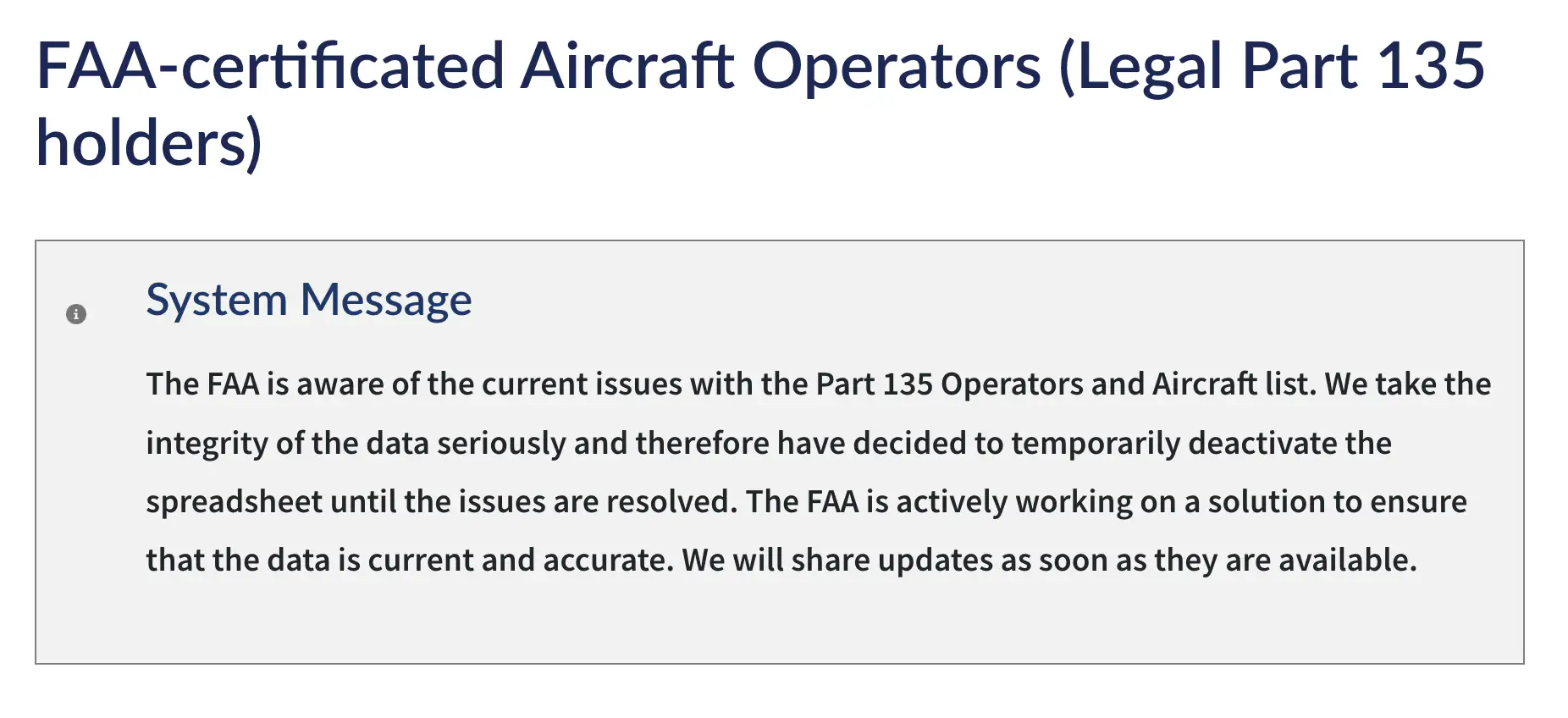
Currently, there is a notice on the FAA page where the list was previously available that states:
‘The FAA is aware of the current issues with the Part 135 Operators and Aircraft list. We take the integrity of the data seriously and, therefore, have decided to temporarily deactivate the spreadsheet until the issues are resolved. The FAA is actively working on a solution to ensure that the data is current and accurate. We will share updates as soon as they are available.’
An FAA spokesperson confirmed the Excel spreadsheet as “our only official list of certificate Part 135 operators.”
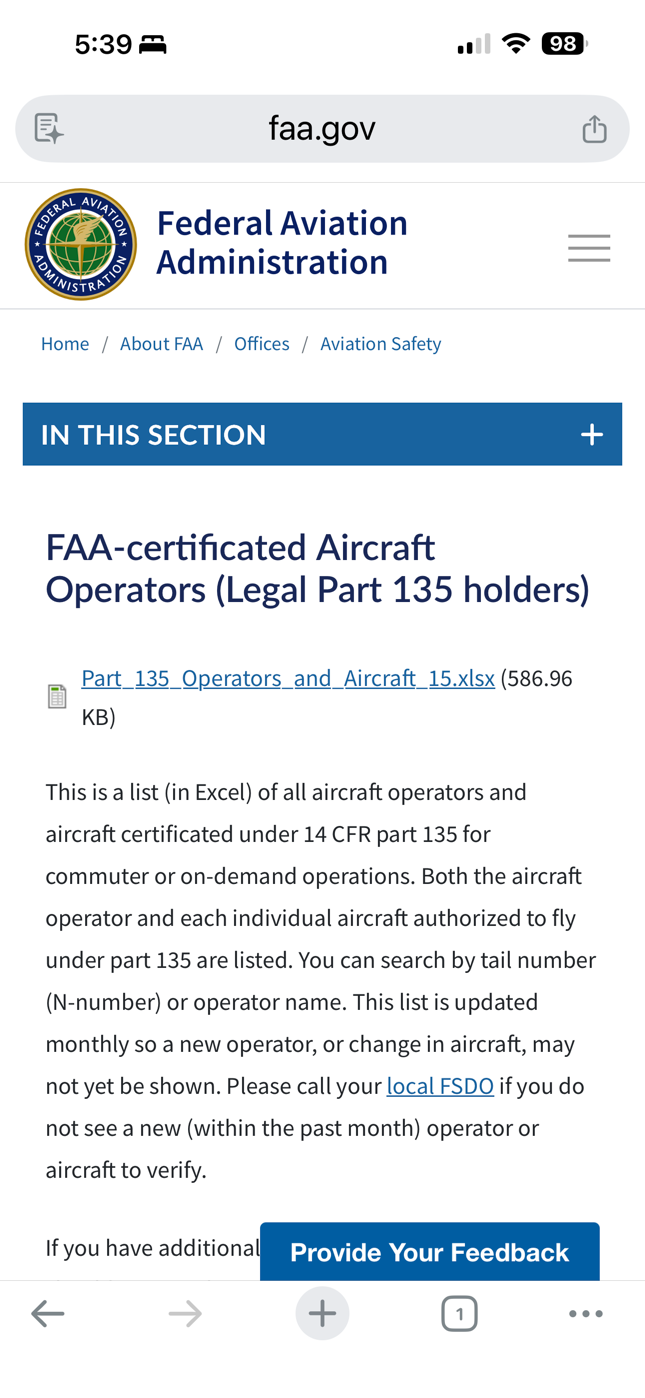
FAA Website Before
![Part 135 operator list]()
The Excel spreadsheet had been updated in the first few days of each month and posted to the FAA website (above).
FAA Website Now
After becoming aware of the continued errors, the FAA decided to pull the public list.
![FAA Part 135 list]()
Last Friday, NATA followed up with an email to members.
NATA said the FAA was working on “a solution to address the discrepancies.”
It noted, “The list is commonly used to look up Part 135 certificate holders and associated aircraft (including by operator name and tail number) as part of charter verification.”
The trade group told members:
‘NATA recognizes the importance of this resource to both the flying public and to legitimate air charter operators; the data it contains must be current and accurate for compliance, consumer awareness, and business decisions.’
In the meantime, NATA is telling consumers and brokers to ask for a copy of the charter operator’s air carrier certificate and confirmation that the aircraft is authorized for charter use before each flight.
NATA says brokers and consumers can also verify that the aircraft and operator are certificated for charter flights by contacting the local FAA field office that oversees the operator.
Why It Matters
An Aviation International News analysis found that between 2010 and 2020, there were no fatal accidents involving U.S.-registered private jets operating under Part 91K, and just three involving Part 135 operations.
By contrast, Part 91 operations accounted for 31 fatal accidents over the 10 years.
The death of former NASCAR driver Greg Biffle in a December crash and the Challenger 650 that crashed last month on takeoff from Bangor, Maine, are recent examples of accidents on jets operating under Part 91 rules.
When it came to turboprops, Part 91K fractional operations again had zero fatal accidents during the decade.
U.S.-registered charter turboprops had 15 fatal accidents.
Part 91 operations accounted for 82 fatal turboprop accidents over the 10 years.
The crashes that killed four people on a night approach to Steamboat Springs aboard an Epic E1000 earlier this month and the crash in Wyoming that killed three members of the gospel group The Nelons in July 2024 were both on turboprops operating under Part 91 rules.
Illegal charter, selling flights by operators or aircraft not certified to do so, has been a large industry focus.
Before the Super Bowl, the FAA issued a warning to consumers about the dangers of illegal charter flights.
The 2019 death of soccer star Emiliano Sala was on an illegal charter flight.