Surf Air Mobility reported annual revenue of $106.6 million for 2025.
That was a decrease 10.8% compared to $119.4 million in 2024.
On-demand charter service revenue, which includes its jet card, increased by 3.1% year-over-year.
Surf Air attributed it to “a shift in mix to larger aircraft and international flights, and the positive impact of BrokerOS on sourcing and broker productivity.”
Overall, it sold 2,929 on-demand charter flights using 440 operators.
Total on-demand flights in 2025 dropped 17% from 3,515 in 2024.
Scheduled service revenue decreased by 15.1%.
The company attributed it to “the impacts of the exit of unprofitable routes, partially offset by improved controllable completion factor, which increased to 98% in the fourth quarter of 2025 from 89% in the fourth quarter of 2024.”
During a call with analysts, CFO Oliver Reeves said, “We are truly pivoting back to growth.”
The company noted that net debt decreased by 47% from $139 million at December 31, 2024, to $74 million at December 31, 2025.
Surf Air Losses
The Net Loss for Surf Air increased by $35.6 million, or 48%, to $110.5 million for the full year 2025.
That is compared to $74.9 million for 2024.
Per the earnings release, “Net loss for both the full year 2025 and the full year 2024 included investment in R&D for technology initiatives, stock-based compensation, transaction costs, and other non-recurring items.”
Technology and development were $10.3 million of operating expense, down from $24.0 million year-over-year for the full year.
Reeves said, “Only a very small portion of its investments are capitalized.”
Full year 2024 results included a $16.7 million net reversal of unearned compensation under the company’s incentive plans.
Adjusted EBITDA loss improved by $2.4 million, or 5%, to $41.7 million for the full year 2025, compared to a $44.1 million loss for the prior year.
Reduced EBITDA Loss
Surf Air said, “The reduction in Adjusted EBITDA Loss reflects the exit of unprofitable routes, the benefits of significant operational improvements, and the positive impact of improved on-demand charter margins.”
Surf Air ended 2025 with $12.7 million in cash, down from $21.1 million.
Deferred revenue, which would include prepaid jet card deposits, was $17.9 million at the end of 2025.
Surf Air cut head count 18% in 2025, ending the year with 573 employees.
Surf Air Q4 2025 Financials
Revenue of $26.4 million for the fourth quarter of 2025 decreased 6% compared to $28.1 million for the same period of the prior year.
Surf Air had guided $25.5 to $27.5 million in Q4 revenues.
On-demand charter service revenue increased by 36% over the comparable period in 2024.
Net loss was $36.9 million for the fourth quarter of 2025.
That compares with a net income of $1.3 million in the prior-year period.
Both the net loss for the fourth quarter of 2025 and the net income for the fourth quarter of 2024 included investment in R&D for technology initiatives, stock-based compensation, transaction costs, and other non-recurring items.
The fourth quarter of 2024 included a $38.9 million reversal of unearned compensation under the company’s incentive plans, per its earnings press release.
Q4 Adjusted EBITDA loss increased by $1.1 million, or 15.9%, to just under $8 million for the fourth quarter of 2025 compared to a loss of $6.9 million for the same period of the prior year.
Surf Air had guided a loss of $8 million to $6.5 million.
CEO Perspective
CEO Deanna White said:
‘2025 was a transformational year for Surf Air Mobility. The strategic investments we made in our operations, software, and capital structure have demonstrated measurable operational and financial improvements. Today, we are no longer resetting. We are pivoting to growth. In 2026, Surf Air Mobility intends to integrate its operational expertise, SurfOS infrastructure, and strategic partnerships into a technology-enabled platform designed to improve efficiency, reliability, and asset productivity across its own operations and the broader aviation ecosystem. Based on confidence in our operational expertise, SurfOS infrastructure, and technology-enabled platform, the company is establishing 2026 revenue guidance 20 to 30 percent above the 2025 results. Building on the operational and financial progress achieved in 2025, the company believes it is well-positioned to expand its technology and platform initiatives to create value for its customers and partners. And we’re intensely focused on turning that position into tangible value for our customers, our partners, and our investors.’
In terms of its private jet brokerage business, Surf Air said it “executed two exclusive wholesale agreements to improve dedicated aircraft capacity, expand margin potential, and provide guaranteed distribution for our operating partners.”
It also launched its Powered by Surf On Demand program.
It’s designed to expand its charter sales by providing BrokerOS software to independent third-party brokers.
Surf Air says it “directed $26 million of strategic financing proceeds toward SurfOS development, go-to-market execution, and enterprise-grade solutions ahead of planned commercialization in 2026.”
It also secured letters of intent and beta agreements with multiple Part 135 charter operators.
Earlier today, Surf Air announced an order for 25 electric aircraft, with options for an additional 75, from Beta Technologies.
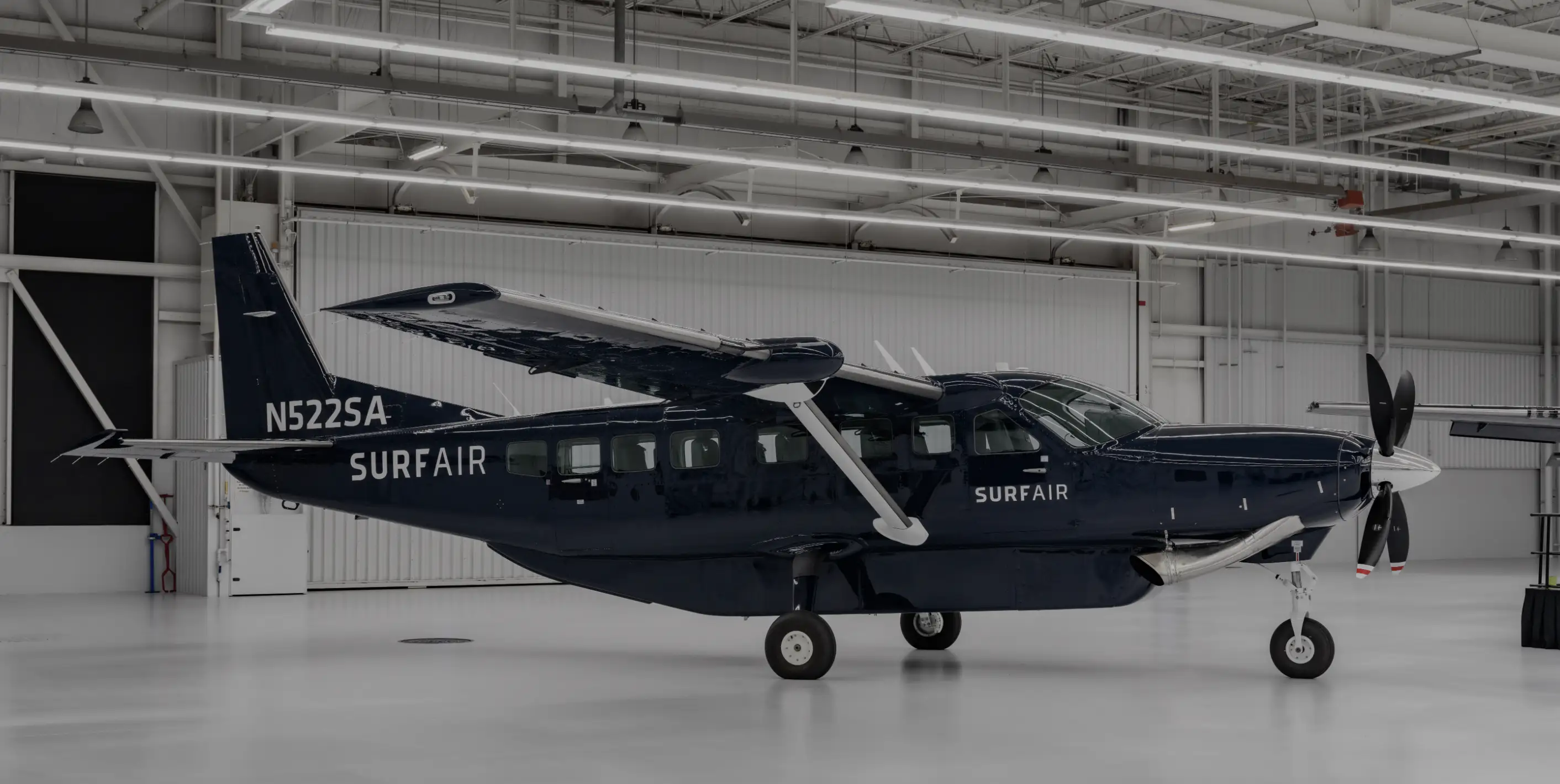
Speaking to analysts, White noted that its Caravan fleet is out of service 25 days per year for required maintenance.
By comparison, she says the electric Beta aircraft will be out of service for only two days per year.
Surf Air 2026 Financial Guidance
Surf Air is guiding revenue in the range of $24 million to $26 million for the first quarter of 2026.
The forecast reflects “an increase in on-demand charter revenue.
It also factors in increasing load factors on scheduled service flights.
Some gains will be offset by “continued revenue impact from the exit of unprofitable routes.”
No revenues from SurfOS are part of the guidance.
It also expects an Adjusted EBITDA loss of $13.5 million to $15.5 million.
That excludes the impact of stock-based compensation, changes in the fair value of financial instruments, and other non-recurring items.
For 2026, Surf Air expects revenue of $128 million to $138 million.
Adjusted EBITDA loss is forecast to be in the range of $50 million to $40 million.
“Our adjusted EBITDA loss guidance reflects significant investment in strategic initiatives, including the continued development and commercial rollout of SurfOS, partially offset by continued efforts to improve the profitability of our scheduled service and on-demand charter businesses,” per the company.
Surf Air continued, “We expect Adjusted EBITDA loss and margins to improve each quarter of 2026, driven by revenue growth and a continued focus on cost management. Adjusted EBITDA excludes the expected impact of stock-based compensation, changes in fair value of financial instruments, and other non-recurring items.”
Surf Air stock ended at $1.80 per share.
The 52-week price ranged between $1.77 to $9.91.
DOWNLOAD: Surf Air 2025 Full Year Financials