Revenues at FlyExclusive increased 9% year-over-year in the first quarter of 2026 to $96.4 million.
Net loss dropped from $23.0 million a year ago to $13.4 million in Q1 2026.
FlyExclusive also continued to report positive Adjusted EBITDA and Adjusted EBITDAR.
Adjusted EBITDA in Q1 was $185,000, up year-over-year from a $6.4 million loss, but down from the $6.6 million positive Adjusted EBITDA in Q4 2025.
Adjusted EBITDAR in Q1 was $4.4 million, up year-over-year from a $1.0 million loss and down from the positive Adjusted EBITDAR of $10.9 million in Q4 2025.
Quarter-to-quarter revenue was down from $104.5 million in Q4 2025.
Improved Reliability
Dispatch Availability, the percent of fleet available for revenue flights, increased by 15% to 57.2%.
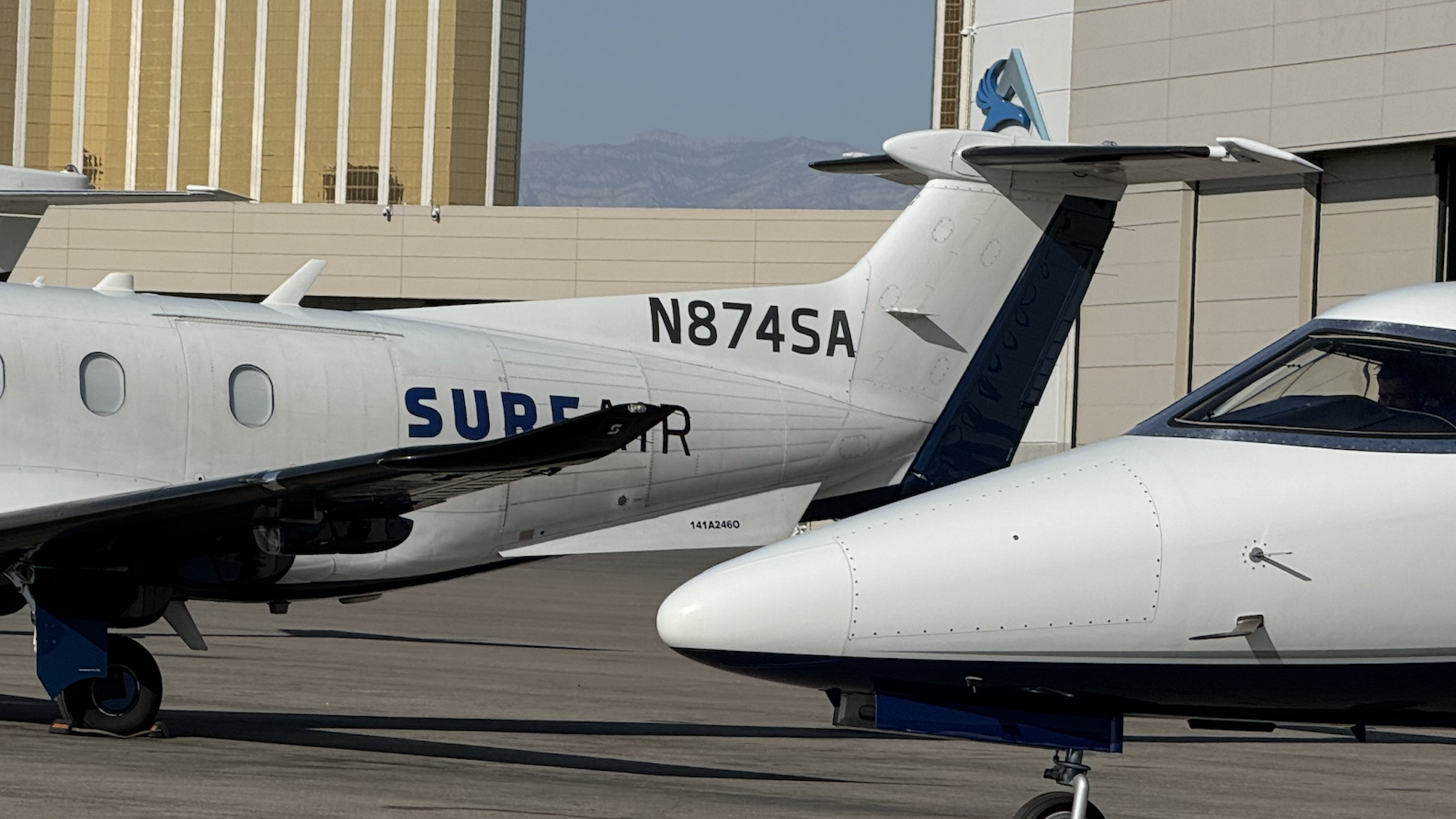
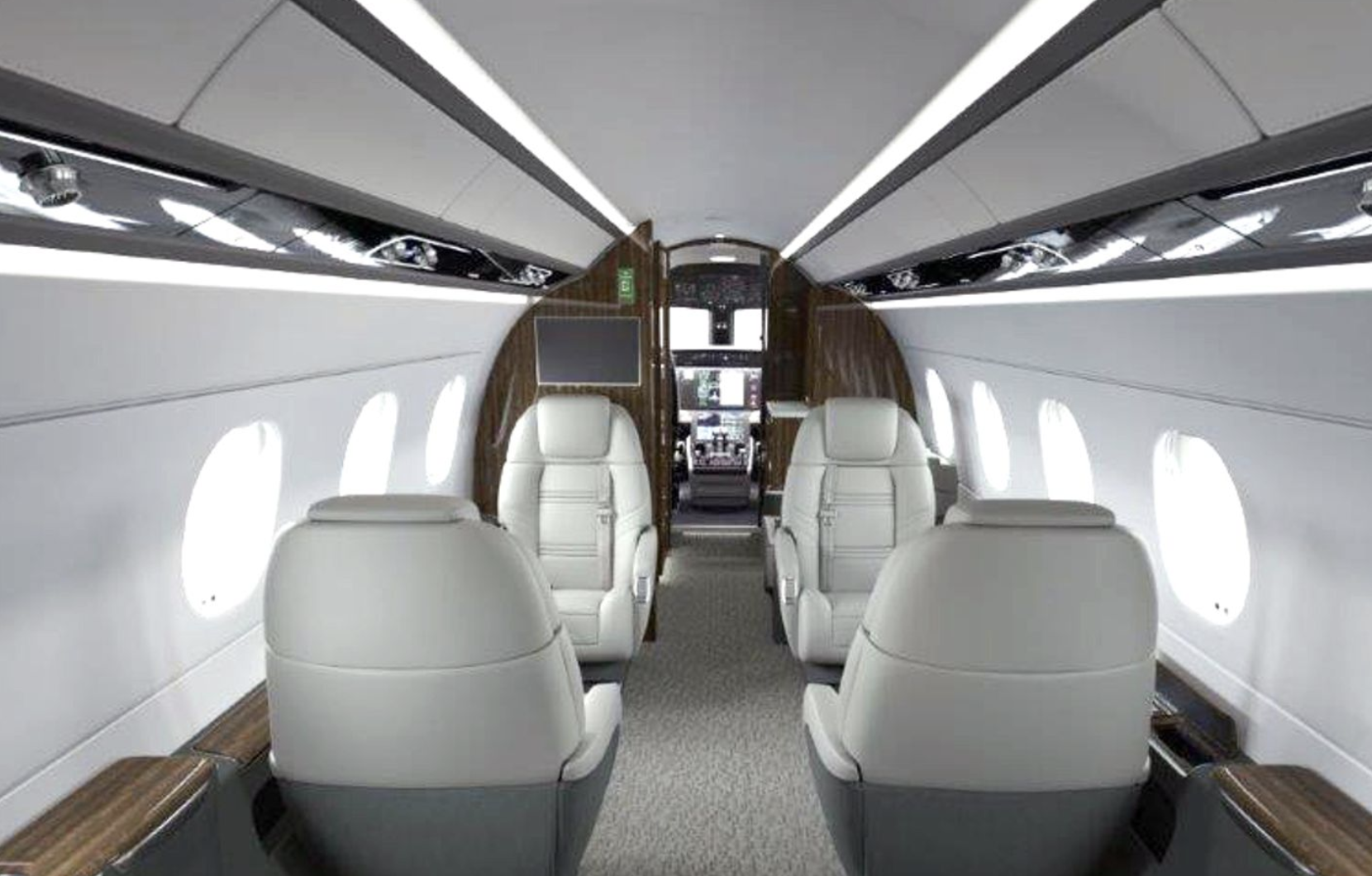
FlyExclusive has been retiring older, less reliable aircraft in favor of new Citation CJ3+ light jets and newer Challenger 350 super-midsize aircraft.
It recently restarted its XLS+ midsize fractional program.
It has also been adding mobile repair units to get airplanes back in service faster.
Each 1% improvement increases monthly revenue contribution by $210,000.
The result was that while aircraft generating revenue dropped year over year by 7%, flight hours in the first quarter were up 7%.
‘Proof of Concept’
FlyExclusive Chairman and CEO Jim Segrave called the results “another important proof of concept point.”
He told an investor call today, “For the better part of two years, I have told the market that we were in the middle of a structural transformation — and that when the transformation was complete, the financial results would reflect it.”
Segrave said, “The first quarter continues to validate that thesis.”
Of the Q1 2026 results, he said, “That result was not accidental, and it was not a function of favorable seasonality.”
He added, “In fact, it was in spite of seasonality as the first quarter is historically the industry’s most challenging.”
Segrave continued, “The company, like the entire aviation industry, was also negatively impacted by multiple major winter weather systems that shut down most of the East Coast for several days each.”
Exceeding Expectations
Segrave said, “Our performance exceeded even our own internal forecast as well as analyst forecasts.”
CFO Brad Garner said Q1 was “the third-largest volume quarter in company history.”
Segrave credited the results to “a more efficient fleet, disciplined operations, and an increasingly high-quality revenue base.”
The CEO added:
‘Long-term debt was reduced by another $10 million in the first quarter, adding to the $86 million total reduction in 2025. The company now operates approximately $522 million dollars of aircraft overall but has reduced the directly owned portion down to $145 million. This, in part, represents our shift to the much more capital-efficient fractionally owned aircraft business. Debt on the directly owned fleet is approximately $112 million, resulting in roughly $33 million of equity in these aircraft.’
Segrave also discussed the fleet transformation.
He told listeners:
‘At the beginning of 2024, we had 37 non-performing aircraft generating operating losses in excess of $3 million per month across the system. As of the end of the first quarter, we reduced that count to just six aircraft, and the aggregate operating loss from those remaining aircraft was less than $250,000 per month. That is a reduction of more than 90% in the financial drag associated with legacy aircraft — and this has been one of the single most consequential operational and financial improvements we have made as a company. By the end of the second quarter, we expect to eliminate three more of these aircraft, cutting the monthly loss to under $100,000.”
He also pointed to new airplanes.
Segrave said:
‘The aircraft we have added to replace those legacy units — primarily Challenger 350s, CJ3s, and XLS+ aircraft — are performing exceptionally well. They fly more reliably and cause less schedule disruptions. They require less unscheduled maintenance. Customers much prefer them. And they generate meaningfully better economics per flight hour than the aircraft they replaced. The quality of our fleet today is categorically, positively different from where we were 18 months ago, and that difference is increasingly evident in our financial results.’
Segrave said unencumbered contribution averages 27% for each CJ3+ and XLS+ it adds to the fleet.
For each Challenger, it is 39%.
“We have now proven our transformation plan will deliver the financial performance we forecasted,” Segrave said.
Evolving Business Mix
FlyExclusive has evolved from its origins in the ad hoc wholesale market to a focus on contracted retail revenue.
Since 2020, contractually committed jet card, partner, and fractional revenues increased from 9% to 49% last year.
Segrave said the change improves revenue predictability.
That “enhances our ability to plan fleet deployment and to schedule maintenance,” he said.
Segrave continued, “It supports pricing discipline – and it builds the kind of long-term customer relationships that are difficult for competitors to replicate.”
He added, “Members contributing to revenue in the first quarter exceeded 1,000 members — marking our eighth consecutive quarter of membership growth.”
Jet Club sales were $25.8 million in Q1, with renewal activity of $16.6 million and new member sales of $9.2 million.
Garner said, “Member retention remains healthy, and new member acquisition trends are consistent with the prior several quarters.”
Segrave said, “That consistency is meaningful. It tells us that the product is working, that customer satisfaction is high, and that word-of-mouth and retention dynamics within the program are operating as we would expect for a premium aviation brand.”
Regarding its fractional program, Segrave said, “Retail fractional share sales increased approximately 47% year over year, with fractional revenue growing approximately 5% on a GAAP basis.”
He noted, “The reinstatement of 100% bonus depreciation has materially accelerated customer interest in fractional ownership, and the pipeline we are seeing for the balance of the year, in part, reflects that dynamic.”
At the same time, Garner called wholesale a “critical utilization maximizer for the fleet.”
2026 Outlook
Looking ahead, Segrave said the “current global environment is, frankly, complex.”
He said, “We have not seen any demand disruption within our customer base.”
Second quarter revenue and flight hours will “significantly exceed Q1 results with “around 15% top line growth quarter-to-quarter.”
Segrave said, “The customers we serve are among the most economically resilient in the world.”
He noted, “Our fractional and Jet Club members are typically ultra-high-net-worth individuals and corporate accounts for whom private aviation represents a productivity tool.”
He called it “a lifestyle priority — not a discretionary expenditure that gets scrutinized in periods of market softness.”
In April, “booking activity, utilization trends, and member engagement have all remained healthy.”
Segrave said, “We do not believe the current environment represents a material headwind to our near-term financial performance.”
FlyExclusive recently implemented fuel surcharges, which Segrave says pass along the direct incremental expense.
The revamp of its jet card last month added language to permit the surcharges.
M&A
Segrave also spoke to M&A.
He said the long-awaited transaction with JetAI is expected to finally close next month.
This includes deposits for three CJ3+ positions with Textron for early 2027 deliveries.
The second tranche of the Volato transaction closed in the first quarter.
It brought the Mission Control scheduling and optimization platform, rebranded as Contrails.
Segrave said:
‘The Contrails platform has the potential to be a meaningful operational differentiator — allowing us to optimize scheduling, improve trip fulfillment rates, and provide network-sharing infrastructure for third-party operators. We receive over 500 trip requests per day, and our ability to fulfill a greater share of those requests is directly tied to our scheduling efficiency and network. We expect to close the final part of the Volato transaction, the Vaunt empty-leg subscription business, over the next quarter.’
FlyExclusive will add around 20 aircraft to its fleet this year.
It will be a combination of CJ3+ light jets, midsize XLS+ jets, and Challenger 350s, according to the executives.
FlyExclusive ATM Facility
FlyExclusive ended the quarter with $18.7 million in cash, down from $29.3 million at the end of 2025.
Deferred Revenue, prepaid jet cards, and fractional share payments were $129.7 million, down sequentially from $135.9 million.
Garner said, “We expect cash to build through the stronger seasonal quarters and as we complete the Jet.AI acquisition in Q2 following the S-4 registration statement being declared effective.”
Garned told listeners, “The operating model is more efficient, the fleet is materially stronger, margins are growing, the quality and predictability of the revenue base continues to strengthen, and liquidity flexibility is improving.”
He added, “On our ATM facility — we currently have approximately $98 million of availability remaining under our at-the-market equity offering program.”
Garner continued, “We view the ATM as a strategic tool that provides optionality and flexibility rather than as a primary source of capital.”
He said, “We have not been aggressive in deploying it, and we intend to continue using it judiciously — specifically to support fleet additions, reduce debt where appropriate, and enhance liquidity if and when the risk-adjusted return on doing so is favorable.”
FlyExclusive is not providing guidance; however, Garner said, “Every quarter of 2026 is expected to outperform the corresponding quarter of 2025 on revenue, adjusted EBITDA, and flight hours.”
He added, “That expectation is grounded in the structural improvements we have already delivered — a more efficient fleet, higher dispatch availability, and stronger utilization per aircraft.”
FLYX ended the day at $2.29.
Its 52-week range has spanned from $1.88 to $8.88.
DOWNLOAD: FlyExclusive Q1 2026 Results