Investors backing Wheels Up, led by Delta Air Lines, have committed to a new $100 million term loan, and the capacity to expand the facility by “an additional $100 million from new or existing investors.”
At the same time, Wheels Up’s reported Q1 2026 EBITDA and EBITDAR losses, despite improvements in operational performance.
Wheels Up CEO George Mattson says the financing will support its fleet refurbishment program and move to modern Embraer light jets and Bombardier super-midsize aircraft.
The transactions, expected to close this quarter, will provide an incremental $165 million in liquidity.
In Q4 of 2025, Wheels Up reported its first positive Adjusted EBITDA and EBITDAR.
Mattson tells Private Jet Card Comparisons that the negative Q1 2026 EBITDA and EBITDAR were expected.
“Q1 is always the weakest quarter…in the airline business, and we expected Q1 to be negative after Q4 was positive, and we also knew it would be the highest point of transitory cost,” he said.
Wheels Up is seeking to move from its origins as a low-cost provider to competing with fractional players in the premium segment of private aviation.
Delta Air Lines has said Wheels Up is a key part of its premium market strategy, which has enabled it to outperform United Airlines and American Airlines over the past decade.
Key points for Wheels Up are a new fleet, increased reliability, and a more flexible suite of solutions that enable it to compete for corporate users effectively.
Mattson said, “Wheels Up is no longer competing on access or price; it is competing on experience, operational reliability, and a product architecture built for how today’s high-value travelers want to fly.”
Q1 2026 Financials
First quarter GAAP revenues for 2026 were $168.9 million, down 5.0% year-over-year.
Gross Loss increased from $1.1 million to $1.9 million year-over-year.
The company said $5 million of that result could be attributed to fleet modernization expenses.
Adjusted Contribution fell 34% to $14.8 million year-over-year.
Adjusted Contribution margin dropped from 12.6% in Q1 2025 and 19.1% in Q4 of last year to 8.7% in the most recent quarter.
Five points of margin variance came from the sale of non-core services businesses, and “transitory inefficiencies from the fleet transition.”
In a letter to investors, Mattson wrote, “Excluding these impacts, underlying margin performance continued to improve meaningfully versus prior years.”
Adjusted EBITDA loss increased from a $24.2 million Q1 2025 loss to a $28.1 loss in Q1 2026.
In Q4 2025, Wheels Up posted its first positive Adjusted EBITDA of $32.9 million.
Adjusted EBITDAR loss in the quarter improved slightly to $18.3 million from a negative $18.8 million year-over-year.
It compared to a positive Adjusted EBITDAR of $36.9 mlllion in Q4 2025.
Net loss was reduced to $82.9 million in the latest quarter from $99.3 million in Q1 2025.
Total Gross Bookings, which include the total value of off-fleet charter flights, were up 10% year-over-year to $267.2 million.
The gross bookings were led by “strong performance in our global charter business and corporate flying.”
Wheels Up Quarterly financials (Last 5 quarters)
| (in millions) |
Q1 2025 |
Q2 2025 |
Q3 2025 |
Q4 2025 |
Q1 2026 |
| TTL Gross Bookings $ |
241.9 |
261.9 |
266.6 |
269.0 |
267.2 |
| Block Sales $ |
133.0 |
127.0 |
127.0 |
188.0 |
NA |
| Revenue $ |
177.5 |
189.6 |
185.4 |
183.8 |
168.9 |
| Gross profit (loss) $ |
(1.1) |
2.2 |
(1.3) |
12.8 |
(1.9) |
| Adjusted Contribution $ |
22.4 |
23.7 |
23.5 |
35.0 |
14.8 |
| Adjusted Contribution Margin |
12.6% |
12.2% |
12.7% |
19.1% |
8.7% |
| Net loss $ |
(99.3) |
(82.3) |
(83.7) |
(28.9) |
(82.9) |
| Adjusted EBITDA $ |
(24.2) |
(29.0) |
(23.2) |
32.9 |
(28.1) |
| Adjusted EBITDAR $ |
(18.8) |
(25.1) |
(19.7) |
36.9 |
(18.3) |
Source: Wheels Up
Cash and cash equivalents were $54.1 million at the end of the quarter, down from $133.9 million at the end of 2025, according to its 10-Q filing.
Deferred Revenue, in part prepaid jet cards, decreased to $687.6 million from $738.9 million, quarter to quarter.
“We expect to meet our liquidity needs for the next 12 months with a combination of cash and cash equivalents, cash flows from operations, strategic dispositions of legacy aircraft assets, proceeds from borrowings under the Proposed 2026 Term Loan expected to be provided by the Lead Lenders and, depending on market conditions, sales of shares of Common Stock under the ATM Program or other debt or equity financings,” according to the 10-Q.
(The full Wheels Up 10-Q filing can be downloaded at the bottom of this report.)
Last month, Wheels Up completed its second reverse stock split.
The move puts it back in compliance with NYSE rules requiring a sustained price above one dollar.
UP closed today at $5.15, down from $7.99 after the 20-to-1 reverse split.
About 90% of shares are held by Delta Air Lines and key investing partners.
READ: Why Wall Street Loves Private Jets
Wheels Up Turnaround
Mattson, a longtime Delta Air Lines board member before joining Wheels Up, has been trying to steer a turnaround since arriving in October 2023.
Mattson’s 2023 arrival followed a $500 million investment led by Delta Air Lines that staved off a likely bankruptcy.
Wheels Up’s fortunes wobbled following its 2021 SPAC IPO.
It struggled to integrate multiple acquisitions that brought multiple aircraft types, pilot certifications, and operating certificates during the COVID-led demand spike and simultaneous restrictions.
Mattson says the 2023 investment did not include the fleet renewal.
He said, “The continued backing of our lead investor group – led by Delta Air Lines – along with the additional new support from AIP Capital, provides the investment capital needed to execute our growth plan and reflects confidence in the progress we’re making to build a strong and sustainable business.”
He called the first quarter “a clear inflection point for Wheels Up, as we completed the transition from our legacy programs and fleet to our Signature Program supported by a premium jet fleet comprised exclusively of the most in-demand and efficient aircraft in the industry.”
Mattson says extra costs included pilot re-training.
He also noted the fleet transition meant increasing from four jet fleets to six at sub-optimal levels before narrowing to the current two.
Last year, the company announced a plan to cut at least $70 million in annual cash cost savings.
Fleet Renewal
Last month, Wheels Up said it had retired or sold the last of its legacy jet fleet 18 months earlier than scheduled.
That included aging Citation Xs and Hawker 400XPs.
Midsize Citation Excel jets exited last year.
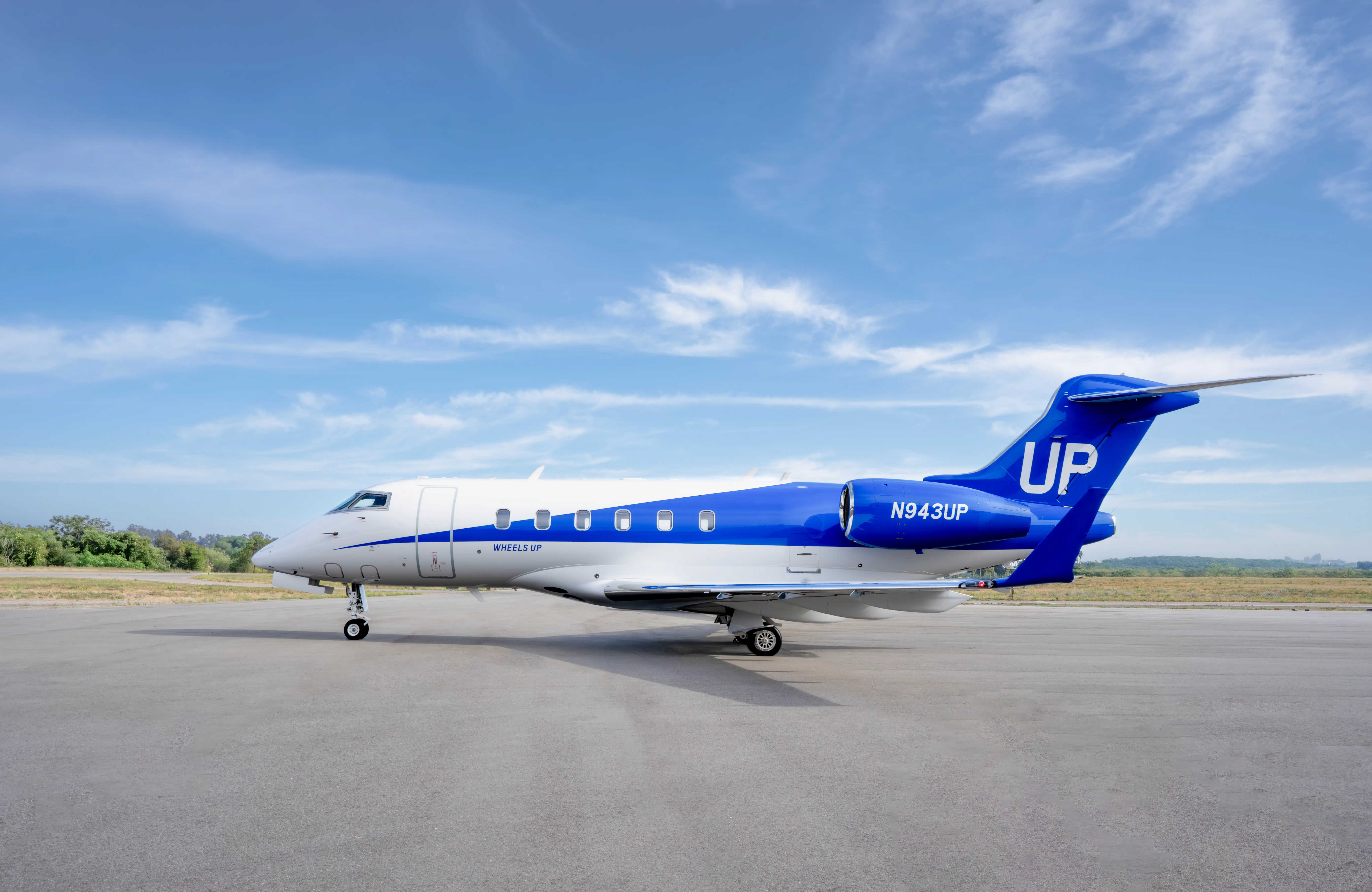
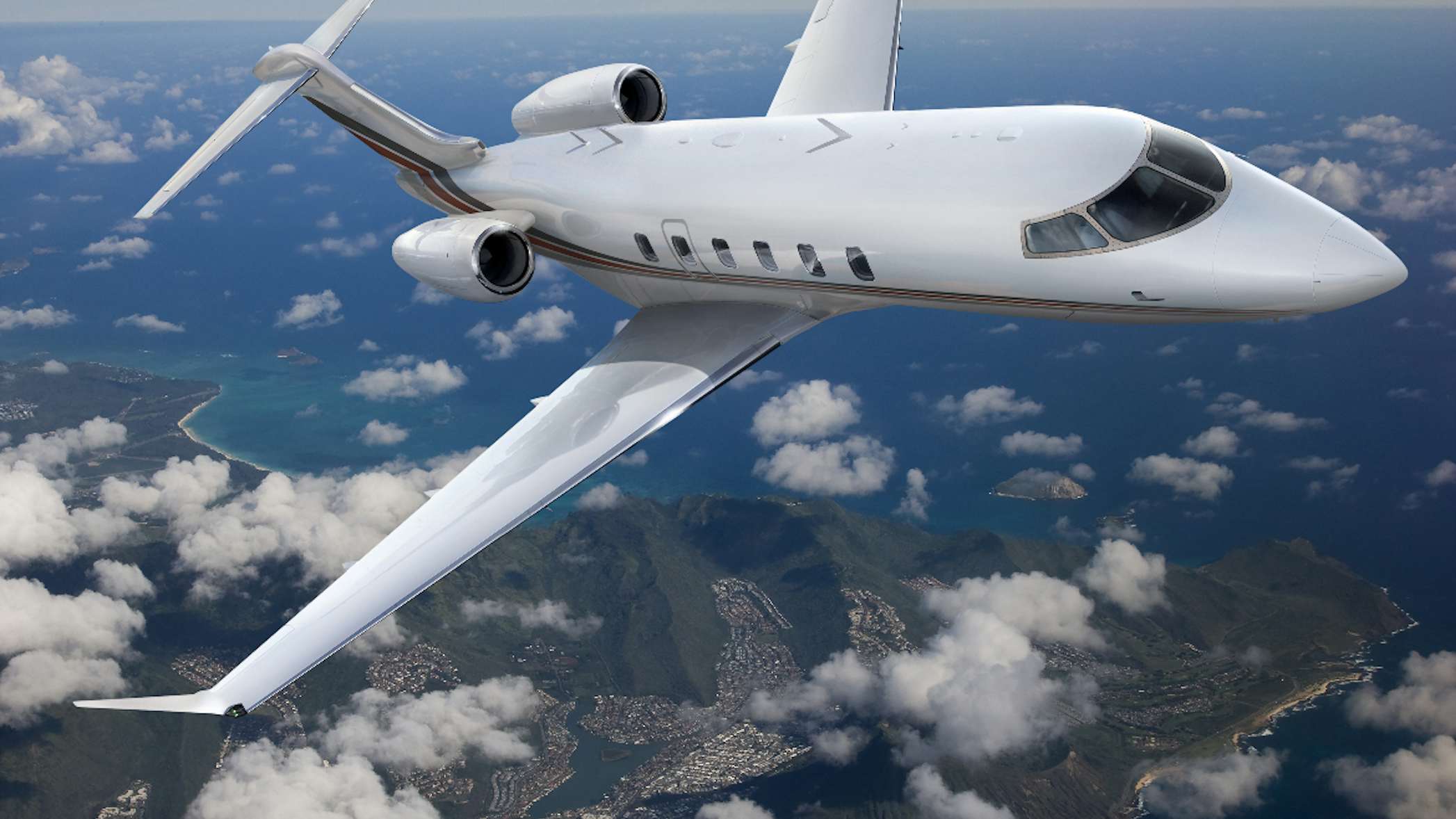
Embraer’s top-selling light jet, the Phenom 300, was selected to replace legacy light and midsize jet types.
Challenger 300s were tapped to replace the Citation Xs.
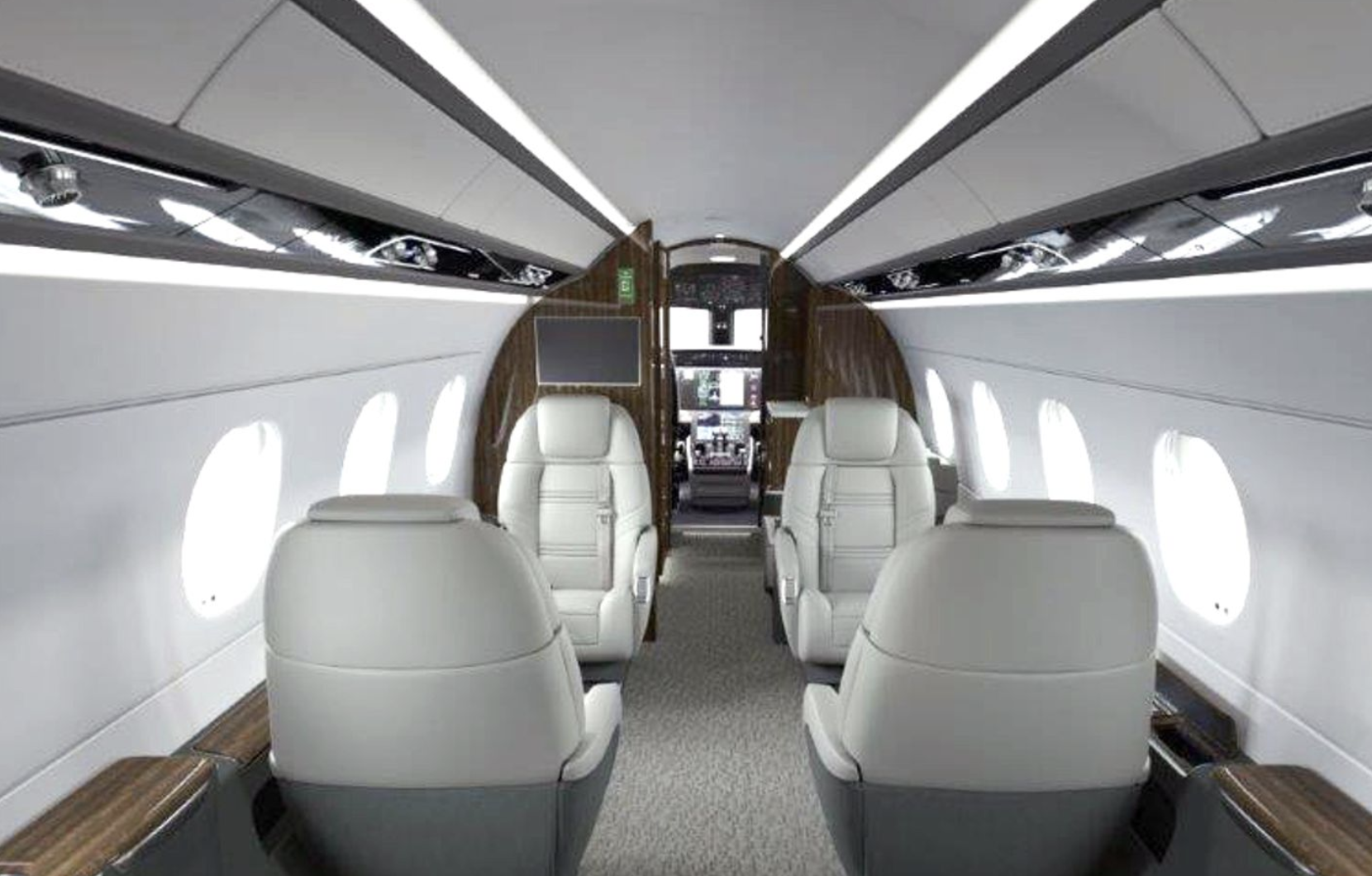
The Bombardier super-midsize jet offers a stand-up cabin.
Mattson says, “People who get on our new aircraft can’t believe it’s a Wheels Up airplane.”
Revenue from the Phenoms and Challengers “more than doubled” year-over-year as the fleet of newer airplanes grew from 21 to 36 at quarter’s end.
In March, Wheels Up said it plans significant fleet growth of Phenoms and Challengers in 2026.
Overall, live flight legs in Q1 2026 dropped 28% to 7,793 from 10,895 in Q1 2025 as a result of the aircraft retirements.
Wheels Up finished 2025 as the fourth-largest U.S. operator based on fractional and charter flight hours.
READ: Private Aviation Deal Book M&A Activity
Delta and Wheels Up
Wheels Up is also getting backing from perhaps its most important constituent, Delta Air Lines CEO Ed Bastian, who has been an ardent supporter of the private jet company.
Delta is the largest shareholder in Wheels Up.
It currently holds a 36% stake in the private jet company.
Delta has been a significant owner since its 2019 deal to sell Delta Private Jets to Wheels Up.
It also has equity investments in Air France-KLM, China Eastern, Grupo Aeromexico, Hanjin Korean Air, LATAM, and WestJet.
Bastian said, “Since our strategic investment in 2023, the Wheels Up team has driven operational excellence, transformed its offering, strengthened the foundation of the company, and set the stage to accelerate their progress.”
Bastian continued, “With their fleet transition complete 18 months ahead of schedule, the company’s momentum continues to build, and this new financing reflects our confidence in the path ahead for our partnership.”
Premium Revenue
Bastian has emphasized private aviation as a key part of the airline’s premium product offering.
Delta’s premium revenue increased from $10 billion in 2014 to $19 billion in 2023 and to $22 billion last year, according to a March presentation at the J.P. Morgan Industrials Conference.
Apparently, American Airlines has now taken an interest in private aviation.
Last month, it added TLC Jet as a partner in its AAdvantage loyalty program.
Wheels Up and Delta have been working closely together to sell private aviation to Delta’s corporate accounts.
Mattson says corporate sales remain the strongest growth segment for Wheels Up.
Wheels Up has also targeted premium Delta One customers for private jet charters via targeted marketing.
There is also Wheels Up marketing in Delta lounges and gate areas.
90% of Private Jet Card Comparisons subscribers say they switch back and forth between airlines and private jets primarily for time savings.
Mattson said that despite uncertainty in the broader economy and concerns about corporate profits, Wheels Up is not seeing any headwinds from customers.
Operational Improvement
On the operations side, Wheels Up reported a Q1 Completion Rate of 98.9% year-over-year.
That was up two points.
On-time departure, which measures from takeoff and includes a 60-minute buffer for late-arriving clients, improved to 91.8%, up from 85.9%.
Flights delayed by more than three hours fell 60% to just 2% from 5%.
There were 68 days year to date with perfect completion and no cancellations.
The so-called Brand Days increased sequentially from 4 to 14, 24, 31, and 44 over the past five financial quarters.
Mattson said, “With the operational complexity of that transition largely behind us, we are increasingly focused on driving consistency, efficiency, and scalable growth across the business.”
He continued, “As we exit the fleet transition phase of our transformation journey more than a year ahead of schedule, we see meaningful opportunities to drive profitable growth through top-line demand supported by operational efficiency, while we continue to invest in an exceptional customer experience, and scale the benefits we are realizing through our one-of-a-kind strategic partnership with Delta Air Lines.”
With its new Signature jet card program alongside its new fleet, Wheels Up is hoping to tap corporations and business flyers as a fractional alternative.
Introduced last September, Signature offers nationwide fixed hourly rates and dynamic pricing options.
So far, there are 844 Signature members, equaling one-third of its current membership base.
Since selling 65 Signature memberships in September, Wheels Up has seen monthly sales of 33, 179, 237, 78, 73, 108, and 71 memberships through April 2026.
In March, Wheels Up ended sales of its legacy jet card program.
In December, it ended the sale of its guaranteed rate King Air program, the launchpad for the company in 2013.
DOWNLOAD: Wheels Up Q1 2026 Financials