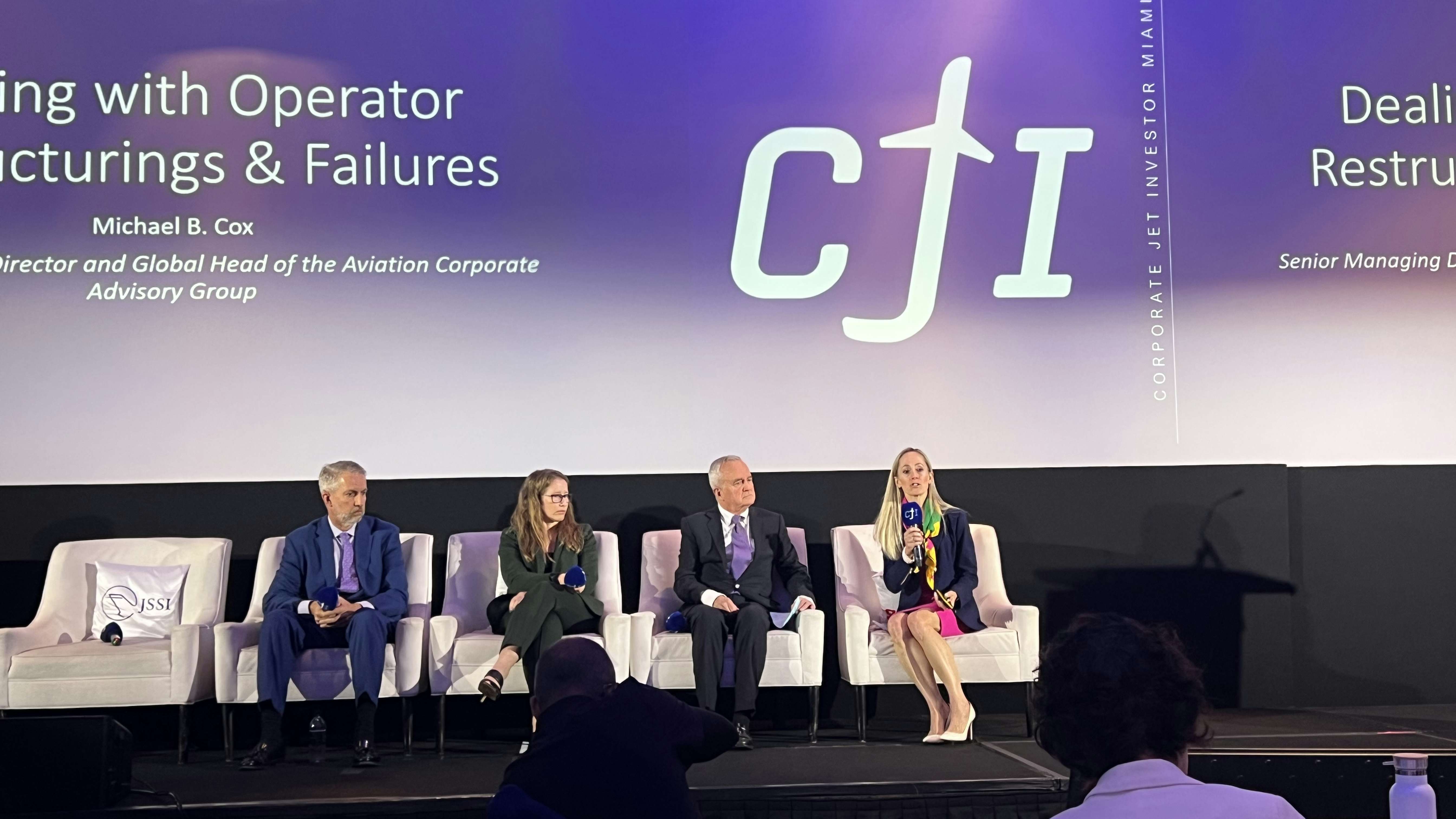
Is private aviation entering a golden age, or is the industry setting itself up for another correction?
Industry leaders, speaking at Corporate Jet Investor Miami, debated that question and pointed to unprecedented wealth creation, strong aircraft order backlogs, and the expansion of fractional ownership as reasons for optimism.
However, they also warned that inadequate infrastructure, supply chain constraints, rising aircraft costs, and geopolitical uncertainty could eventually interrupt the industry’s growth.
John King, who helped build Solairus Aviation into a behemoth in aircraft management, believes the industry is enjoying a particularly favorable period.
“I think we live in the golden age,” King said, pointing to expanding wealth in the United States and other markets.
Business cycles
King, who has experienced multiple industry cycles, cautioned that exuberance inevitably gives way to downturns.
He believes those cycles are becoming shorter, with market conditions changing more rapidly than in previous decades.
Sean Vick of AE Industrial Partners also sees sustained growth, potentially extending another four or five years, but warned that a single geopolitical event could change the outlook.
Vick identified infrastructure as a significant obstacle.
The industry lacks sufficient hangars, maintenance capacity, and airport infrastructure, while the air traffic control system struggles to keep pace with demand.
He also pointed to the supply chain, where small companies manufacturing critical components can delay aircraft deliveries when production problems arise.
Vick believes artificial intelligence could eventually improve efficiency across the aviation ecosystem, including maintenance, supply chains and customer service.
Fractional ownership
Fractional ownership reshapes the market.
Perhaps the most significant structural change is the growing role of fractional ownership.
King called the expansion of fractional programs one of the industry’s biggest recent shifts, although he questioned whether the market would eventually return to historical norms.
Brent Monroe of Aero Ventures, a sister company of fractional start-up Bond, said fractional operators accounted for about one in five business aircraft deliveries in the first half of 2026.
He added that fractional providers represent approximately 18% of manufacturers’ aircraft backlogs.
That compares with approximately 13% of backlogs in 2009, when fractional operators accounted for only about 2% of deliveries.
Vick believes the largest fractional providers have reached the scale needed to run sustainable businesses.
He said customers increasingly want an asset-light solution that eliminates the complexity of managing aircraft while providing reliable access to private transportation.
The ability to arrange flights without managing crews, maintenance or scheduling represents a compelling proposition for wealthy travelers.
However, Vick questioned whether the market has room for numerous additional fractional providers, given the capital required to establish operations and guarantee availability.
King said fractional ownership also complements whole aircraft ownership.
He estimated that 15% to 20% of Solairus customers might hold fractional shares, although he emphasized that he did not have an exact figure.
Owners use those shares when their aircraft undergo maintenance or cannot accommodate a particular mission.
Scale and consolidation
Consolidation represents another important industry trend.
King said smaller operators face increasing difficulty competing against larger companies that can spread costs across bigger fleets.
He recalled believing Solairus would achieve attractive economics with 35 aircraft, only to discover that the company needed considerably greater scale.
King said operations began improving around 50 aircraft.
Nevertheless, he emphasized that growth must improve customer service rather than increase fleet size.
Vick expects further consolidation, particularly among suppliers, where fragmented production networks create vulnerabilities.
He also sees challenges for new fractional entrants competing against established providers such as NetJets and Flexjet.
Meanwhile, aircraft prices have increased dramatically, raising the financial stakes for operators and owners.
Luxury or necessity?
Despite concerns about weakness in the broader luxury market, panelists argued that private aviation enjoys a different demand profile.
Vick said some customers undoubtedly consider private flying a luxury, but most view it as an essential business tool that saves time and improves productivity.
Monroe pointed to a widening imbalance between aircraft supply and the number of wealthy individuals who can afford private aviation.
He said manufacturers delivered approximately 1,300 business jets in 2008, compared with roughly 850 last year, even as the global billionaire population expanded substantially.
That imbalance could help support demand through future economic downturns.
Still, the executives did not dismiss the possibility of a significant correction.
Vick predicted a deep downturn eventually, although he declined to speculate about its timing.
King similarly acknowledged that market conditions could change almost overnight.
For now, however, the combination of wealth creation, fractional expansion and growing demand for convenient private transportation gives the industry reasons to remain optimistic.
The unanswered question is whether infrastructure, aircraft manufacturers, and operators can keep pace with that demand before the next economic cycle arrives.