New research shows that higher prices remain the top reason jet card and fractional ownership flyers are considering switching suppliers.
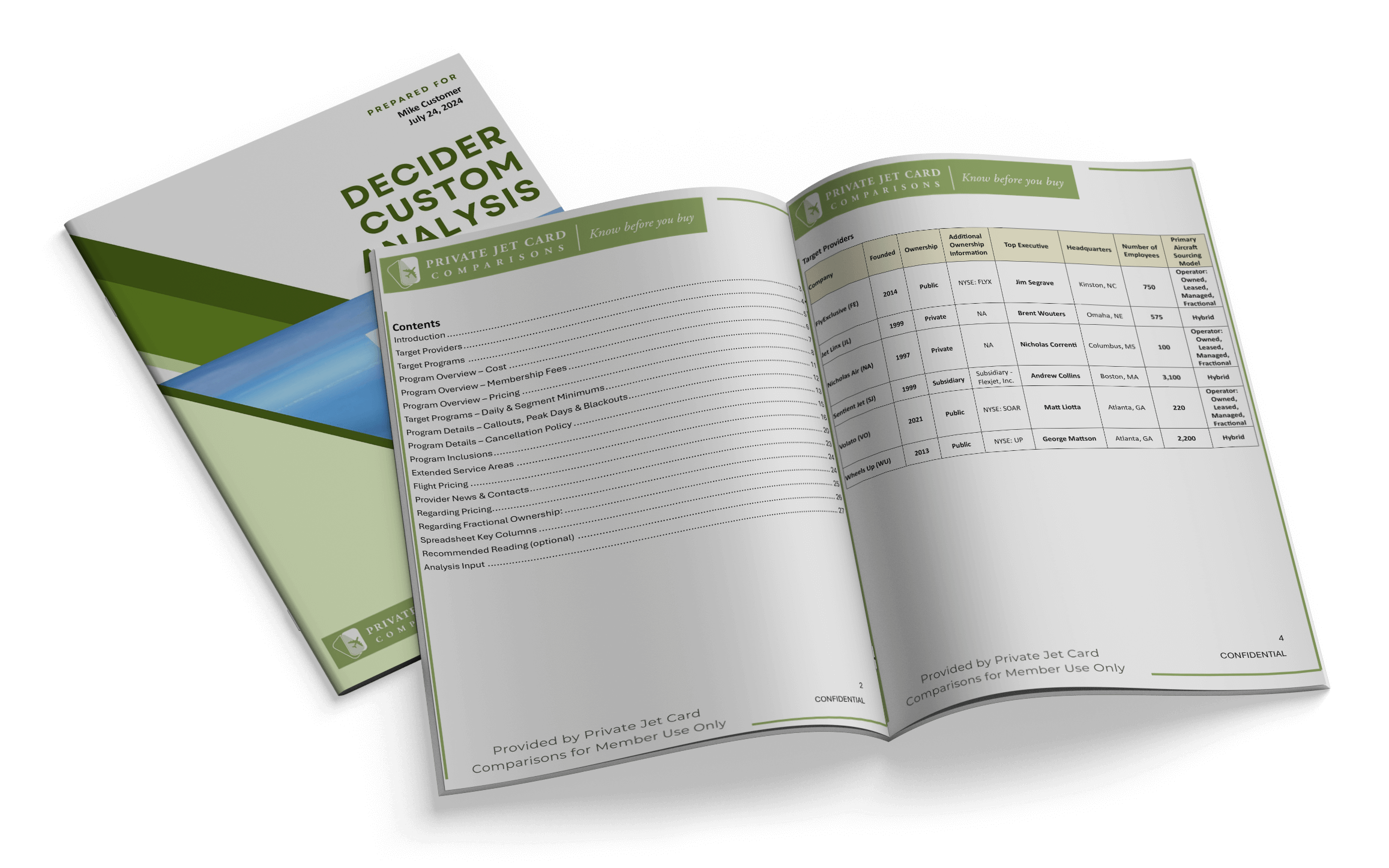
That’s according to the 2025/26 Edition of The Jet Card Report by Private Jet Card Comparisons.
Over 540 subscribers of Private Jet Card Comparisons completed the annual survey.
More than one in five are in fractional ownership programs.
Nearly 70% are members of jet card programs.
Some 44.2% charter ad hoc, 10.1% own their own jets, 9.5% use by-the-seat and jet-sharing services, and 2.7% use private aviation from their company, where they are not an owner.
Nearly a quarter (22.3%) catch rides on friends’ private jets.
The research reflects that many private flyers have more than one solution.
In fact, 55.1% of aircraft owners use jet cards for supplemental lift.
READ: Websites, online groups offer cheap private jet seats. Is it legal?
Switching Providers
Respondents were asked if they were considering switching providers.
Thirty-eight percent (38.0%) said they were.
That’s down from 41.9% in 2024.
It’s also a significant drop from 2023, when 55.2% of respondents said they were considering making a change.
Compared to two years ago, 31.3% fewer subscribers said they were likely to switch.
Fractional customers were less likely to be considering a change.
Just over a quarter (25.7%) of fractional ownership respondents said they were looking at a change.
However, that number more likely reflects the typical five-year duration of fractional contracts.
Jet cards are usually sold in increments of 25 hours or $100,000, making them easier to exit.
Subscribers who reported service issues —including delays and cancellations—over the previous 12 months were significantly more likely to be considering a change.
Over half (55.3%) of respondents who had issues said they were considering changing private jet flight providers.
The difference underscores how providers’ responses to letdowns can significantly impact customer retention.
READ: Comparing the 5 ways to fly by private jet
Reasons To Change
Respondents were asked for the reasons most impacting their decision to seek another private aviation provider.
Respondents cited price increases as the top reason for considering a change.
57.2% listed increased prices as the top reason.
That was down from 64.5% last year.
Private Jet Card Comparisons’ quarterly tracker of jet card pricing shows that hourly rates are 27.1% higher than in Q4 2019, before the pandemic.
However, they are 33.9% higher than Q4 2020, when the CARES Act waived the 7.5% Federal Excise Tax.
The second to switch was Flight Delays, Cancelations, Changes at 26.8%.
While up slightly from last year (24.3%), it was down from 37.4% in 2023.
Financial viability remains a key concern, with 21.1% citing it as a reason to consider other providers.
That was up from 17.8% last year.
However, financial concerns were provider-dependent.
For example, for NetJets flyers, it was a non-issue, with no respondents citing it as a reason for switching.
Back to the overall respondents.
Declining Customer Service (18.6%), Poor/Dirty Condition of Aircraft Cabins (18.0%), Too Many Peak Days/Blackouts (16.5%), Poor Communication When Something Goes Wrong (14.4%), Changes To PSA Contracted Rate Area (11.9%), Fuel Surcharges (11.3%), Longer Callouts (7.7%), Billing Errors (7.2%), Higher Peak Day Surcharges (5.7%), and Longer Daily/Segment Minimums (5.2%) were reasons cited by at least 5% of respondents.
Again, the reasons for changing varied by provider.
Using NetJets as an example again, while it doesn’t have financial viability issues, 38.7% of respondents cited too many peak days and blackouts as reasons for considering a switch.
Its jet cards currently have 90 peak days or blackouts. The current average for jet cards is 36.5.
For the Berkshire Hathaway unit, the peak days and blackouts were second only to higher prices as a reason to move along.
Overall Satisfaction
In some good news, 82.5% of respondents rated their providers Excellent or Very Good.
That continued a three-year upward trend from 2022, when only 61.7% of subscribers gave their providers a top rating.
If you add in the Average ratings, 94.1% of respondents checked Excellent, Very Good, or Average.
In fact, 1.6% said it was Too Soon To Tell.
So only 4.3% of subscribers said their providers were Below Average or Poor.
The two most prominent players in the market scored the best.
Flexjet (97.3%) and NetJets (95.2%) were rated Excellent or Very Good by customers.
While there is often debate between fleet operators and broker or hybrid programs (which use in-house fleets and third-party operators), two hybrid programs also scored very high Excellent/Very Good ratings.
Jets.com (86.4%) and Sentient Jet (86.3%), which both use third-party operators and in-house fleets — what we describe as hybrid programs — finished in a dead heat in Excellent/Very Good ratings.
Private Jet User Research
It’s important to note that the subscriber survey portion has a +/-3% margin of error for the 546 responses overall.
That means, for individual providers, there would be more variation if a few more respondents had answered differently.
So, we will quote Mark Twain, who said about using numbers to bolster weak arguments, “Lies, damned lies, and statistics.”
The annual research also includes what subscribers want during the buying process.
A total of 671 subscribers requested an analysis for the period from September 2024 through August 2025.
The annual subscriber survey was conducted from July through September 2025.
Research covers ad hoc charter users, jet-sharing, and by-the-seat private aviation, as well as what flyers want, including cabin categories and amenities such as WiFi and pet travel.
The full table of contents is here.