December 13, 2025
Craft’s Bombardier Challenger super-midsize fleet will provide the foundation for a play allowing private aviation access in an exchange fund.
Miami-based Craft Charter is moving from a wholesale-focused charter operator to a consumer model inspired by a century-old investment strategy in an exchange fund that its executives say offers tax-deferral benefits—and access to private aviation.
Founder and CEO Israel Slodowitz says of a half-dozen initial customers who each put up over $1 million, half have yet even to take a flight.
That, he says, is because the Craft Aviation Exchange Fund is a financial product strategy.
Cost-efficient access to private aviation is a byproduct.
The 29-year-old says he first got the idea while attending the University of Southern California’s Marshall School of Business.
Navigating the challenges of private aviation shouldn’t cause any gray hairs for Slodowitz.
His LinkedIn bio shows a stint as a combat soldier in the Israel Defense Forces.
He specialized in finding and dismantling improvised explosive devices and landmines.
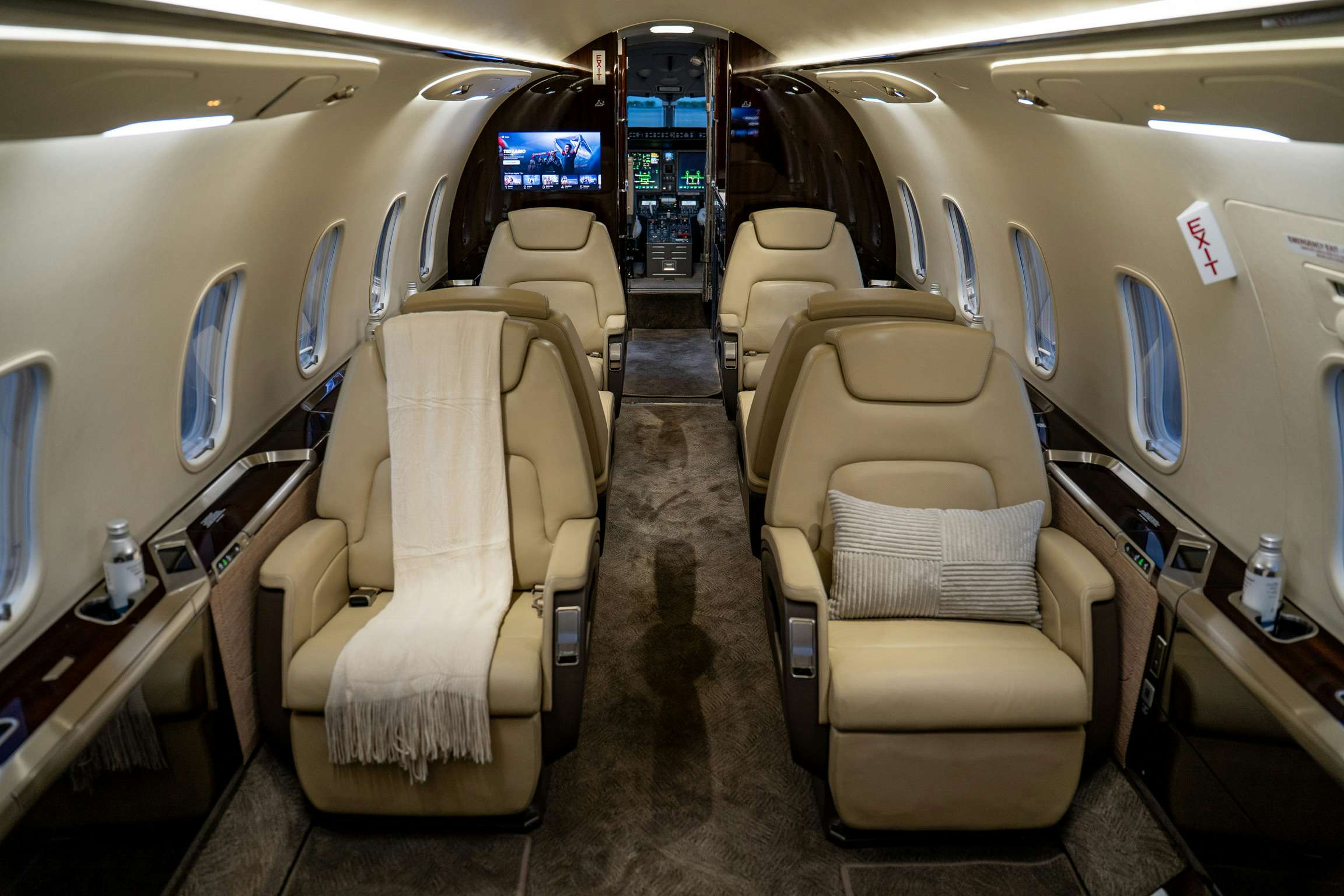
Since 2020, he has been the owner of the Opa Locka-based Part 135 operator, where his current fleet of three Challenger 300s all feature renovated cabins, high-speed Starlink Wi-Fi, and Apple TV.
Craft Charter, he says, has provided a supplement lift for leading fractional operators.
It is also a provider for jet card programs that offer premium super-midsize access.
And its primary business, he says, has been on-demand charter in the wholesale market via brokers.
Since 2020, Craft has flown over 45,000 hours.
The company has flown the sitting POTUS, former U.S. presidents, British royalty, and leading musicians, including Justin Bieber and Ed Sheeran.
The new guaranteed-rate, guaranteed-availability product sits between jet cards and fractional ownership.
Slodowitz says it won’t replace the wholesale business.
In fact, part of the proposition is that customers will likely underfly their annual usage rights.
Typically, fractional share owners fly around 95% of their allocated hours.
That means providers need to invest in a core fleet to handle when owner demand exceeds the fractional fleet.
Availablity and rates aren’t guaranteed on peak days, which range from 9 to 20 days.
The number of peak dates—and hourly rates—decreases the more you put into the fund.
The entry point is currently $1.5 million, which allows you to fly up to 25 hours per year.
You pay a one-time initiation fee of $50,000.
There is an annual management fee of 1.5% of your contribution, based on its current value, and it is calculated quarterly.
That means at the start $22,500 on $1.5 million.
The idea is that the fund appreciates over time.
The hourly rate for the Challenger 300 series is $8,950 plus FET, with no repositioning costs within the Continental U.S.
At $5 million, the hourly rate falls to $6,450, plus FET.
Repositioning to the nearest customs port applies to flights to Canada, Mexico, the Caribbean, Central, and Northern South America.
Hawaii charges are back to the U.S. West Coast.
Daily minimums are just 60 minutes, including taxi time.
Craft Charter LLC manages aircraft owned by the fund and receives 10% of all charter revenue.
The fund you are invested in charges a 1.5% fee on the funds it manages.
Former Wheels Up executive Sam Meyer, head of sales, says the concept is getting a warm reception from wealth advisors who can use the product as part of their financial planning for HNW clients.
20% of the fund must be used for aircraft ownership.
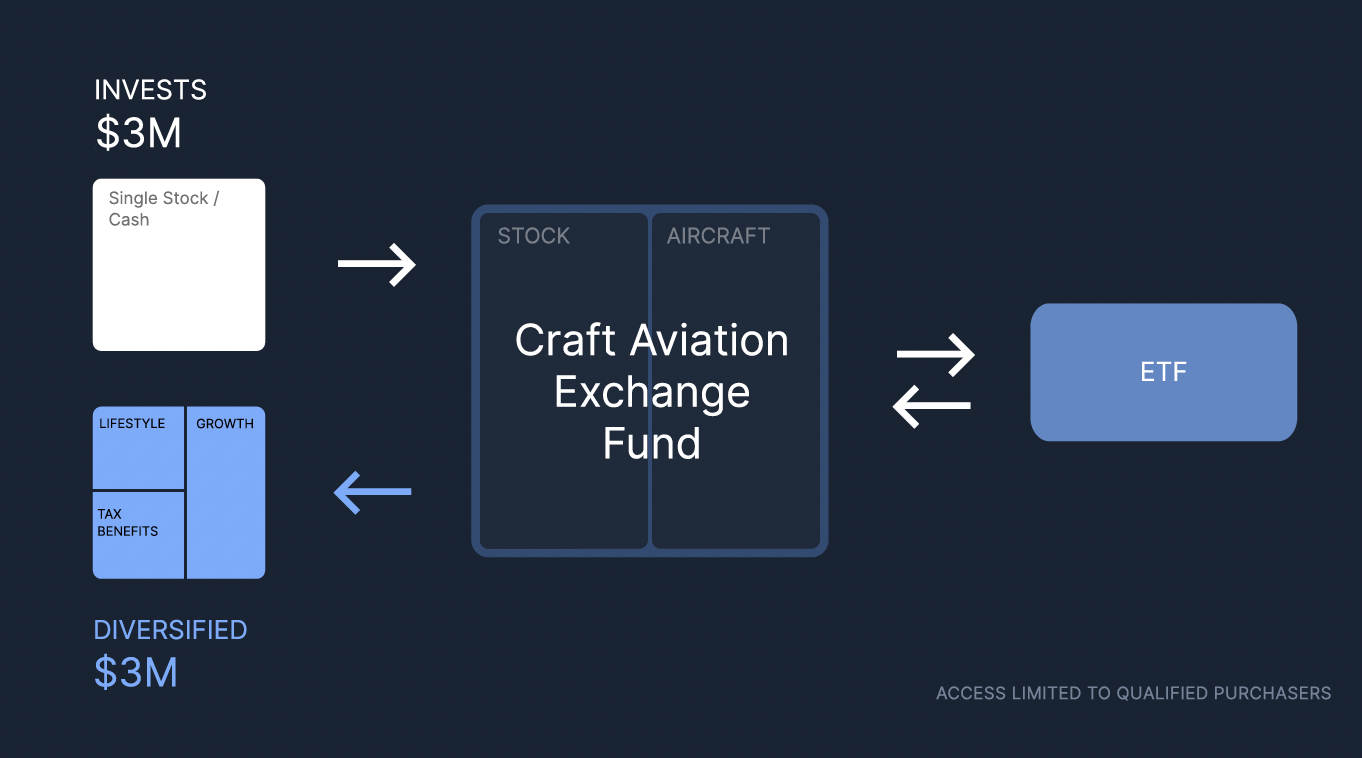
Joiners can contribute stock, airpalnes, or cash to the fund.
There is a seven-year commitment.
Per the sales pitch:
‘Historically, high-net-worth individuals have faced two separate challenges: the tax burden of diversifying concentrated stock positions and the capital inefficiency of accessing private aviation through fractional ownership, charter, or jet cards.’
At the end of the seven years, you receive “a diversified mix of stock and ETF shares.”
The structure is a 721 exchange.
To be more specific:
Craft Exchange Pod – Glidepath, LLC is a Delaware limited liability company and is classified as a partnership for tax purposes. The Pod was formed as an aviation-focused exchange fund, with an objective to qualify under Section 721 of the Internal Revenue Code, as amended, which permits holders of property to defer the recognition of a taxable gain or a loss when they contribute such property to a partnership, subject to the satisfaction of certain conditions. A key condition for such tax treatment is that the partnership is not deemed to be an investment company, which can be accomplished by ensuring that more 20% of the value of the assets in the partnership consist of assets that are not readily marketable securities.
There is a penalty of at least 30% for early exit.
Slodowitz says the fund employs a variety of common risk mitigation strategies to manage market volatility.
Meyer adds that the current rates are likely to change in 2026.


Find the perfect solution for your private aviation needs
Save Time. Buy Confidently.
Receive an apples-to-apples comparison of programs that meet your needs from more than 500 jet card and fractional options covering 65 points of differentiation and over 40,000 data points.