An analysis of 2026 jet card sales from OneFlight International, based on documents reviewed by Private Jet Card Comparisons, shows the company took in $226 million in jet card-related cash through early September.
However, it also issued $176 million in flight credits, bonuses, and other discounts, including waived membership fees.
Combined, those transactions created a liability for future flights of around $400 million.
That does not include obligations from existing balances entering this year.
In other words, the jet card broker gave out discounts and bonuses equivalent to 77.9% of the cash it took in.
Typical jet card deals give one free hour for every 25 hours, a 4% bonus, while 10-15% bonuses are considered generous.
Everybody gets a deal
OneFlight officials positioned the jet card deals as limited loss leaders designed to attract new customers; however, an analysis of over 1,300 transactions from 2026 tells another story.
41% of the transactions came with bonuses or credits so large the deal was 100% or greater than the cash OneFlight received.
64% of transactions included bonuses or discounts equivalent to at least 50% of the jet card cash received.
OneFlight Jet Card Sales and Bonus Credits
| Period |
Jet Card Cash Received |
Jet Card Bonus Credits |
Total Cash and Credits |
Credits, Discounts, Waivers as a % of Cash Deposits |
| January |
$ 21,868,875.00 |
$ 17,252,625.00 |
$ 39,121,500.00 |
78.9% |
| February |
$ 16,609,500.00 |
$ 9,342,600.00 |
$ 25,952,100.00 |
56.2% |
| March |
$ 26,852,500.00 |
$ 19,730,350.00 |
$ 46,582,850.00 |
73.5% |
| April |
$ 29,027,581.00 |
$ 18,658,719.00 |
$ 47,686,300.00 |
64.3% |
| May |
$ 25,676,367.00 |
$ 19,313,398.00 |
$ 44,989,765.00 |
75.2% |
| June |
$ 34,040,581.00 |
$ 30,523,950.00 |
$ 64,564,531.00 |
89.7% |
| July |
$ 35,406,875.00 |
$ 29,687,475.00 |
$ 65,094,350.00 |
83.8% |
| August |
$ 29,392,500.00 |
$ 23,161,550.00 |
$ 52,554,050.00 |
78.8% |
| September |
$ 7,447,500.00 |
$ 8,684,900.00 |
$ 16,132,400.00 |
116.6% |
| Total YTD |
$ 226,322,279.00 |
$ 176,355,567.00 |
$ 402,677,846.00 |
77.9% |
| Average |
$ 172,897.08 |
$ 134,725.41 |
$ 307,622.50 |
77.9% |
In fact, 86% of all deals carried a value for future flights of at least 25% more than the cash paid by customers.
Back to the well
Most transactions were with existing clients, not new ones, according to the documents.
Only 220 of the 1,309 transactions were marked as new customers.
New customers accounted for $36 million of the $226 million in jet card cash the BAJit jet card broker received in the first nine months of the year.
![Youtube: Oprah: You get a car]()
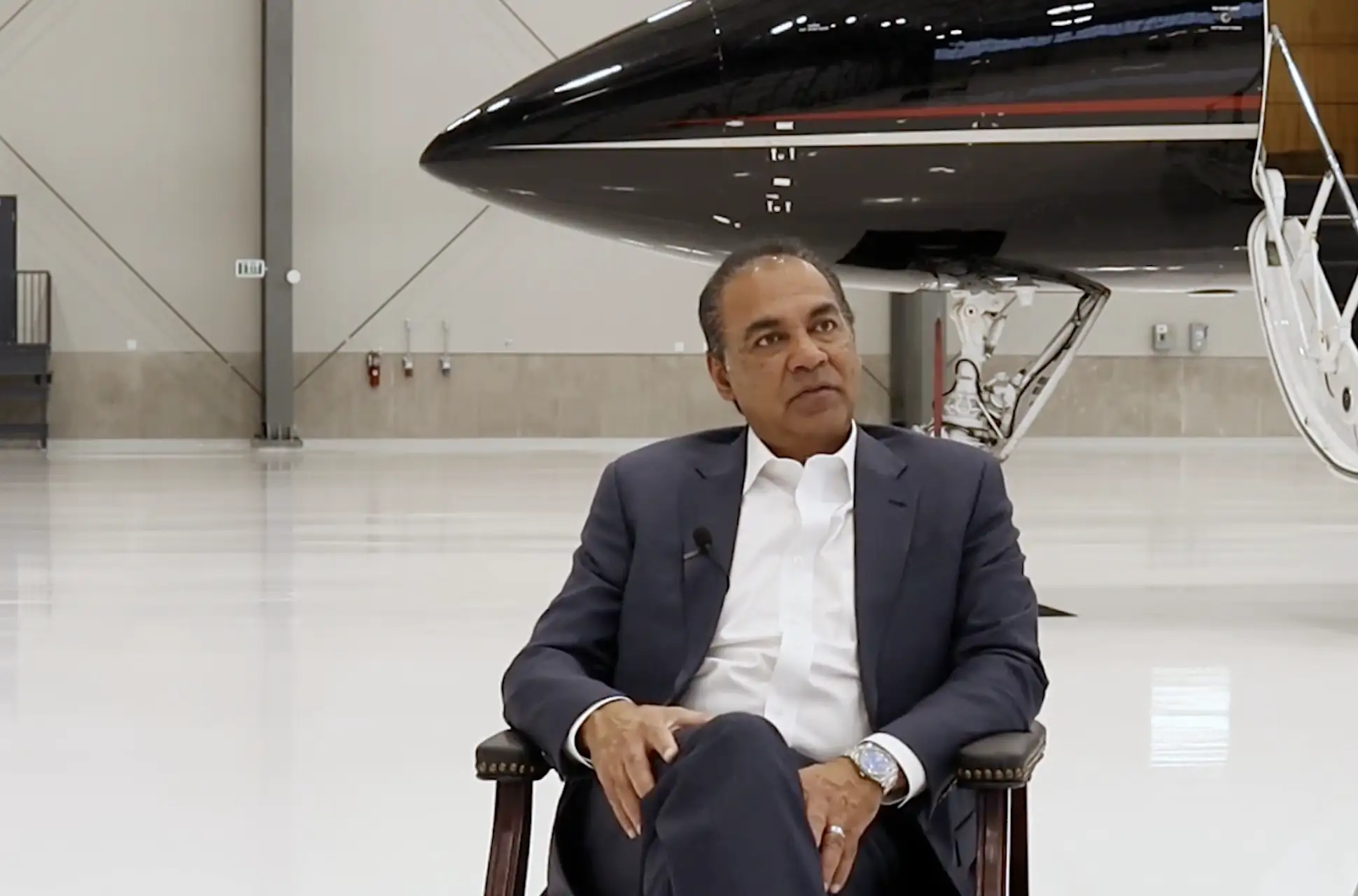
In an interview published September 10, 2026, the week before OneFlight paused flight activity, its CEO Ferren Rajput said, “The promotions are loss leaders, but those loss leaders drive a lot of business. The phones ring, we create more business. The point is you sell 10 cheap cards, and you get those customers for the next four or five years.”
Multiple transactions
However, the sales transaction data reviewed by Private Jet Card Comparisons aligned with allegations in now seven lawsuits that the company went back to existing customers with large balances and asked them to wire more cash through a constant flow of offers.
In a new lawsuit filed this week, Gregory Deal alleges his salesperson, Waqas Nawaz, emailed him with the subject line: “Quick heads up — one member-only exception.”
Nawaz wrote that “my CEO approved one exception that I can extend to one existing member.”
The offer was for a “$100,000 deposit” with $100,000 in additional flight credits, giving him $200,000 in flights for $100,000 in cash.
Deal’s filing shows he paid OneFlight $250,000 in October 2024; $115,000 in January 2025; $100,000 in May 2025; $100,000 in December 2025; and $250,000 in May 2026.
In total, Deal wired $815,000, succumbing to multiple offers to increase his prepaid balance for future flights.
Kamran and Sharri Jinnah paid OneFlight $745,000 for prepaid flight deposits and related membership charges in just over six months.
A $300,000 transfer occurred on January 20, 2026. On February 23, 2026, they paid an additional $150,000. A $295,000 transfer followed on June 25, 2026.
As of September 2026, the Jinnahs maintained an unused prepaid account balance of $815,834.57, including the flight credits.
Deals to the end
In the days before OneFlight paused operations on September 16, 2026, records show it took in $7.4 million in cash while giving $8.7 million in bonuses.
At least 17 deals gave customers who sent at least $250,000 in cash another $250,000 in bonuses plus 10 free hours on a large-cabin jet, which, based on OneFlight’s rates, should carry a value of around $160,000, for a $ 660,000 flight value for $250,000 in cash.
The sales logs, circulated daily to the entire sales team, counter the narrative that the deep discounts were limited offers mainly available only to new customers.
A lawsuit filed last month by Jeremy Ricks in the United States District Court for the District of Colorado alleged that OneFlight International was “consistent with the operation of a Ponzi scheme in which new money is used to pay old obligations.”
Cash crunch
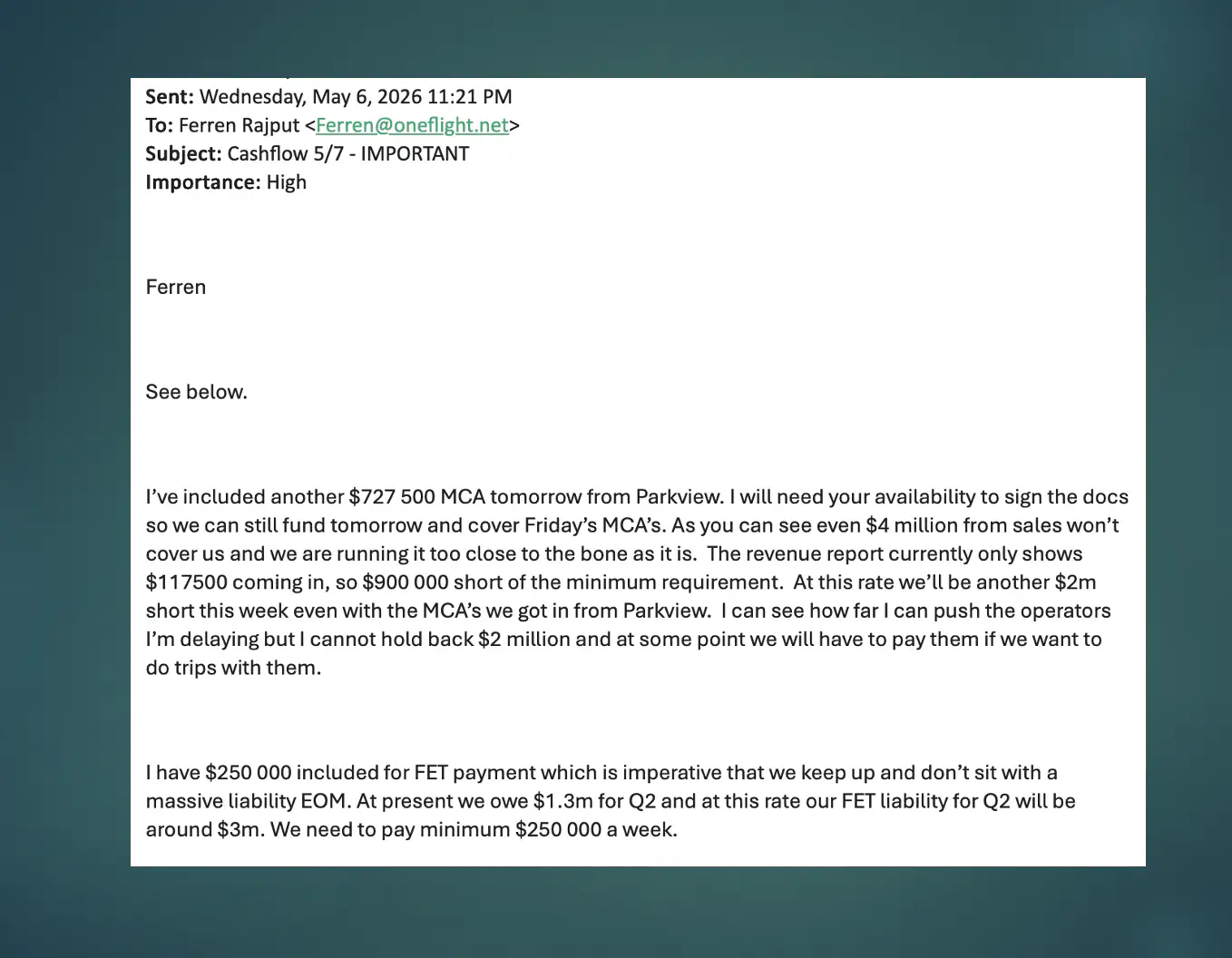
An email to Rajput from May of this year showed that despite tens of millions in cash coming in each month, the broker was struggling with payroll.
That email read in part, “As you can see, even $4 million from sales won’t cover us, and we are running it too close to the bone as it is.”
It continued, “The revenue report currently only shows $117,500 coming in, so $900,000 short of the minimum requirement. At this rate, we’ll be another $2 million short this week, even with the (merchant cash advances) we got in from Parkview (a company providing the MCAs).
![OneFlight Cash Flow]()
The email stated, “I can see how far I can push the operators I’m delaying, but I cannot hold back $2 million, and at some point we will have to pay them if we want to do trips with them.”
It also warned, “I have $250 000 included for FET payment, which is imperative that we keep up and don’t sit with a massive liability EOM. At present we owe $1.3 million for Q2, and at this rate our FET liability for Q2 will be around $3 million.”
Losing money
The deep discounts continued years after OneFlight had told potential investors it was losing money on flights.
According to the 2023 presentation, “From OneFlight’s inception (in 2010), profitability from flights alone has been an elusive objective, difficult to realize across all flight services rendered.”
It continued, “This is due to the logistical complexity of scheduling the right aircraft, when needed, and at the departure point required by BAJ members.”
At the time, it said, “Membership fees have more than covered the greater costs of individual flights than fares received.”
However, the 2026 data shows OneFlight waived membership fees dozens of times.
On flight costs, OneFlight in 2023 said management was “confident” it could “realize gross margins of 3% to 12% on the vast majority of the flights it will schedule this year and going forward.”
Cash deficit
However, OneFlight appeared unlikely to come close to that forecast when it paused operations last month.
With around $400 million in cash and credits just from 2026 sales, if OneFlight were able to purchase those flights at a 25% margin, it would have required over $300 million in payments to charter operators, some $75 million more than it took in.
At its most optimistic forecast, buying flights for 12% less than the trip cost would have required about $354 million in cash.
That was $128 million more than the cash it took in from selling the programs our analysis valued at $400 million in flight obligations.
About the analysis
Here’s how we arrived at the numbers for discounts, free flights, and so forth.
In reviewing the over 1,300 transactions:
- Actual numbers were used when stated.
- We excluded the value of free flights for 20 ambassadors.
- We excluded the value of “buyback” hours unless the records specified the number of hours.
- We valued Hawaii roundtrips at $100,000. If a customer paid $30,000 for a Hawaii roundtrip, we valued the discount at $70,000.
- We valued European roundtrips at $150,000 and, like Hawaii trips, accounted for any cash components.
- For discounted jet cards, we valued light jet hours at $7,000 per hour, midsize jets at $8,000 per hour, super midsize jets at $10,000 per hour, and large cabin at $12,000 per hour to calculate discounts. This was below industry-average pricing at the end of Q3 2026. It meant that when a customer was sold 40 hours on a light jet for $200,000 in cash, we valued those flights at $280,000 ($7,000 x 40), hence an $80,000 discount.
- For free hours on large-cabin jets designated as an add-on, we used the BAJit published hourly rate of $15,860 per hour for a Gulfstream G350. This may be higher than costs if the flights were fulfilled on two in-house Gulfstream jets.
- We valued comp flights at $25,000 each, although they could be less or considerably more.
- We excluded the value of complimentary experiences, including one-week yacht charter vacations and VIP hospitality trips to the Super Bowl, F1 races, and golf tournaments, some of which included free flights, and for which OneFlight received over $9 million in cash.
- We identified at least $440,000 in waived membership. Those membership fees would not have applied to future flights. That’s about 1/10th of 1 percent of the $402 million total.
Overall, the $176 million value in free flights and credits is based on direct data and our best estimates based on the above calculations.
An attorney representing Rajput declined to comment about our report.