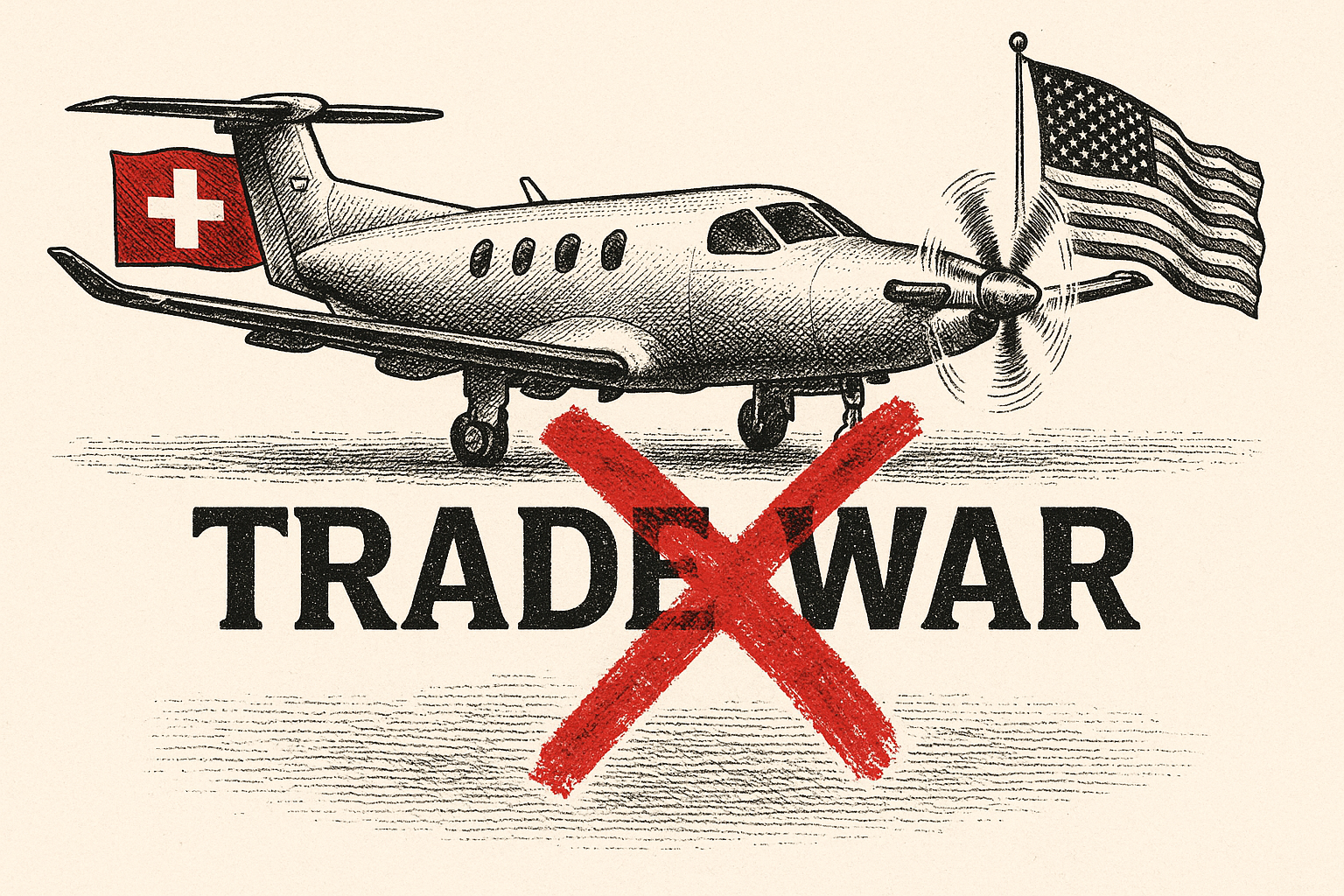
Two U.S. Pilatus operators say they are pleased and relieved after the U.S. and Switzerland reached a framework for a new trade agreement.
In early August, the Swiss OEM said it was halting shipments to the U.S. after the Trump Administration imposed 39% tariffs.
Pilatus makes the popular PC-12 turboprop and has been expanding its presence with the PC-24 light jet.
On Friday, the White House announced the agreement.
It read, “President Donald J. Trump announced a Framework for a historic trade deal with the Swiss Confederation and the Principality of Liechtenstein that will provide U.S. exporters unprecedented access to Swiss and Liechtenstein markets and drive billions of dollars in investment on U.S. soil, creating thousands of jobs across America.”
The White House said Swiss companies will invest at least $200 billion in the U.S., with $67 billion starting in 2026.
Pet the announcement:
‘On April 2, President Trump declared a national emergency in response to the unprecedented threat caused to the United States by the large and persistent trade deficit caused by a lack of reciprocity in our bilateral trade relationships, disparate tariff rates and non-tariff barriers, and U.S. trading partners’ economic policies that suppress domestic wages and consumption.’
Pilatus responded to the tariffs on Swiss imports by temporarily halting shipments to the U.S.
Civil Aircraft Exemption
The agreement framework reached last week calls for a 15% tariff.
However, aviation is likely to be exempted, meaning no tariffs on airplanes and parts.
The exemption is based on the 1979 Agreement on Trade in Civil Aircraft.
Switzerland is an important export customer for Boeing.
Its national airline, Swiss International Airlines, operates a fleet of 12 Boeing 777s.
Tariffs would also impact airplane parts.
That could have made it uneconomical to operate the U.S.-built jets in a market where margins are razor-thin.
Not extending the tariff exemption to aviation could also impact future orders from Swiss parent Lufthansa Group.
Swiss International CEO Jens Fehlinger had been part of a trade delegation that attended White House meetings, according to Reuters.
Despite agreeing on the framework, tariffs remain in effect until the deal is signed.
After that, U.S. Customs would also have to update its systems.
Pilatus Operators Speak
Tradewind Aviation COO David Zipkin tells Private Jet Card Comparisons, “As a dedicated operator of Pilatus aircraft, we’re pleased to see the reduction in tariffs on Swiss imports.”
He adds, “This change supports our ongoing commitment to maintaining a top-tier fleet and delivering exceptional service to our clients.”
FlyUSA CEO Barry Shevlin said, “Owners are relieved; there were some concerns about additional parts availability issues and, of course, parts costs increasing.”
The company had acquired PC-12 operator Tryp Air Charter in May.
Representatives of Pilatus, PlaneSense, and SkyShare were not immediately available to comment.
PlaneSense is the seventh-largest charter/fractional operator in the U.S.
It operates a Pilatus-exclusive fleet.
optin-monster-inline slug=”bikxydvh3yy1yhaljwws”]