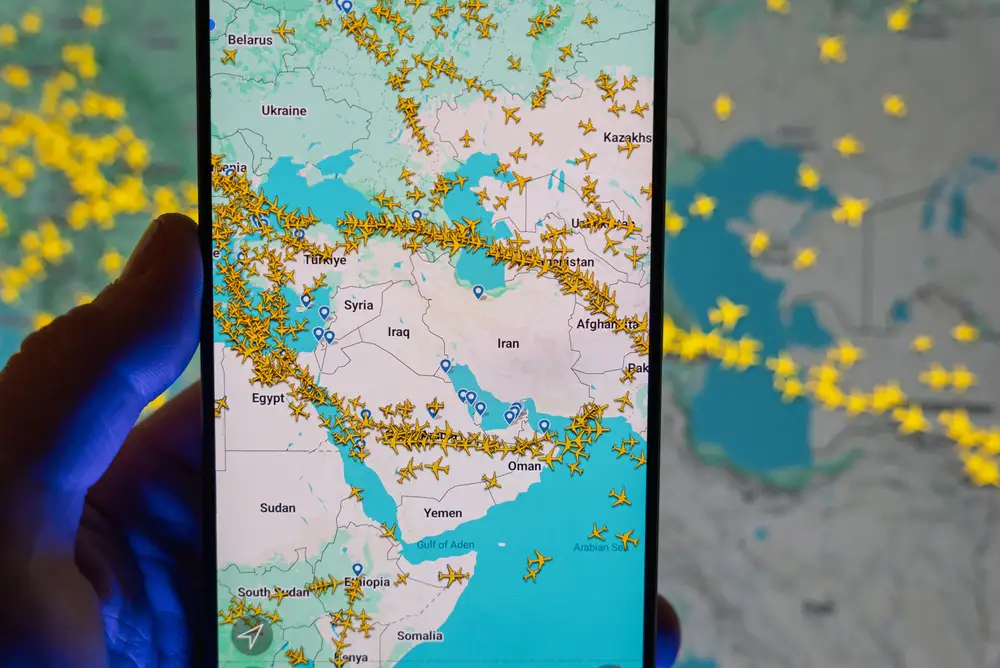
In the digital age, tracking flights is so much easier than having to whip out your binoculars.
Before satellites, airlines tracked their own flights. Pilots used two-way radios to report their location to ground stations at checkpoints along their route. Dispatchers updated the progress and relayed the information to the arrival airport, where workers manually updated the flight status on chalkboards or with painted slates. Desk agents made announcements over public address systems as friends and family anxiously awaited updates.
With the advent of free flight trackers, airline and private jet travelers can monitor their flights in real time and receive updates on delays, reroutes, diversions, weather issues, ground stops, and the airlines they are flying with. gate changes.
Track inbound aircraft to avoid delays at your departure.
Get notified about delays impacting your departure airport due to weather, congestion, diversion, and even wars.
What is a Flight Tracker?
Flight trackers are online tools that display live aircraft locations, profiles, statuses, and routes.
Trackers are available both as websites, accessible from any web browser, and as phone apps.
These platforms pull data from various sources, including Automatic Dependent Surveillance–Broadcast, live FAA data, Mode S transponders, and Multilateration flight data.
Under Federal Aviation Administration law, ADS-B broadcasts must be transmitted every second by aircraft.
It is meant to provide real-time precision and situational awareness to both pilots and air traffic controllers.
ADS-B is unencrypted and public, and republishing these broadcasts is protected by free speech and U.S. law.
How do flight trackers work?
Free flight trackers collect data and display it on an interactive map.
Users can search for specific flights by tail number or hex ID, track their own flights, or view historical flight data.
Some popular free flight trackers include ADS-B Exchange, PlaneFinder, and Flightradar24.
Because planes broadcast real-time data, flight trackers show a plane’s position, speed, route, and altitude.
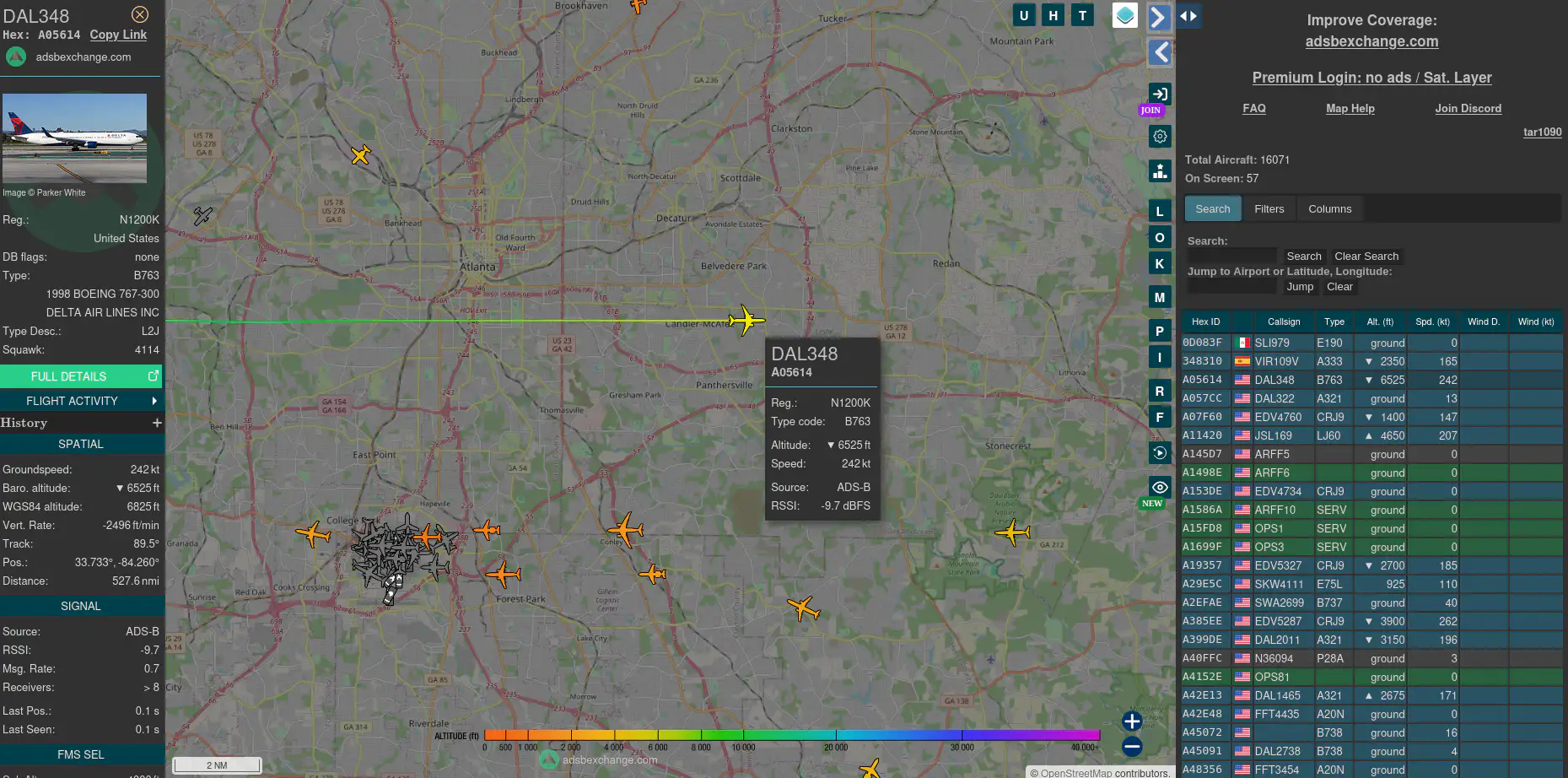
Flight trackers identify planes and assign them profiles based on both their tail number and their hex ID.
![ADS-B Flight Tracker Example]()
An example of tracking a plane, this one flying over Atlanta. The plane colors denote altitude, with grey meaning grounded. Among many other details, the profile of the selected plane shows its tail number, hex ID, owner and maker, and spatial information. Source: ADS-B Exchange.
While tail numbers are self-explanatory, a hex ID is more obscure. It is also known as the International Civil Aviation Organization 24-bit aircraft address.
The hex ID is a globally unique six-character identifier that is broadcast by every civil aircraft worldwide via ADS-B.
Many platforms offer customization options, such as setting alerts for specific gate changes or delays, saving favorite flights, filtering out plane types on the map, and syncing calendars.
Free flight trackers are often freemium, relying on ads (though ad blockers can stop that) or premium subscriptions to make money.
Some premium features can include unlimited flight history, saving filters and bookmarks, 3D view and cloud layer, and more!
Flight Tracking use cases
Travelers can stay informed about flight status, delays, diversions, and gate changes, reducing stress and anxiety during travel.
Or, for friends or family of travelers, you can track their flight in real time so you never miss the pickup again.
On some in-depth flight trackers, tail numbers or hex IDs are linked to a profile for each plane.
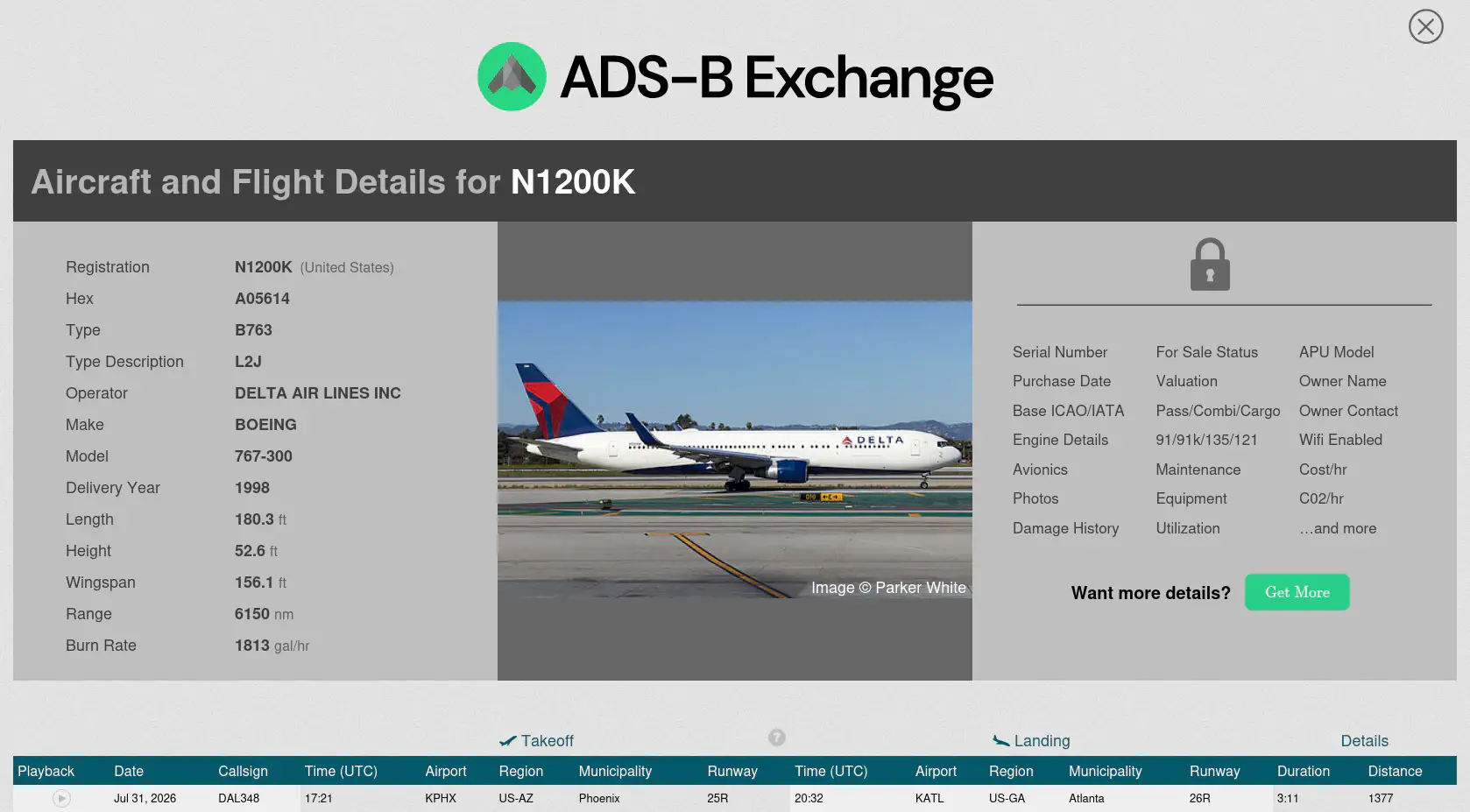
In addition to position and speed, trackers may include other plane details such as model, type, size, range, serial number, owner, whether Wi-Fi is enabled, and even fuel burn rate!
![ADS-B Exchange Plane Profile]()
Looking at the profile for this plane, the same one selected in the previous example, we see everything from its registration, operator, maker, model, and even the exact dimensions of the plane. Source: ADS-B Exchange.
For private jet flyers, the ability to see exactly where your plane is on the ground, and not just in the air, can be especially useful.
Private jets use fixed-base operators, which are usually spread around an airport.
For example, busy airports such as Teterboro Airport in New York City have multiple FBOs that can be miles apart.
FBOs want to make flyers’ wait for their jet as pleasant as possible, with lounges, bathrooms, Wi-Fi, and sometimes additional amenities.
However, if you end up at the wrong FBO, assuming your jet will leave from there, that pleasantry will quickly turn to panic.
While a private flyer’s broker or operator should let them know before a flight which FBO their jet will be at, a flight tracker can tell you which FBO you need to be at.
Can private planes be tracked, too?
Yes, private airplanes can also be tracked. As mentioned, every transponder-equipped aircraft is required to emit ADS-B.
However, just as with commercial flights, passenger details are not public information and cannot be searched through flight trackers.
For flyers using jet cards, on-demand charter flights, or fractional flights, flight tracking can be a useful way to monitor your flight’s progress and proximity.
Just as with commercial flights, this would allow you to stay up to date on any delays.
But it is still possible to know who owns a jet with a flight tracker. For one, flight trackers usually list a plane’s owner, operator, make, and model.
Platforms and flight tracking hobbyists can also identify the owner of an aircraft using FAA records, corporate disclosures, court documents, and public reporting.
In fact, jet tracking has proliferated in recent years, with both hobbyists and journalists joining in.
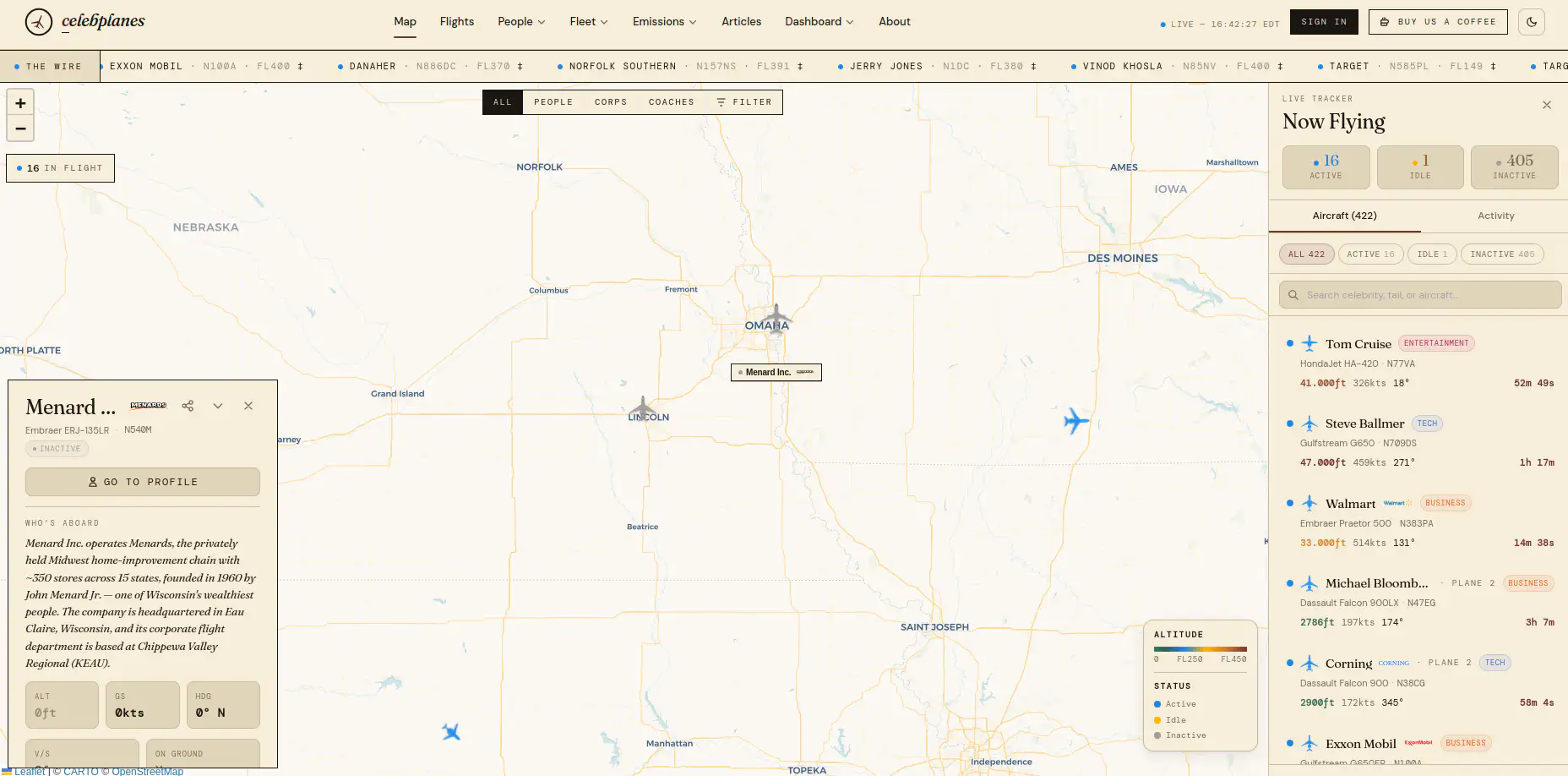
Some flight tracking platforms even specialize in monitoring the flight activity of celebrities or private jets. Among the most popular are Celebplanes and Jet Spy.
![Celeb Planes Menard]()
In this example, the selected plane belongs to Menard Inc. Just as before, the plane is grounded, so it is gray. However, just as with commercial flights, private jet manifests are not public. Flight trackers cannot know who is on board or how many people are on any private jet. Source: Celebplanes.
READ: Celebrity Private Jets and Cost To Buy, Cost To Fly
Private jet privacy
It is possible for private jet owners to ‘block’ their tail number or hex ID from public view in the U.S, at least partially.
Some such quiet flyers include celebrities, large corporations, or military aircraft. They can have their identifiers hidden from the FAA System Wide Information Management (SWIM) data feed.
For civilians or corporations who own private jets, this is handled through the FAA Limiting Aircraft Data Display or the Privacy ICAO Address programs.
Additionally, as of 2025, it is possible to request that the FAA withhold aircraft ownership data from its websites.
However, blocking identifiers in the SWIM data feed only works against flight-tracking websites that rely on them.
Other tracking websites that rely on public ADS-B data would still see the ID and information on such aircraft.
Ultimately, it is extremely difficult for private jet owners to fly unseen. The only sure way of flying untracked is to use on-demand charter, fractional ownership, or jet cards.
This is because, as previously stated, the owners of private jets are public knowledge, but the passengers are not.
Therefore, using a charter, fractional ownership, or jet cards offers the flexibility and privacy that owning a private jet cannot.
Private jet privacy controversy
The ability to track prominent jet owners has drawn attention from both flyers and the media.
Jack Sweeney, a college student at the time and now a software engineer and aviation information advocate, set up social media accounts tracking private jets.
These accounts, operated by bots, reported constant updates on the movements of private jets owned by celebrities such as Elon Musk, Taylor Swift, and Mark Cuban.
Sweeney’s bots obtained information from public sources, such as the ADS-B transmissions mentioned earlier.
While Sweeney received offers and threats to take down the highly popular accounts, he accepted only one offer from Mark Cuban to do so, in exchange for his professional advice and friendship.
Two months after purchasing Twitter (now X), in October 2022, Musk suspended most of Sweeney’s accounts alongside several journalists.
However, Sweeney is still active on other social media platforms, and the move did little to stem public and media interest in tracking prominent private jets.
Future of flight tracking
In an interview with Private Jet Card Comparisons, Sweeney said the public’s interest in flight tracking is a key part of the flight tracking community.
Sweeney described:
‘For the public, these platforms increase engagement with aviation whether it’s for airshows like EAA AirVenture, helping aviation spotters get the perfect photo, or simply sparking interest in younger audiences and bringing a better understanding of the industry to the masses.’
These days, besides his main job as a software engineer, Sweeney also runs TheAirTraffic and Ground Control, pillars of the online flight tracking community
Sweeney also pointed out that flight tracking makes it easier for the media to report on aircraft incidents, providing the public with immediate information rather than waiting for the FAA to release it.
When asked what he thought characterized and separated the best flight trackers from the worst, he responded that “it largely depends on their underlying motivations, whether they provide unfiltered data, and how easy they are to use.”
On this point, while platforms like Flightradar24 and FlightAware rely on FAA data, and therefore abide by its rules and restrictions, ADS-B Exchange has largely unfiltered data.
“Looking toward the future,” commented Sweeney, “I see massive potential for flight tracking technology and publications to implement new features.”
He continued:
Artificial Intelligence is going to play a major role here. We are already seeing startups leveraging AI to analyze ATC communications, ACARS, and ADS-B data, making flight tracking more intuitive and making it much easier to extract actionable insights.’
Conclusion
Flight tracking has become essential for modern travel.
Now, travelers can monitor their flights in real-time, inspect every aircraft in the sky, and even track the globe-trotting superstars of the world!
By understanding these tools, travelers and companions can remove the uncertainty from travel.
While flying will always have its complexities, long gone are the days of wondering whether your ship sank at sea before you arrived in port.