Jet Linx is formally relaunching its base partner program, keeping key attributes of the former program while adopting a new approach.
If you are interested, it will take an investment starting in the seven-figure range.
Of course, you would be an owner of one of the nation’s largest private jet operators.
The base partnerships were the driving force as the Omaha-based private jet management company and charter operator expanded in the last decade.
From 2009 to 2019, it grew from a single location in its hometown to 22 locations across most of the country.
Current locations include 13 of the 25 busiest private jet airports in the U.S.
Jet Linx ended 2024 as the nation’s 9th-largest private jet operator based on charter and fractional flight hours.
It ended last year with 33,770 flight hours.
That represented a 7.7% increase since 2019.
During that same period, total charter and fractional flight hours grew by 29.9%, according to ARGUS TRAQPak.
2019 to 2024
The move to restart its base partner program comes after a five-year hiatus.
The pause followed the entry of private equity and the subsequent roll-up of its existing base partners into the corporate entity in early 2020.
At first, Covid slowed growth plans.
All travel initially ground to a halt.
Even private jet operators saw flying drop by 90% in the early stages of the pandemic.
After that, Executive Chairman Jamie Walker says the frenzied market caused by demand for private aviation made M&A valuations unworkable.
2021 set a record for private jet flight hours.
That record was broken in 2022.
2023 and 2024 saw slight decreases.
2025 is expected to set another record.
In July 2023, Walker moved from his longtime CEO role to the Chairman role.
This past summer, Brent Wouters, who came in as CEO, exited.
Walker became Executive Chairman, assuming the role of chief executive, if not in title, in responsibility.
Ready To Grow Again
Walker credits Wouters with streamlining the company structure and setting the stage for a new period of growth.
With valuations of charter operators cooling, Walker tells Private Jet Card Comparisons, “We’ve now started seeing an opportunity…M&A will be in our future in 2026.”
The new base partner program aligns local partner interests with both national expansion and the addition of second or even third locations in existing markets.
The previous structure meant base partners controlled expansion in their local markets.
They also didn’t directly benefit from nationwide growth.
Now, base partners benefit from national and local market growth, which the corporation will fund.
In fact, the new structure opens the opportunity to have more than one partner in a market.
Walker says it’s not unlike the growth of the Four Seasons or Ritz-Carlton hotel groups.
The luxury hotel brands realized there was demand for their product not only in new markets but also in different locations within cities where they already had properties.
Walker tells Private Jet Card Comparisons the restart of the base partner program will mean achieving its longtime goal of opening its first West Coast locations.
Currently, its westernmost outposts are Scottsdale, Salt Lake City, and Denver.
The Los Angeles basin, San Diego County, and the San Francisco Bay area are at the top of its target list.
However, Walker says there is a substantial list of places Jet Linx could set up shop.
Walker says any cities with a regional population of two million or more people and at least 40 Part 135 aircraft within a 100-mile radius would work well for expansion.
He cites Birmingham, Alabama, as an example.
The Jet Linx Model
The Jet Linx model is based on providing the same local touch service offered by “mom and pop” management companies and charter operators.
Walker says the “mom and pop” phrase is a compliment.
Walker says, “I say that term respectfully. That’s not a negative to us.”
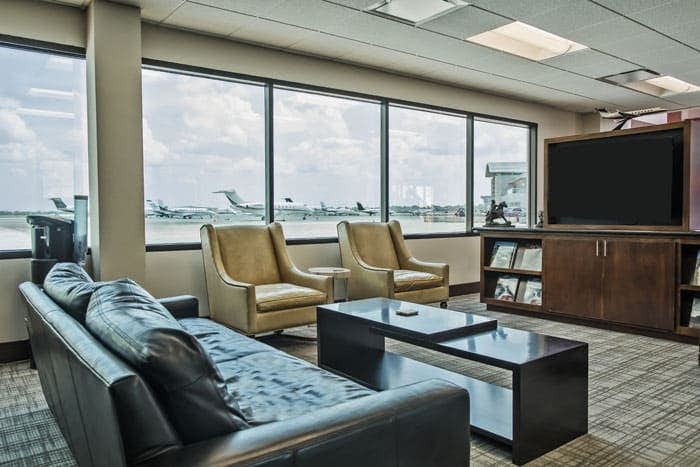
Jet Linx offers flyers a private terminal experience, hangar, local sales and support, and locally based pilots for the aircraft it manages for owners at its base locations.
It drives charter revenue for aircraft owners through its guaranteed availability and guaranteed-rate jet card program.
Aircraft owners and jet card members access private lounges at their home airport and across the network.
Jet card members and aircraft owners also enjoy valet service and car detailing.
They get personalized service from local staff and pilots who know all the local members by name.
Because of scale, Jet Linx can offer a guaranteed jet card program that wouldn’t make sense for single-location operators.
Jet Linx uses both its in-house fleet and third-party charter operators.
For customers, the network of terminals means a personalized experience in more places away from their home airport.
Walker points out that NetJets and Flexjet are both expanding their network of local terminals, something he sees as an endorsement of the concept.
Walker says the key for Jet Linx is the local connection.
When the company moved to centralize some of its service touchpoints, feedback underscored the high value its clients placed on having those local contacts.
He adds, “(The mom and pop personalized service is) actually what we’ve been trying to duplicate this whole time…not the big companies.”
Jet Linx Base Partner
The new base partner program restructures how partners participate.
They have equity in the national company with “liquidity opportunities at any time.”
Previously, it operated with partnerships structured at a local level.
The new approach incentivizes base partners to support growth and expansion, both within their base area and beyond.
It opens the door for multiple base partners in a location.
What’s more, it could mean expanding its network of private terminals in markets served by multiple airports.
Places like New York, Atlanta, Miami, Dallas, Chicago, and South Florida could all support Jet Linx terminals at multiple local airports, Walker says.
At the same time, the new structure enables Jet Linx to maintain a higher level of standardization than it achieved when it moved away from the original local-entity structure.
Base Partner Profile
What is Jet Linx looking for in a base partner?
The partner is more of an ambassador.
They don’t have to manage the local operations.
However, they need to be active in the local community.
Walker says Jet Linx is looking for partners who can “leverage local social, business, and philanthropic relationships for Jet Linx to win new jet card members and aircraft owners.”
That means making “warm introductions” to the sales team.
Base partners also advise on local marketing, public relations, and nonprofit opportunities.
A key function is building community connections by recommending local charities to support and serving as the company’s face to the community.
Walker says the profile means typically longtime residents who spend at least half the year in their community.
Having built successful local-market businesses and being active in social circles are important.
Base partners gain benefits from the number of customers – jet card and aircraft management – they can bring into the fold.
The new structure means they get credit for customers outside their base location, so perhaps in places where they have vacation homes.
They earn credits that can be used for jet card flights or applied to operating bills if they are aircraft owners.
Jet Linx Jet Card
Under Wouters, Jet Linx expanded its jet card guaranteed rates and availability beyond its base locations.
While the new focus returns to existing and new base markets, Walker says there are no plans to change the structure of its current jet card programs.
In addition to flights in the Continental U.S., guaranteed rates extend to the Caribbean, Mexico, and Canada.
The program also enables members to upgrade and downgrade aircraft size categories.
It offers guarantees across the four key categories – lights, mids, super-mid, and large cabin.
There are both deposit tiers and a pay-as-you-go option.