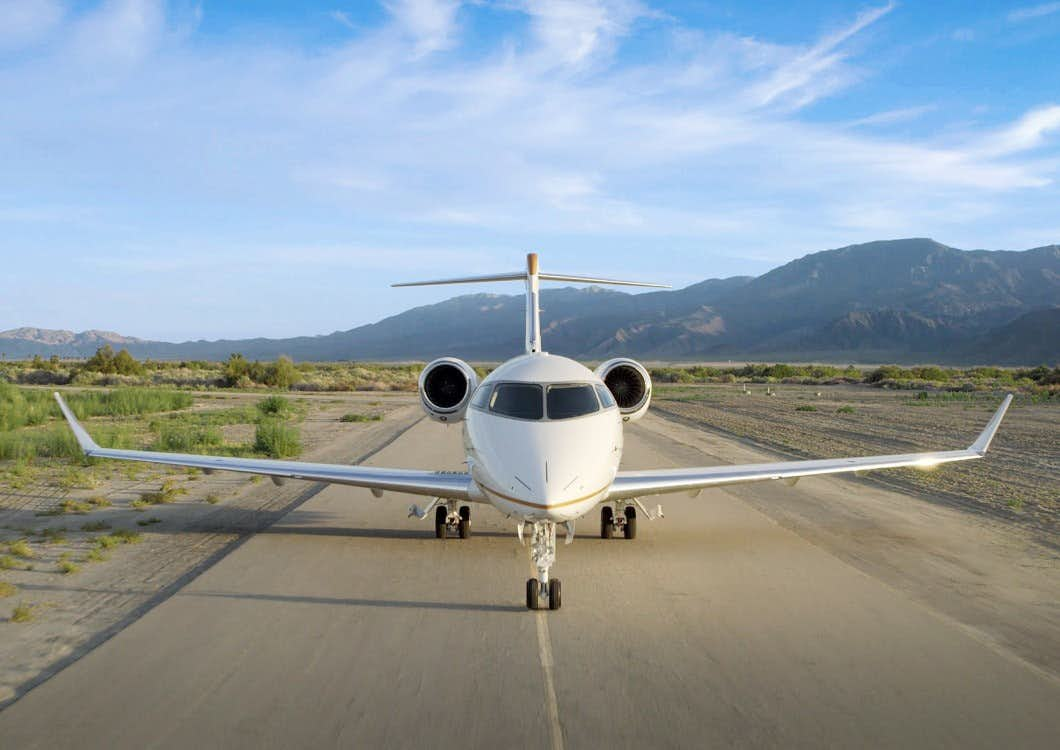
Tariffs, not decertification, are the most significant concern following President Donald Trump’s threats against Canadian private jet maker Bombardier last week.
Experts speaking at Corporate Jet Investor in London earlier today said decertification was highly unlikely.
Decertification would ground Canadian-made private jets operating in the United States.
Seven of the nine largest U.S. operators based on fractional and charter flight hours operate the Bombardier jets.
However, potential tariffs, while also unlikely, are more uncertain, they said.
In a Truth Social post on Thursday night, Trump threatened the Canadian OEM in retaliation for Transport Canada’s failure to validate the certification of four Gulfstream Aerospace-made private jets.
Trump posted:
‘Based on the fact that Canada has wrongfully, illegally, and steadfastly refused to certify the Gulfstream 500, 600, 700, and 800 Jets, one of the greatest, most technologically advanced airplanes ever made, we are hereby decertifying their Bombardier Global Expresses, and all Aircraft made in Canada, until such time as Gulfstream, a Great American Company, is fully certified, as it should have been many years ago. Further, Canada is effectively prohibiting the sale of Gulfstream products in Canada through this very same certification process. If, for any reason, this situation is not immediately corrected, I am going to charge Canada a 50% Tariff on any and all Aircraft sold into the United States of America. Thank you for your attention to this matter!’
Top U.S. Bombardier Operators
The Canadian-made Challengers and Globals are featured in numerous fractional and charter fleets.
NetJets, Flexjet, Airshare, and, more recently, FlyExclusive offer fractional ownership in Bombardier private jets.
NetJets offers the Global 5000, 5500, 6000, and 7500, as well as the Challenger 350, 3500, and 650.
Flexjet features the Challenger 350 and 3500.
Airshare offers the Challenger 3500.
FlyExclusive has a pre-owned Challenger 350 fractional program.
VistaJet uses the Globals and Challengers in its membership programs.
Wheels Up has been adding to its charter fleet of Challenger 300 and 350s.
Nicholas Air features the Challenger 350 in its jet card program.
Bombardier Decertification
The experts said following the Truth Social post, there had been no official follow-up actions.
The experts questioned whether Trump could decertify existing Bombardier aircraft currently operating in the U.S.
Vedder Price aviation attorney David Hernandez said only a safety concern would allow decertification.
He told the audience, “There is zero risk that will happen anytime soon.”
Watson, Farley & Williams attorney Jim Bell said he was in “99%” agreement regarding the unlikelihood of decertification.
He caveated it by adding, “I flag it purely because we’ve seen this time and time again with President Trump that he tries to find loopholes.”
That could range from POTUS just stating he has the authority – which the experts said would be immediately challenged in court – or that he was acting in the public interest, although Bell said it wasn’t clear that he could do that either.
Trump Tailwinds
Despite Trump’s on-again, off-again tariff threats since taking office, private aviation has returned to its halcyon days, particularly in the U.S.
Private jet dealers and brokers who are members of the International Aircraft Dealers Association recently gave a bullish perspective.
Bonus depreciation as part of the Big Beautiful Tax Bill gave the industry strong tailwinds.
Trump Tariff Impact
The experts at CJI London said that if Trump proceeds with taxing the Canadian jets, it could backfire.
YYZLaw’s Ehsan Monfared said overall aviation and aerospace exports are a huge winner for the U.S.
He said that in 2024, U.S. exports held a $133 billion to $22 billion advantage over imports.
Moderator Alisdair Whyte pointed to a Bombardier statement, noting it employs 3,000 workers in the U.S.
He said the Canadian OEM has over 2,800 U.S. suppliers.
Hernandez noted that various wing components for the top-end Global aircraft are made in the U.S.
Air Canada operates Boeing’s 777 and 787 passenger airliners.
WestJet operates over 140 Boeing 737 variants, and its long-haul fleet consists exclusively of Boeing 787 models.
Canadian fractional AirSprint operates Citation CJ2 and CJ3 models made by Textron Aviation.
Swiss Miss
However, tariffs are a concern.
Trump imposed 39% tariffs on imports from Switzerland that impacted Pilatus aircraft before agreeing to a deal late last year.
While there is an EU trade deal in place, deals with Brazil and Israel have yet to be inked, said import tax expert Tobias Kleitman.
If implemented, tariffs on Canada would affect new Bombardier aircraft and some pre-owned models if they had been operating in a foreign country.
Fractional ownership start-up Bond announced a $1.7 billion order for Globals and Challengers in October.
Its first delivery is planned for early 2027.
Airshare and NetJets have open orders and options for Bombardier aircraft.
While the panelists agreed Trump was right to call out Transport Canada, they said the delays were more likely due to bureaucracy than obstruction.
Monfared said Transport Canada typically will expedite validation when there is commercial demand.
He said the lack of demand for U.S.-made private jets in Canada has less to do with the product and more to do with Bombardier’s wider support network for maintenance and a larger supply of pilots trained to fly its private jets in its home country.
The panelists said that since Trump’s social media post, there has been no follow-up executive order to proceed with the tariffs.
What Should You Do?
If Trump proceeds with tariffs, that could affect parts.
That would impact maintenance costs for the existing fleet.
The experts advised ensuring that the force majeure clause in any contracts specifically covers tariffs.