Earlier this month, Starlink announced price increases of up to 100% for private jet owners.
The new pricing goes into effect Aug. 7, 2026, and replaces previous plans.
The news caused a flurry of media reports that extended beyond the industry.
It also created a social media storm.
Starlink has quickly become a customer favorite.
Starlink New Pricing
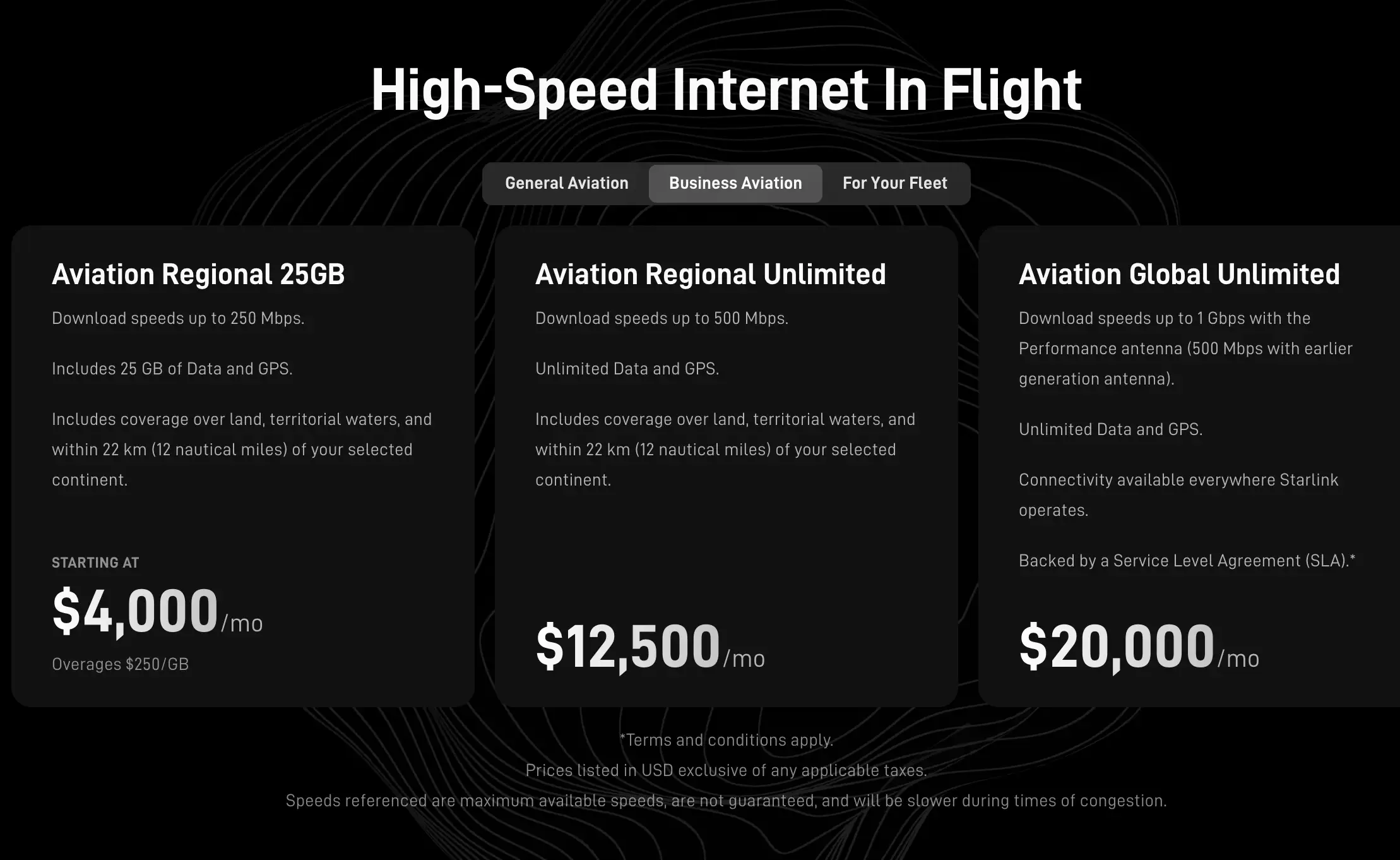
With the new pricing, aircraft owners who want Starlink WiFi connectivity while flying more than 12 nautical miles beyond the coast of their region will see prices double.
The Aviation Global Unlimited Plan is now $20,000 per month.
It provides worldwide connectivity wherever Starlink service is available.
Speed is up to 1 Gbps with a Starlink aviation performance antenna.
Those in a regional plan would see a 25% increase.
Aviation Regional Unlimited would go to $12,500 per month.
Speed is up to 500 Mbps.
The regional plan includes service for specific continents and up to 12 nautical miles from the coastline.
Starlink Business Aviation Pricing (effective Aug. 7, 2026)
![Starlink Private Jet Pricing]()
That would mean service gaps for flights between South Florida, Texas, and Southern California as they cross the Gulf of Mexico (or America).
It would also apparently mean no service between the West Coast and Hawaii.
A third plan, Aviation Regional 25GB, costs $4,000 per month.
After 25GB of data, users pay $250 per additional GB.
It provides speeds up to 250 Mbps.
Mbps is short for megabits per second.
It is the standard unit of measurement for internet speed and bandwidth.
It measures how many millions of bits of data your network can transfer or receive in one second.
A higher Mbps means your internet connection is faster and can handle data-heavy tasks more efficiently.
Price Increase Reaction
One industry player told Corporate Jet Investor, “They have come out and raised prices way too early. They have definitely had a big bite of the pie, but it won’t last long now.”
A reseller said, “It is insane. It is everything that its competitors have been warning of. Once they have locked customers in, they could keep raising prices every year.”
Corporate Jet Investor wrote:
‘Starlink’s move comes as the aviation connectivity market is becoming even more competitive. Gogo’s Galileo system, which uses the Eutelsat OneWeb low Earth orbit network, is gaining market share (the company also has a three-year price guarantee) and is being rolled out on more aircraft types. Honeywell is hoping to launch its JetWaveX product in the next few months. This can connect with different types of satellites, which could reassure owners who do not want to be locked into a single provider. Viasat is also working on adding low Earth orbit capability with Telesat. And then there is Amazon’s new low-Earth-orbit constellation. Musk may now be significantly richer than Jeff Bezos, but Amazon already has relationships with many of the world’s biggest companies and entrepreneurs through its Amazon Web Services (AWS) business. Delta Air Lines (a big AWS customer) will start installing Amazon Leo in 2023.’
One private jet owner wrote to Aviation Week.
He said, “I was one of the first Bombardier Global 6000 owners to install Starlink Aviation in 2024, investing over $300,000 in equipment and installation.”
The private jet owner continued, “Because I split time seasonally between the U.S. and Europe, the new Regional plan isn’t a viable option for me at all, as it would leave my aircraft without service for half the year.”
He noted, “My only choice is Global Unlimited at $20,000 per month—a 208% increase over my current actual spend of roughly $6,500 per month.”
However, not everyone saw the price increases as unreasonable.
One poster on Reddit wrote, “Even $20k a month cost is basically nothing in the realm of bizjet operating costs. Fueling a G650 to full tank costs more than the max monthly cost.”
WiFi Demand
38.9% percent of private jet flyers who use Private Jet Card Comparisons’ Decider Customer Analysis say they require WiFi for their private jet flights, with a further 35.0% saying they want WiFi if possible.
However, the percentages are higher with larger aircraft.
For example, 50.9% of super-midsize jet users said they require WiFi, with an additional 39.6% saying they would like it if possible.
Charter, Fractional Impact
Fractional and charter operators with floating fleets aim to achieve at least 800 occupied flight hours per aircraft per year.
Occupied hours of the course exclude empty repositioning flights.
For Aviation Global Unlimited, that equates to $300 per occupied hour ($240,000 per year divided by 800 occupied flight hours).
For Aviation Regional Unlimited users, the annual cost is $187.50 per occupied hour based on 800 flight hours.
The average hourly jet card rate at the end of Q2 was $11,314, according to the latest Private Jet Card Comparisons analysis.
However, for operators with dozens or hundreds of airplanes, those numbers may not look small, even if they don’t have to pay the rack rates of individual owners.
Baker Aviation CEO Tim Livingston tells Private Jet Card Comparisons, “I haven’t decided what the best solution is. It’s a $420,000 monthly increase for us. (I’m) still negotiating with Starlink to see if we can work a better fleet plan.”
Baker Aviation, with over 40 Challenger 300s and Citation Xs, is a major supplier for jet card and ad hoc charter brokers.
In 2025, it ranked as the 10th-largest U.S. private jet operator based on charter and fractional flight hours.
On the fractional side, Flexjet President, Technical Services Jay Heublein says, “Our (fractional) aircraft owners often see their aircraft as an extension of their home or office, and high-speed, reliable connectivity is vital to that experience.”
He says, “As the first private aviation provider of Starlink, the best in-flight connectivity solution in the industry, we consider WiFi to be a non-negotiable.”
Heublein says for customers, “To that end, it is included in the cost of their fractional purchase.”
A spokesperson for FlyExclusive says, “Starlink has fundamentally changed the onboard experience by delivering faster, more reliable internet, and we believe that’s a worthwhile investment for our customers.”
She says, “Like any operator, we continually evaluate costs and pricing, but our priority is providing an exceptional ownership and charter experience.”
FlyExclusive, which offers both fractional ownership and jet cards, currently includes WiFi at no extra charge.
It announced its move to Starlink in January 2026.
Northern Jet has been installing Starlink and currently includes it in base hourly rates.
Vice President Dan Beldowicz says the company will continue to provide WiFi at no additional charge to both its jet card and fractional customers.
Fly Alliance CEO Christopher Tasca says the operator will also continue to provide WiFi to its jet card and fractional customers at no additional fee to its contracted pricing, regardless of whether the aircraft has Starlink.
Last December, Fly Alliance became the first private jet flight provider to offer a jet card that guaranteed Starlink WiFi.
One operator, who asked not to be identified, said, “For our jet card and fractional clients, we will eat the cost,” adding, “For our wholesale operations, we can pass on some costs to the client, since those aircraft in our fleet that do have Starlink are always in high demand.”
NetJets, which had previously announced its Starlink service, declined to comment.
JSX, which offers complimentary Starlink WiFi, did not respond.
Aero said it doesn’t plan to pass along the costs.
For his part, Livingston says, “We won’t be adding a line item surcharge or anything. It may be that our overall operating costs rise with the market. I want to let the market work itself out.”
However, at least one fleet operator says he has now stopped installation of Starlink.
Nicholas Air CEO Nicholas Correnti told Corporate Jet Investor, “We selected Starlink primarily because we wanted to support American-made products.”
He added, “Given this sudden and significant pricing change, we have paused to evaluate the long-term implications and ensure we are making the best decision to protect our operation and serve the best interests of our members.”
Nicholas Air had just announced it would install Starlink back in March.