Do separate accounts or refundability protect your jet card money?
September 17, 2026
Exploring how high planes fly and what their limits are, from commercial airliners to private jets of several sizes and weights.
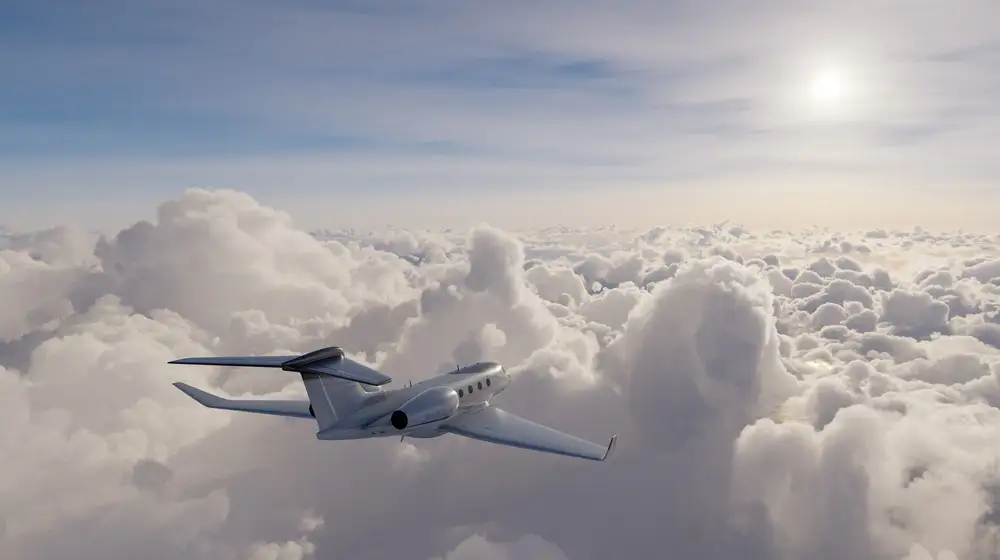
We all know that planes like to fly high for more than just pretty views, since they don’t want to bump into every rain cloud on their flight path.
But how high do planes usually fly, and why don’t they go even higher? Plus, how does a plane’s size, model, and type affect their preferred altitude?
Planes can fly anywhere from 3,000 ft high for smaller planes to 100,000 ft for supersonic and rocket-powered aircraft.
However, most aircraft never go that high. Commercial airliners usually use the “cruise altitude” of 30,000 to 40,000 feet above mean sea level.
In fact, commercial and private flights prefer to stay around cruising altitude, which lets planes fly over terrain, rough weather, and lower aircraft like small planes and helicopters.
At that height, planes face less air resistance and consume less fuel, while soaring over rough weather smooths the ride for passengers.
In some emergencies, pilots can use the higher altitude to choose where to land and descend safely.
To put these heights in context, birds usually fly at or below 500 ft.
Exceptions include the Rüppell’s griffon vulture, which has been recorded flying at 37,000 ft.
Thunderstorms can pass 60,000 ft, though rain clouds usually hover below 10,000 ft.
Meanwhile, America’s tallest mountain is Denali, in Alaska, at 20,310 ft. Mt. Everest is 29,032 ft.
While commercial airlines adhere to strict cruising altitudes, private jets enjoy more flexibility in their flight path and altitude.
This is because jets follow their flyers’ wishes more closely, and they often cruise higher than airlines, with lighter aircraft that are more fuel-efficient and faster.
The main reason for their higher altitude limit is their lighter weight, which affects physics and their thrust-to-weight ratio.
The following table compares various private jets alongside the popular airliners, Airbus A320 and Boeing 747-200.
| Aircraft | Cabin Size | Max operating altitude (in feet) | Max takeoff weight (in pounds) |
| Cirrus SR22 | Turboprop | 17,500 | 3,600 |
| King Air 350 | Turboprop | 35,000 | 16,500 |
| Cirrus Vision SF50 | Very Light | 31,000 | 6,000 |
| Phenom 100 | Very Light | 41,000 | 10,582 |
| Phenom 300 | Light | 45,000 | 17,968 |
| Challenger 300 | Super Midsize | 45,000 | 38,850 |
| Gulfstream 700 | Ultra Long Range | 51,000 | 101,600 |
| Airbus A320 | Narrow-Body | 39,000 | 170,000 |
| Boeing 747-200 | Wide-Body | 45,000 | 785,000 |
Important to note is a bell curve effect: as aircraft get heavier, they can fly higher, to a certain point.
This is because, despite the added weight, larger planes can carry bigger engines and more fuel, helping them ascend higher.
However, as seen between the Gulfstream 700 and the Boeing 747, this effect eventually plateaus, leaving jets able to cruise higher than airliners.
Besides weight, pilots often choose altitudes based on weather conditions, airspace restrictions, and even scenic views.
Despite flyers’ and owners’ preferences, air traffic controllers still play an important role in assigning which altitude level, or “highway,” planes should take to avoid collisions and keep traffic moving.
Not all planes can fly at all altitudes, since planes must be FAA-certified to provide safe cabin pressure at higher altitudes.
Without ensuring cabin pressurization, flyers above 10,000 feet would face the effects of oxygen deprivation (hypoxia), including ear discomfort, fatigue, and dehydration.
So, planes use pressurization systems to lower pressure to levels that simulate 6,000 to 8,000 ft, which is far more comfortable for humans.
Few people experience negative, impactful symptoms at those pressure levels.
But despite cabin pressurization, other limits keep planes from soaring as high as they’d like.
Others include aircraft size, weight, wingspan, and outside air temperature, said a VP of flight operations and a former pilot who spoke with Private Jet Card Comparisons.
Primarily, he said, airlines fly around flight level 400 (about 40,000 feet), with most cruising around FL330 to 380.
However, private jets are smaller and lighter, allowing them to cruise higher at up to FL 500.
The lighter air at that altitude improves fuel efficiency and helps keep flyers above most bad weather.
Regarding weight, he also mentioned that all aircraft depart heavier than they land, because of the extra weight of fuel.
For context on how much fuel weight matters, the following table compares some popular jets, with data from manufacturer websites.
| Aircraft | Maximum zero fuel weight (in pounds) | Maximum fuel capacity (in pounds) | Maximum takeoff weight (in pounds) |
| Pilatus PC-24 | 14,660 | 5,964 | 18,740 |
| Cessna Citation Sovereign | 18,150 | 11,223 | 30,775 |
| Gulfstream G500 | 52,100 | 30,250 | 79,600 |
So, because a jet with full fuel cannot carry its max payload (and vice versa), jets become about 60% heavier, only through fuel.
Because of this, the VP described how planes lighten mid-flight as they burn fuel.
As their weight decreases, pilots can ask air traffic controllers to let them “step climb” to a higher altitude.
Many factors go into choosing what altitude to fly a plane.
From the plane’s weight and build, to the preference of its passengers, the air traffic around it, and the judgment of the pilots themselves.
But whether planes fly at 35,000 or 50,000 feet, pilots will do their best to carry their passengers with speed and comfort.
Generally not, since cabin pressurization maintains similar conditions regardless of actual altitude.
As mentioned above, humans experience hypoxia mostly above 10,000 ft, but cabin pressure usually keeps passengers at 6,000-8,000 ft.
However, higher altitude generally does lead to smoother flights, with less turbulence for passengers to feel.
Yes, but not from any plane you’re likely to fly in.
Earth’s curvature only becomes pronounced once you leave the atmosphere and enter space, far above the limit of most aircraft.
Even from commercial airliners and private jets, the curvature is near-invisible.
It only becomes perceptible, though subtle, at about 70,000 ft high, which only military and rocket-powered aircraft reach.
So, unless you are an Air Force pilot or astronaut, you won’t see Earth’s curve from your plane window anytime soon.
Usually, but only if the aircraft and trip support it.
As described above, each aircraft has a service ceiling they prefer to stay under. Operating at or above the ceiling is risky.
Still, since most weather disturbances occur under 30,000 ft, flying higher is usually safer.
Generally yes, for the reasons described above. Flying high reduces air drag and avoids nasty weather.
However, a slightly lower altitude with strong tailwinds may prove faster than a higher level with headwinds.
Pilots and modern dispatch systems analyze winds to select the most time- and fuel-efficient altitude.
No, both jets and airliners are equally very safe transportation.
Just like their commercial cousins, private jets are subject to FAA safety standards, pilot training requirements, maintenance, and more.
Both airliners and jets have seen historical growth in safety, alongside year-over-year reductions in accidents in the U.S.
While private jets do beat airliners in passenger time-saving and comfort, such as through catering, personal flight attendants, and personalized attention, those benefits are independent of altitude.
Ironically, despite the cultural vision of dramatic plane crashes, aviation (all categories, not just private) is overwhelmingly the safest form of transportation, with no close competition.
In 2024, per Department of Transportation data, 222 people were injured nationwide across all aviation categories.
Meanwhile, the DoT estimated that 2.4 million were injured in highway accidents (including cars, motorcycles, trucks, etc…) in that same year.
The next largest category, public transit, had only 10,449 injuries in 2024.
An Aviation International News analysis found that between 2010 and 2020, there were no fatal accidents involving U.S.-registered private jets operating under Part 91K (fractional operators), and just three involving Part 135 (charter and jet card) operations.
Since then, only two accidents involving charter and fractional aircraft have resulted in fatalities.
The death of former NASCAR driver Greg Biffle in a December 2025 crash and the Challenger 650 that crashed in January 2026 on takeoff from Bangor, Maine, are recent examples of accidents on jets operating under Part 91 rules.
Part 91 rules, for non-commercial flights by the airplane’s owner, have less stringent requirements for pilot experience, training, airplane maintenance, and operations than 91K and 135.

Find the perfect solution for your private aviation needs
Save Time. Buy Confidently.
Receive an apples-to-apples comparison of programs that meet your needs from more than 500 jet card and fractional options covering 65 points of differentiation and over 40,000 data points.