A couple of themes have emerged from some jet card promotions since OneFlight International announced it was “pausing” flight activity earlier this week.
Jet card clients have given the company more than $150 million for future flights they haven’t taken yet.
If OneFlight can’t find an exit ramp, members will lose those funds.
Jet card customers will be unsecured creditors in a bankruptcy.
Since OneFlight was a broker, it likely has few valuable assets, such as airplanes or parts, although that hasn’t helped much in charter operator insolvencies.
That said, promotions from other private jet companies targeting OneFlight customers, in some cases, speak to the natural concern of putting good money after bad.
READ: Private Jet Card Comparisons introduces Tips & Tricks channel
False inferences
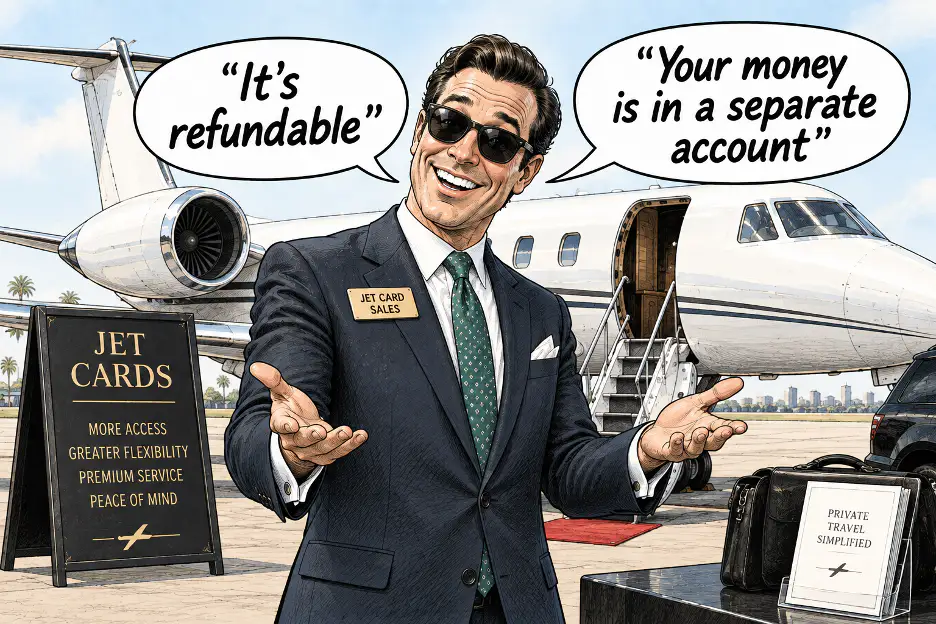
Two egregious claims relate to the security of your money.
First is refundability.
While refundability of jet card deposits is a nice feature, it works only when the company is financially sound and solvent.
In other words, if a company is out of money, your refund request won’t mean much.
There will be no money to provide refunds.
The second egregious claim about the security of your money is that keeping it in a separate account protects you.
In some cases, those accounts are escrow accounts.
There are two points here.
First, keeping jet card funds separate and moving them only in concert with your flight is good business practice.
It prevents management from believing that pile of cash can be spent on marketing and other activities.
Multiple models
That said, multiple jet card sourcing models exist.
A broker program probably requires anywhere from 50% to 150% of your flight value to buy that flight from a third-party operator.
They need that money six months after you join, when you call or click to book.
On the low end, they may have found an empty leg; at the other end of the spectrum, a short-notice flight in the Midwest may be a money loser.
The same is true if they have to source a recovery flight if the first operator cancels.
By the same token, a jet card seller with an owned or leased fleet may need only a fraction of your trip cost to fund the flight, since it is already making lease or debt payments for aircraft and hangars, paying pilots and operations, inventorying parts, and covering the overhead that comes with operating a jet.
Managed fleet jet cards sit somewhere in between, since aircraft owners foot the expenses, but up to 85% of your trip price has to go back to the jet owner.
The second point is whether it’s a separate account; if the company needs to tap into that money to keep the lights on, nothing prevents it.
Even if the funds are kept in a separate escrow account, there’s still risk unless you have to sign off every time funds are transferred and the account is dedicated to you.
Industry failures
If OneFlight fails, it won’t be the first.
Charter operator JetSuite’s 2020 Chapter 11 bankruptcy saw jet card members lose over $50 million. Its funds went straight to operations. That was clear in the jet card contracts.
Verijet, another charter operator, filed Chapter 7 last year, causing $10.5 million in jet card losses. Funds also went directly into the till for general corporate purposes.
Fractional operator Jet It filed for Chapter 7 last year after grounding its fleet in 2023. Yes, owners had the asset of their shared jets. They had to pay off liens and legal fees before they could sell the airplanes. Haircuts were involved.
AeroVanti’s CEO Patrick Britton-Harr was convicted earlier this year on six counts of wire fraud related to $15 million in payments from its Top Gun members that were supposed to buy airplanes. There was an escrow account! When the money was released, it never ended up buying airplanes. A former CEO estimated the company owed as much as $50 million, including unpaid sponsorships to the Chicago Cubs and Tampa Bay Buccaneers.
PlaneSmart, a Texas-based operator run by his brother, is trying to restart the AeroVanti program. Britton-Harr, who is facing a second trial for medical testing fraud, is seeking a new trial.
Cirrus SR-22 operator Imagine Air shut down in 2018. Its subsequent Chapter 7 filing showed it owed between $1 million and $10 million. Zetta Jet, another operator, owed vendors over $50 million when it filed for Chapter 11 in 2017. I don’t have copies of those contracts.
READ: Comparing the 5 ways to fly by private jet
The bottom line
So what’s the bottom line?
There are lots of ways to “lose” money flying privately.
Airplane owners get hit with unexpected maintenance expenses that also keep their airplanes grounded.
Fractional programs can fail.
Ad hoc charter contracts often have stricter cancellation policies compared to jet cards, plus additional expenses many jet cards cover. Flying ad hoc can be more expensive when you aren’t making efficient trips.
When it comes to jet cards, remember.
Refundability helps if your needs change.
Keeping jet card funds in separate accounts, based on model, is good management practice.
Neither protects your funds in the case of an insolvency.
Two of our previous stories on this topic:
READ: Do separate accounts provide security in a flight provider failure?
READ: Refundable Jet Cards: The good and bad