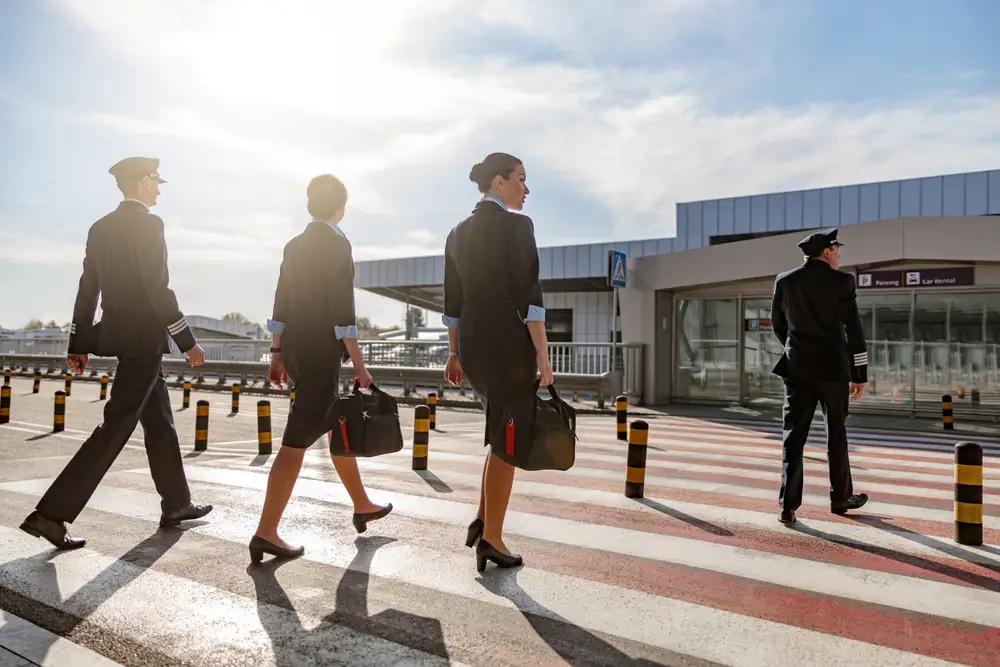
Stewards, hosts, cabin servers: these experienced, many-named travelers crisscross the sky to keep private jet flights running and passengers satisfied.
But their role and responsibilities vary widely depending on both their employer and the plane’s operator.
Here is the average workday, struggles, and pay of a private aviation cabin attendant.
Index
The daily routine
On the job, some cabin attendants wake up in their own beds, while others stay at a crew hotel.
Large private jet operators like NetJets and Flexjet have their own crew bases or domiciles, where the cabin attendants live when they are not working.
While traveling, corporate and private flight attendants can often stay in hotels, even racking up reward points while they’re there.
In a floating-fleet model such as with NetJets, VistaJet, and Flexjet, cabin attendants must commute to their crew base.
Like pilots, attendants can technically live wherever they want, even abroad, as long as they report for work at the base.
However, attendants must balance that freedom with the fatigue and personal cost of long commute times.
While they cover the cost of flying attendants back to their home base, attendants must return home on their own dime.
For example, if a cabin attendant’s base is Fort Lauderdale, they have to get there from wherever they live.
Corporate Flight Departments
For corporate flight departments and based private jets, though, there is no formal structure for where attendants usually live.
Attendants tend to live close to private aviation, and so concentrate in cities. Aircraft owners and corporate flight departments often want cabin attendants to live near where aircraft are based, although this varies.
Long before flight hours start, the workday is busy.
Flight attendants help pilots with pre-flight inspections and speak with other crew members. In the plane, they check and stock the pantry and prepare to serve a wide variety of cuisine that private jet flyers can order.
Unlike airlines, what is served and how it is served varies from flight to flight based on what the customer wants.
That makes each flight unique to prepare for.
Then comes boarding and, finally, flying.
From there, attendants don’t simply sit in the galley and scroll social media.
“You have a higher standard of luxury to adhere to and to provide in private aviation,” said Marcey Decker, a private flight attendant with Solairus Aviation, in an interview with Private Jet Card Comparisons.
Decker continued:
‘And you have, I would say, not higher safety standards, just more meticulous safety standards on a private jet because you’re the only flight attendant. There to provide any aid or react in an emergency situation. You’re the only one there besides the pilots, so it all falls on you.’
Decker elaborated that client service is more proactive than in commercial aviation. Attendants need to anticipate flyers’ needs and help them.
“Perhaps the most difficult quality to teach is anticipatory service,” a Flexjet spokesperson told Private Jet Card Comparisons.
Among operators’ preferences in flight attendants, including communication and luxury experience, anticipatory service was highlighted as essential.
The spokesperson continued:
‘We look for candidates who possess a natural ability to interpret an Owner’s unspoken cues and respond before a need is expressed. Throughout the interview process, we observe for subtle signs they may possess this instinct. For example, an aircraft Owner seated in the four-place club or dining table with their feet angled toward the aisle is often signaling a desire for service or assistance. Recognizing these small but meaningful cues is what distinguishes good service from truly exceptional service, so we look for cues during the interview process that offer us hints they may be attuned to.’
Part 135 operators face stricter regulation than Part 91 owners, who are private owners (individuals or corporate flight departments) flying on their own jets.
Aircraft management companies often operate both Part 91 aircraft and Part 135 aircraft.
And when an aircraft with a Part 135 charter certificate flies for the owner on a non-commercial flight, it operates under Part 91 rules.
The biggest differences between jet attendant roles are schedule predictability, scope, role creep, and job stability, Jamie Gibson said.
Gibson, who spoke in an interview with Private Jet Card Comparisons, is a corporate flight attendant. She is also the founder of Flightess, a networking platform for private aviation attendants.
On schedule predictability, large fleet operators tell flight attendants their schedules in advance; how long they’ll be on duty, though not usually where.
However, when working for private owners under Part 91 flights, attendants may not know what their next few months of flying will look like.
The next biggest difference that Gibson described was job scope. Large jet operators, like NetJets, have separate departments for tasks such as catering and cleaning.
But with smaller owners, such as a private owner or corporate flight department, an attendant often has to take over several responsibilities. That can include catering, provisioning, inventory, and cabin standards.
This also relates to role creep, especially with private owners. Cabin attendants may be asked to do duties and roles outside of flying. They may help the owner with off-plane work, which would not happen with corporate flight departments or large fleet operators.
And the last difference is one flyers likely don’t think of: job stability.
“Working for a large fleet operator is comparatively secure,” commented Gibson. “Corporate flight departments and owner operations are mercurial.”
She described how Part 91 jet owners can sell aircraft and end a crew member’s job suddenly, regardless of their performance.
Sleeping on the job
Counterintuitive as it may be, flight attendants need sleep as much as they need work.
On long-haul flights with long duty and flight hours, crew needs to take their rest.
On commercial airliners, aircraft often have hidden rest areas for crew to rest and sleep. These compartments include bunks, climate controls, and quiet separation from passengers.
Yet the reality of rest for private jet cabin attendants is quite different.
Gibson described how, on long-haul flights, flight plans include pilot rest time. It can involve extra flight time, a third pilot, and shift changes to ensure a proper rest plan.
“The flight attendant is frequently not built into that plan,” said Gibson. She said attendants were often not planned for as they are not legally required on most jet flights.
‘A camping chair in the galley. Excusing yourself for a quick catnap in the forward lavatory or even the floor of the galley when the clients’ cabin is quiet and asleep. Sometimes nothing at all, on a flight where you are the only person responsible for the cabin and pilots for 15 straight hours. An airline operating that same sector would have contractually and federally protected crew rest for its cabin crew. We do not have the equivalent.’
Work hours, pay, and tipping
The U.S. currently has around 131,000 flight attendants, with a median salary of $67,000.
Overall, yearly employment is projected to grow 9%, higher than the national average of 3%, with around 19,800 openings per year.
According to an industry survey, the median salary for private aviation attendants is $106,000.
Meanwhile, the NBAA‘s 2026 Compensation Survey reported an average flight attendant salary of $120,000. The average base salary of a senior flight attendant was $161,000.
Importantly, the survey treated flight attendants and senior attendants as separate categories.
However, beyond pay amount, pay structure differs significantly between commercial and private flying.
“We are generally paid a day rate when contracting,” said Gibson, on how private attendants’ pay structure differs from airlines. “The clock starts when the day starts.”
She continued:
‘An airline flight attendant is typically paid by flight hours, which historically has meant they are not paid for boarding, delays or sitting at the gate. Those are two fundamentally different compensation philosophies, and it is a more interesting comparison than the headline numbers.’
Large private jet fleet operators such as NetJets, Flexjet, VistaJet, Qatar Executive and others have rigid pay scales, measuring pay by seniority and hours. They also publish their pay and benefits to attract recruits.
“Part 135 charter tends to be reasonably standardized across the board as well,” commented Gibson. “Part 91 corporate flight departments and private owners are where it becomes genuinely dynamic.”
For Part 91, Gibson described pay as being based on the size of the flight department, including flight attendants and aircraft.
Rather than earning more based on experience or hours worked, attendants’ pay is split across the department’s budget.
So, a single attendant working in one aircraft can earn more than several attendants working multiple jets for a company’s flight department.
Flight hours and schedule differences
Private flight attendants saw average duty hours rise 44% and weekend days worked rise 62%, according to the NBAA’s 2026 Compensation Survey.
Meanwhile, senior flight attendants saw an 8.9% increase in base pay per flight hour, while logging fewer flight hours year over year.
For context, flight hours count only the time between takeoff and landing. Duty hours also include administrative work, training, deadheading, and airport standby reserve.
These work-time categories apply to both private jets and airliners.
‘In most cases, if you (a flight attendant) have a scheduled duty period of 14 hours or less, you must have at least nine consecutive hours of scheduled rest after your duty period before you have another duty period.’
But despite these similarities, the lives of airliner and private attendants differ greatly because of one key fact.
Is a flight attendant required?
“On most private jets, the flight attendant is not a required crewmember,” said Gibson.
Gibson explained that for Part 91 and Part 135 jets, flight attendants are only required when there are more than 19 passengers.
Since all private jets except VIP Airliners carry fewer than that, private jet operators and owners face far less legislation than their airliner counterparts regarding attendants.
“It is why there is no federally mandated training standard for us,” explained Gibson, “Why duty and rest rules that protect airline crews generally do not protect us, why there is no designated crew rest on a fifteen-hour flight, and why the pay, the requirements and the working conditions vary so enormously from one operation to the next.”
Gibson continued:
‘An airline flight attendant’s job is defined by regulation. Ours is defined by whoever is paying for it.’
About 25% of Flexjet’s fleet flies with flight attendants on board, a spokesperson told Private Jet Card Comparisons.
Cabin servers, as the operator calls them, are present on all large-cabin aircraft, including Gulfstream jets.
Flexjet plans to have roughly 300 attendants on staff by end-of-year.
While “safety procedures and first aid are incorporated into their training, their core function is service and hospitality.”
“Requests for Cabin Servers beyond the large-cabin fleet for U.S.-based aircraft is considered,” explained the spokesperson, “Is not guaranteed and carries an additional service fee. This does not apply to Europe as our super-midsize Praetor 600 fleet based there come with Cabin Service.”
As for schedules, Flexjet attendants are either eight days on and six days off, or seven on and seven off.
When on duty but without any flights scheduled, attendants can still work by planning for future flights.
On-ground preparations can include reviewing owner preferences and upcoming itineraries, and arranging vintages, food, or specific amenities to suit an owner’s taste.
Tipping Flight Attendants
But beyond their base salaries, do private attendants get tips, and are they expected?
“I would say a good 75% of the clients that charter the aircraft do tip us,” answered Marcey Decker.
She clarified that on non-charter flights, where the private jet’s owner employs attendants, tips are much less common. Special tips may still pop up for working holidays or unique occasions.
“It’s generally given to the flight attendant in an envelope or just a cash handoff,” said Decker, describing the average post-flight tip. “And we divide it by three of us, two pilots and one flight attendant. And that usually does happen on charter flights.”
When asked how much flyers tipped, Decker said, “It just varies. Sometimes it’s $100 per person. Sometimes it’s $200 per person.”
The following table is a compensation analysis of private flight attendants nationwide, for Part 91 and Part 135 operators.
Private Jet Flight Attendant Salaries
Percentile
Market Composite, Total Cash Compensation
Benefits (-401k)
Bonus
401k Match
10th
$106,000
$8,000
$10,000
$3,000
25th
$119,000
$13,000
$11,000
$5,000
50th
$153,000
$23,000
$14,000
$8,000
75th
$183,000
$46,000
$17,000
$11,000
90th
$223,000
$68,000
$20,000
$18,000
Data courtesy of Response Aviation Search.
Becoming a flight attendant
This high-flying career doesn’t require a college degree, but it still has several barriers to entry.
The following criteria often reflect corporate preference, not legislation, and vary by operator.
On the commercial side, many airlines require a minimum age of 21, legal authorization to work in the country, and background checks.
A high school diploma or GED minimum is required, with a height requirement of at least 5’2″, on account of needing to reach higher up.
Good vision, no visible tattoos while in uniform, a valid passport, and the ability to swim 50 meters unassisted are required.
Bonuses include customer service experience, foreign language skills, and prior aviation experience.
After a background check, drug screening, and fingerprinting, candidates complete paid Initial Operating Experience training. That lasts several weeks.
IOE training ensures attendants know FAA safety procedures, equipment, emergency evacuation, medical emergency response, conflict de-escalation, food service, and more.
After that, candidates go on to do real IOE. They fly on real flights with senior flight attendants supervising.
After a couple of trips, an airliner employee becomes a fully certified flight attendant.
Private jet differences
Again, in what should be a recurring theme by now, jet attendant hiring requirements differ from those at major airlines. They also vary wildly between private jet operators.
“We almost always pay for it (training) ourselves when getting started in this industry,” said Gibson.
She said most attendants enter the job already trained by companies like Aircare or FlightSafety.
Gibson continued:
‘An airline trains you and pays you while it does. In private aviation you typically arrive already trained, on your own money, before anyone has offered you work.’
On appearance requirements, Gibson said some operators have them, noting that VistaJet has strict rules about tattoos. Other operators have none.
Meanwhile, second languages help with internationally-based aircraft but matter little on domestic Part 91 jets.
Private jet cabin attendant experience
Gibson emphasized that luxury hospitality experience is a big plus for private flight attendants. That includes fine dining, luxury hotels, and especially yachts.
“Yacht crew experience is regarded as a major bonus,” explained Gibson, “Because the skill set transfers almost directly (to private aviation): confined quarters, wealthy principals, long duty periods, absolute discretion.”
Private jet operators value luxury and flight experience most, unlike commercial airliners. Operators say so themselves.
“Cabin Hosts arrive with three plus years of first-class-level hospitality experience and speak two to three languages on average,” said a VistaJet spokesperson in an interview with Private Jet Card Comparisons.
At VistaJet, where attendants are called cabin hosts to emphasize their service role, each attendant must complete a 15-day training course.
Then, attendants fly with a ‘Cabin Host trainer’ for 10 customer flights to check their performance and training before they can fly alone.
The spokesperson continued:
‘Cabin Host training includes training to the standards of the British Butler Institute, MedAire and Norland College, wine training up to WSET Level 2, plus fire-fighting, communication skills, food safety and hygiene, and advanced plating training. Additionally, in-house safety training – ESET, CRM and MedAire. Every flight deck carries two crew plus at least one Cabin Host on aircraft super-midsize and above.’
Similarly, FlexJet has its in-house Red Label Academy to ensure in-flight service is standardized and luxurious across the fleet.
Red Label is based in Flexjet’s Farnborough terminal. Per a spokesperson, it is “focused on high-end service and hospitality excellence.”
The spokesperson continued:
‘The curriculum combines both theory and hands-on practice, with masterclasses covering etiquette, fine dining, wine education, luxury hospitality standards and premium cabin presentation. As part of our ongoing commitment to excellence, we make a significant annual investment in training and development to ensure our teams continue to set the standard for luxury private aviation hospitality. ‘
And like VistaJet, Flexjet also prefers experience in luxury hospitality, customer-facing roles, communication skills, and professionalism.
Challenges
While it is easy to remember how attendants serve flyers, their other, subtler role is just as important: ensuring flyer safety.
Related to that, one difference between commercial and private flight attendants is in safety training.
“You just see less priority on safety in corporate aviation than you do in commercial,” commented Gibson. She held that safety and aviation were inextricably tied together.
She continued:
‘Obviously, we want to hold that (safety) as our number one virtue and priority. But you do start to see with different operators and different flight departments that service becomes the number one concern. And more so human capital in that way too, versus really holding safety as a true number one priority.’
“There are companies that don’t require you to go through safety training,” said Gibson, regarding private and corporate jet operators.
She continued;
‘They have a little bit of a nomenclature loophole… a flight attendant is something other than a flight attendant, therefore they are able to skirt the fine print of not having them be safety trained, or hold safety responsibility.’
When asked about the future of flight attendants, Marcey Decker speculated on AI’s potential integration in jets.
Flying and service are her favorite parts of the job, Decker said, adding that the personal, attentive care attendants provide can’t be replaced by AI.
“Maybe one pilot could be replaced,” said Decker. “I don’t want to fly on an airplane that a pilot’s not up there.”
She continued:
‘I don’t feel comfortable with that, but I could see in the future where maybe the pilots’ jobs are taken over by AI. But the service and safety side of it in the cabin can’t be taken by AI. So, I think that private jet flight attendant job, their role in the cabin, is pretty safe.’
Conclusion
Flight attendants, both commercial and private, have one of the most versatile jobs in aviation.
They must be safety-conscious, strong in customer relations, emotionally intelligent, and attentive.
Their profession is also marked by uncertainty, change, and adaptation. Reflective, perhaps, of private aviation too, as the industry constantly adapts to geopolitical events.
And yet flight attendants manage it all, handling minutiae and onboard service so pilots can fly with peace of mind and flyers can enjoy their time in the sky.