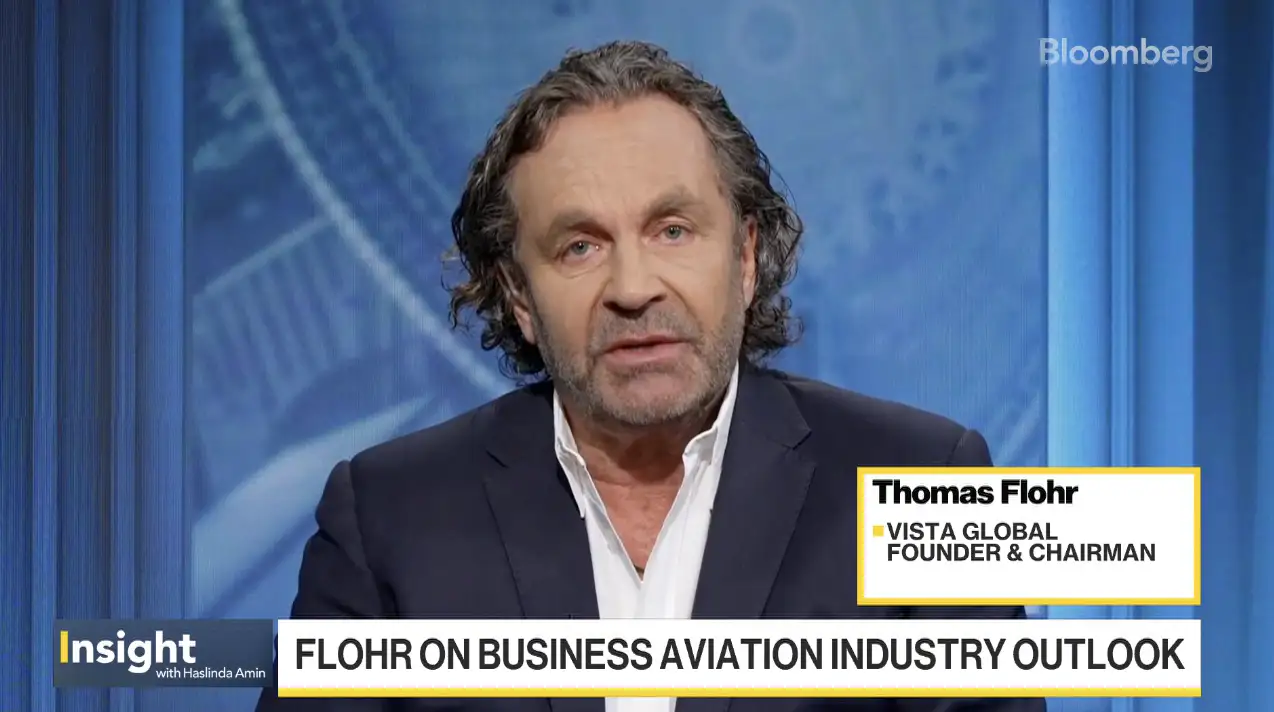
After a spate of acquisitions beginning in 2018, Vista Global Chairman Thomas Flohr says the global private jet company will grow organically.
In a wide-ranging interview with Bloomberg’s Paul Allen, Flohr also commented on a previous report from the news platform that the company was preparing for a possible IPO.
“Well, you saw the articles that Bloomberg came out with, and at this point in time (and) I can confirm that the company has retained investment banks to advise it on its optionalities, and that’s what is currently being worked on with the investment banks,” Flohr told the host, adding, “Until further notice, we’ll come back if there’s any news breaking on that.”
Vista Global is the parent company of VistaJet and XO.
Flohr said the company is seeing high demand for its version of a jet card, its multi-year subscriptions, the Program, for flyers who need over 50 hours per year, and VJ25, starting at 25 hours per year.
Both have minimum terms of three years.
Borderless billionaires
“Demand is really at the strongest level since the post-COVID days,” Flohr said.
In addition to its normal base of global jetsetters, Flohr says a new slice of frequent worldwide flyers he calls borderless billionaires is spurring demand.
Flohr said:
‘When we talk about the borderless billionaires, it’s really the the tech industry, it’s the it’s the finance industry driving that growth, and we’re seeing a lot of corporate demand, and you know what can be maybe done on Zoom for some operating level, ultimately, deals are done between human beings, and they need to get to point to point to the remotest places on on the planet, and that’s what really facilitates at a shortest notice, and that’s really driving the growth at the at the very top end.’
Flohr also said VistaJet is benefiting from the asset-light private jet access its programs offer clients.
“There is this transformational development of asset-light being much more accepted. If you do a subscription with Vista, it’s (an operating expense) versus going to the board and asking for a capex investment into a $50 million or $80 million jet, and that trend is strong,” Flohr says.
Vista is also benefiting as the asset-light approach expands globally.
Flohr told Bloomberg, “It used to be maybe more in the Western world. Now it’s everywhere around the globe, and that’s really driving the subscription model versus the full or fractional aircraft model.”
In a separate interview with CNBC, Flohr said VistaJet matched 2025’s full-year subscription hours in the first nine months.
No more acquisitions
However, Flohr said not to expect Vista Global to be in acquisition mode.
From 2018 through 2022, Vista Global made multiple acquisitions.
That included operators XOJet, Jet Edge, Air Hamburg, Red Wing, and Talon Air.
Vista also picked up brokers Apollo Jets and tech-led JetSmarter, and Camber.
Last year, it sold Red Wing to what is now JetExcellence.
It sold its minority stake in Talon Air to the charter operator’s managment back in January.
“We’re the only company with a truly global infrastructure, and there is really nothing to buy out there,” Flohr says. “Our main competition is full aircraft ownership, and the global infrastructure that we have today doesn’t require that we enter a new market.”
He continued, “We keep on adding airplanes to that infrastructure, and that’s how we satisfy the growth. So you will not see any M&A activity at Vista in the foreseeable future.”
Vista Global ranks as the third-largest U.S. private jet operator based on charter and fractional flight hours.
It currently has over 200 aircraft globally.
READ: Private Aviation M&A Deal Book
VistaJet fleet strategy
To meet demand for longer flights, it is upgrading its fleet of Global 7500s to the Global 8000 platform.
The upgrade extends range by about two hours.
Vista plans to complete conversions by the end of the year.
To handle continental missions, Vista placed a firm order for 40 Challenger 3500s, with options for 120 more, with Bombardier earlier this year.
Flohr said the delivery schedule for the super.
Flohr said the delivery schedule is in part based on subscription sales, which give visibility into future demand since they are at least three years in duration.
“If we take a Challenger 3,500, usually we would probably sell the capacity to four or five clients that are coming on, so it’s pretty much self-financing,” adding, “Although it goes on the balance sheet, there is an immediate deleveraging effect because of the EBITDA that these airplanes are creating once the airplane is delivered.”
Fuel price impact
Fuel price spikes do not impact Vista Global, Flohr noted, because it passes them through to customers, the same as if they owned a jet.
Flohr also shook off questions about global turmoil and its potential impact on private aviation.
He told the host, “The company is 22 years old, so we’ve seen a lot in those 22 years, and hence there’s a huge amount of experience in the company on how to deal with and how to plan for such potential disruptions.”
He said clients understand when disruptions are out of their control, and that safety comes first for both crew and customers.
Watch the full interview on Bloomberg TV.